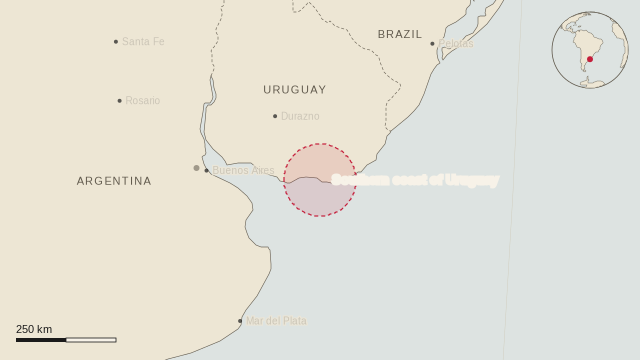
2026·Southern coast of Uruguay, from the Río de la Plata to the Atlantic
Uruguay.Uruguay · residents in nine departments see lights in formation
Between January 13 and February 15, 2026, the Uruguayan Air Force commission that takes UFO reports (CRIDOVNI) logged 25 reports of white lights crossing the night sky in nine departments, mostly to the south, over the Río de la Plata and the Atlantic. Residents and tourists in Punta del Este and elsewhere shared photos and videos. On February 16, after checking them against aerospace data, the Air Force concluded they were Starlink satellites and other low-orbit networks. A radio station in Maldonado spoke of about 30 reports.
Tier A · AcceptableWhat do they mean? →
Institutional evidence: several identified independent witnesses, or contemporary official documentation, without an instrumental record to corroborate them.
What it was
93%satellite
The most likely explanation.
- 93% satellite
- 2% other earthly causes
- 5% no known cause
See the split across the six explanations
Earthly origin (human or natural)95%
No known cause5%
Ordinary cause the sources propose: satellite
What happened
The Commission for Receiving and Investigating Reports of Unidentified Flying Objects (CRIDOVNI) is part of the Uruguayan Air Force and was created on August 7, 1979. According to the Air Force, it receives, analyzes and evaluates reports of unidentified aerial phenomena, and in each case considers whether there could have been a hoax, a conventional phenomenon or an illusion. Between mid-January and mid-February 2026, at the height of summer and of the tourist season, it received a series of reports of lights crossing the night sky.
One hot spot was Punta del Este, in the department of Maldonado. Listeners of the local radio station Cadena del Mar told the station's journalist Marcelo Umpiérrez that they saw up to five points of light per sighting, moving from the southwest toward the south. According to the accounts the station gathered, the lights seemed to move erratically, vanished at times and reappeared in other formations, which is why many people did not take them for airplanes or for the satellites they knew.
According to the EFE news agency, tourists and residents posted photos and videos on social media and sent them to the local press. As early as January 21, Montevideo Portal reported that residents of the beach town of Las Flores, also in Maldonado, had been photographing lights they had not seen before for weeks. For several days, the station said, people speculated that they were UFOs.
On February 16, the Air Force released the CRIDOVNI summary, which EFE and the Uruguayan press reported. The commission had received 25 reports of "avistamientos nocturnos de luces en vuelo" (nighttime sightings of lights in flight) between January 13 and February 15, from nine departments: Montevideo, Canelones, Maldonado, Rocha, San José, Rivera, Colonia, Lavalleja and Cerro Largo. Seven are in the south and east of the country; Rivera and Cerro Largo are in the north and northeast. According to the Air Force, the witnesses agreed in describing "luces de color blanco en desplazamiento" (moving white lights), seen toward the south, southeast and southwest, mostly over the Río de la Plata and the Atlantic Ocean. They saw them low or midway up the sky, between 10 and 40 degrees above the horizon.
The commission evaluated the accounts, photos and videos from the witnesses and checked them against "los registros y datos aeroespaciales disponibles" (the available aerospace records and data); according to Cadena del Mar, it compared orbital paths and times. It concluded that the lights were passes of satellites of the Starlink system, run by the U.S. company SpaceX, and of other platforms in low orbit. According to the newspaper El Megáfono, the commission added that such reports tend to rise when constellations of satellites make visible passes, which surprise people who are not familiar with the sight. The reports that reproduce the summary do not say which satellite matches each report, or why some lights seemed to go out and come back.
The figures differ between outlets. EFE, the Medios Públicos news site and El Megáfono, which reproduce the Air Force summary, give 25 reports, and Infobae attributes the same figure to the Canal 10 newscast Subrayado. Cadena del Mar wrote "alrededor de 30" (around 30), without saying where the number came from. The gap remains unexplained; 25 is the figure in the official summary as those reports quote it.
In those five weeks, SpaceX launched ten batches of Starlink satellites, according to the launch catalog kept by astronomer Jonathan McDowell. Three lifted off from Cape Canaveral, Florida, on January 14, 18 and 30; seven from Vandenberg Space Force Base, California, between January 22 and February 15. Each batch carried 24 to 29 satellites, which at first travel together, one behind another, at about 250 kilometers up, before climbing to their working orbit.
The orbits of the Florida batches reach farther south than Montevideo, and the California batches pass over almost the whole planet, so both could pass over Uruguay. Launches on those dates do not prove that every light was a satellite: the satellite also had to be above the witness's horizon at the time of the report and still lit by the sun, even though it was already night on the ground. According to Cadena del Mar, the commission compared times, but the news stories that carry its summary do not publish that check for each report.
Where it happened
Why it matters
The case shows how a state UFO office works when a wave of sightings arrives through social media. The Air Force gathered five weeks of reports along with the witnesses' photos and videos, checked them against orbital data and released a conclusion on February 16, one day after the last report, while the images were still circulating. The Uruguayan and regional press ran it under similar headlines: they were not UFOs, they were satellites.
It was not the first time. Cadena del Mar recalled that three years earlier there had been similar reports in the east of the country. In 2023 the Air Force published a case of the same kind, though in the west: lights seen at around 12:30 a.m. on February 11, 2023, from the Almirón hot springs and the Paysandú airport, to the south and about 15 degrees above the horizon. In May 2023, CRIDOVNI attributed them to Starlink satellites, as it did other reports from various towns between February 10 and 13. What has been published does not show whether the reports in the east that the station recalled were the Paysandú ones, in the west, or others.
The weak point of the case is the detail. The conclusion groups 25 reports from nine departments and five weeks under a single explanation, and the published summary does not allow it to be checked one by one: it gives neither the dates nor the times of the reports, nor the witnesses' names, nor the images the commission analyzed. Accounts such as the lights that vanished and reappeared over Punta del Este are explained only as a group. The explanation is the one put forward by the only institution that saw all the material, and no published analysis contradicts it.
In those same days, according to the Telenoche newscast as cited by Infobae, the Air Force reached a preliminary agreement with the U.S. All-domain Anomaly Resolution Office (AARO) to exchange analysis software and equipment and, possibly, to set up observation stations. In July 2026, the Air Force reported working meetings and technical workshops between CRIDOVNI and AARO on methods for ruling out conventional phenomena.
Documents and sources
Documented evidence
- EFE dispatch datelined Montevideo, February 16, 2026: CRIDOVNI received 25 reports of "avistamientos nocturnos de luces en vuelo" (nighttime sightings of lights in flight) between January 13 and February 15 in nine departments; witnesses described moving white lights seen toward the south, southeast and southwest, 10 to 40 degrees above the horizon; the commission checked photos, videos and accounts against the available aerospace records and data and concluded they were Starlink satellites and other platforms.
- El Megáfono, February 16, 2026: 25 reports "en el último mes" (in the past month), white lights "en formación" (in formation); according to the commission, such reports tend to rise with visible passes of satellite constellations.
- Cadena del Mar, February 17, 2026: listeners in Punta del Este told journalist Marcelo Umpiérrez that they saw up to five points of light per sighting, moving from the southwest toward the south, which vanished and reappeared in other formations; the station gives "alrededor de 30" (around 30) reports, says the commission compared orbital paths and times, and opens and closes the story with its listeners' doubt: "¿Será así?" (Could that be so?).
- Montevideo Portal, January 21, 2026: residents of the beach town of Las Flores, in Maldonado, had been photographing lights they did not usually see for weeks; they saw them again on Wednesday, January 21, and journalist Marcelo Umpiérrez posted photos. According to their social media posts, specialists they consulted ruled out airplanes because of the lights' color.
- Jonathan McDowell's launch catalog (GCAT): ten Starlink launches between January 14 and February 15, 2026, three from Cape Canaveral (groups 6-98, 6-100 and 6-101, orbits inclined 43 degrees) and seven from Vandenberg (groups 17-30, 17-20, 17-19, 17-32, 17-33, 17-34 and 17-13, about 97 degrees), each carrying 24 to 29 satellites, with initial orbits of about 240 to 270 kilometers.
Show 2 more facts
- Uruguayan Air Force Statement No. 4/2023 (May 2, 2023), signed by the president of CRIDOVNI: the lights seen at around 12:30 a.m. on February 11, 2023, from the Almirón hot springs and the Paysandú airport, to the south at about 15 degrees, and other reports from February 10 to 13, were passes of Starlink satellites.
- Uruguayan Air Force news item of July 31, 2026: working meetings and technical workshops between CRIDOVNI and AARO on analysis methods and procedures for ruling out conventional phenomena.
Sources
- EFE, "Uruguay atribuye a satélites Starlink luces reportadas en el cielo," on swissinfo.ch (Feb 16, 2026) — Main source: wire dispatch quoting the Uruguayan Air Force summary (25 reports, dates, departments, description and conclusion).
- Medios Públicos, "Fuerza Aérea atribuye a satélites Starlink luces reportadas en el cielo" (Feb 17, 2026) — News site of Uruguay's public media; carries the same text with the Air Force quotes.
- El Megáfono, "Cridovni recibió 25 reportes por luces en el cielo y confirmó que eran satélites" (Feb 16, 2026) — Lights "en formación" (in formation) and the commission's remark on visible passes of constellations.
- Cadena del Mar, "Misterio (cielo uruguayo): Fuerza Aérea determinó qué eran las luces vistas en Punta del Este" (Feb 17, 2026) — Punta del Este accounts gathered by the station; gives "alrededor de 30" (around 30) reports, against the 25 in the official summary.
- Infobae, "Misterio en Uruguay: comisión que estudia ovnis concluyó qué fue el fenómeno que se vio en el cielo," by Pedro Tristant (Feb 17, 2026) — Attributes the 25 reports to Subrayado (Canal 10) and the AARO preliminary agreement to Telenoche (Canal 4).
- Uruguayan Air Force, Statement No. 4/2023, "Avistamiento de luces" (May 2, 2023) — Primary source for the Paysandú precedent (February 2023), attributed to Starlink satellites.
- Uruguayan Air Force, "La Fuerza Aérea Uruguaya continúa fortaleciendo la cooperación internacional en materia de investigación aeroespacial" (Jul 31, 2026) — Primary source for CRIDOVNI's meetings and workshops with AARO.
- Montevideo Portal, "Las extrañas luces en el cielo de un balneario en Uruguay; no son de una aeronave" (Jan 21, 2026) — Story from the first week of the wave: residents of Las Flores (Maldonado) were photographing the lights, and journalist Marcelo Umpiérrez posted photos on Wednesday, January 21.
- Jonathan McDowell, General Catalog of Artificial Space Objects (GCAT), launch log and satellite catalog (accessed Nov 20, 2026) — Dates, sites, satellite counts and orbital inclinations of the Starlink launches in the period.
Context (not images of the event)

A train of Starlink satellites photographed on May 13, 2020, from Gonnet, in La Plata, Argentina, on the shore of the Río de la Plata across from Montevideo. It is a reference photo, not one of the 2026 sightings.
Wikimedia Commons (BugWarp) · CC BY-SA 4.0 · open original
Related cases
Cases with the same likely cause.
Satellite · Within 10 years
Caleta Lobos · three airline crews see lights below Orion's Belt
2024 · Tier A
Satellite · Within 10 years
Paposo · three airline crews see lights over the desert
2023 · Tier A
Satellite · Within 10 years
Calama · the light “following” an Argentine Learjet
2023 · Tier B
Satellite · Within 10 years
Antofagasta · an aircrew films three flashing lights
2023 · Tier A