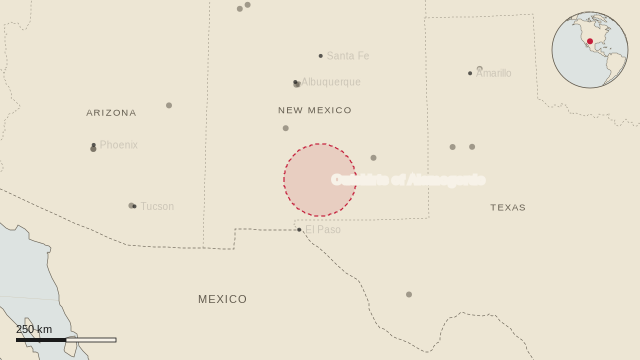
1975·Outskirts of Alamogordo, New Mexico, United States
United States.Moody case · a sergeant says he lost 85 minutes
In the early hours of August 13, 1975, Sergeant Charles Moody, an aircraft mechanic at Holloman Air Force Base, said a metallic disc stopped about 80 feet from his car near Alamogordo, New Mexico, that his engine would not start and that 85 minutes were missing. He wrote it down the next day; Official UFO magazine forwarded it to the organization APRO, which investigated. Months later, after a self-hypnosis method, he said he had been aboard. He is a single witness, with no physical evidence at the site and no known official investigation, and the prediction of contact in his letter did not come true.
Tier B · IndicativeContact accountWhat do they mean? →
Limited evidence: it falls short of what Tier A requires. Any one of these is enough: a single testimony (or several witnesses who saw it together), testimony gathered years later, or an account without contemporary primary documentation.
What it was
55%ordinary cause, unidentified
The most likely explanation.
- 55% ordinary cause, unidentified
- 3% other earthly causes
- 42% no known cause
See the split across the six explanations
Earthly origin (human or natural)58%
No known cause42%
Why no ordinary cause is identified
What happened
Sergeant Charles L. Moody was 32 and had 13 years in the U.S. Air Force. He worked as an aircraft mechanic at Holloman Air Force Base in New Mexico, held a high security clearance and had flown more than 700 hours as a flight mechanic on cargo aircraft. He lived in Alamogordo with his wife Karon, a nurse, and their two children. He said he had never seen a UFO and used to make fun of people who claimed to have. On August 12, 1975, he read that a meteor shower was expected around 1 a.m. He got off his shift at 11:30 p.m., watched television until 12:30 a.m. and drove to a dirt road on the outskirts of town, where he sat on the left front fender of his car. He counted eight or nine bright meteors until about 1:15.
According to his first letter, around 1:20 he saw a dull metallic object that seemed to drop out of the sky and hover, wobbling, about 100 feet (30 m) away and 10 or 15 feet off the ground. It moved slowly toward him. Moody got into his car and could not start it, as if there were no battery; he later recalled that the interior lights did not come on when he opened the door. The object stopped about 70 or 80 feet away. It was about 50 feet across and 18 to 20 feet thick. Moody heard a high-pitched sound, like a dental drill, and to the right of center he saw an oblong window with the shadows of two or three human forms. When the sound stopped, he felt numbness and a calm like floating on a cloud.
The object rose very fast and vanished without a sound, and the car started. Moody looked at his watch: it was 2:45. The whole thing had seemed to last one or two minutes, so an hour and 25 minutes were missing. When he got home, the kitchen clock read 3:00. Karon later told Lorenzen that her husband came in around that hour, "looking pale and sick." Moody told his wife about the object but not about the lost time. The next day his back hurt a little and he felt lightheaded.
The next day, Moody wrote a letter asking that his name be withheld for fear of losing his position. Official UFO magazine forwarded it to the Aerial Phenomena Research Organization (APRO) in Tucson, which received it on August 20. Its director, L. J. Lorenzen, called that same day and spoke with Karon, and on the 21st he spoke with Moody, who told him he had a rash on his lower body, "like a heat rash," and lower back pain "as though someone had hit him with a baseball bat."
Moody planned to go to the base clinic without mentioning the UFO. On September 2, Lorenzen and field investigator W. C. Stevens flew to Alamogordo. Moody took them to the site, where they found no physical evidence of any kind. At the site he was agitated, admitted fear and said he felt an urge to run from the questions. Lorenzen described him as a responsible, conscientious person who had experienced something that did not fit his earlier ideas.
APRO's September 1975 bulletin published the case under the name "Mr. X." It said that Moody had agreed to a polygraph and a hypnotic regression, neither yet done. It also said that the next day he had physical symptoms and later that week consulted a doctor, that neither the diagnosis nor the symptoms could be discussed, and that "the indications are that this man struggled violently for some time." In September, a friend of Moody's, Dr. Abraham Goldman, a former Air Force flight surgeon and then a neurosurgery consultant, advised him of a method of meditation or self-hypnosis to restore his memory.
According to Lorenzen, it appeared to work, but after recalling part of the missing period Moody remembered being told he would not remember for a couple of months, and Lorenzen suggested that the recall was "programmed." On September 29 Moody said he had been ordered overseas. On October 6 he said he had full recall of having been aboard, and Lorenzen found that it was by no means total. The hypnotic regression APRO planned for November was not carried out, because his shipping date was moved up to October 29.
On November 14, a letter from Moody reached APRO with what he remembered of the inside, and Lorenzen read it on the 15th; Moody had already told him part of it by phone. Lorenzen had spent the 13th and 14th with Travis Walton in Phoenix. He described beings about five feet tall, with large hairless heads, very small ears, eyes a little larger than human, a small nose and thin lips, who spoke without moving their lips and wore skin-tight black clothing, except the "elder" or leader, in silver-white.
They called him Charles. The leader touched his back and legs with a rod-like device and told him there had been a scuffle at first contact and that he was only correcting a possible misplacement. Moody wrote that he did not remember any scuffle, but that his back hurt the next day. He went down, on a floor that dropped like an elevator, to a room with a huge carbon rod surrounded by crystals, the "drive unit," and saw a black box whose purpose he was told never to reveal and which he could not remember.
According to the letter, the leader said this craft was only for observing and that the main craft was about 400 miles above the Earth, and asked Moody not to remember anything for at least two weeks. In another passage, without saying who told him, Moody wrote that within three years those beings would make themselves known to all mankind, perhaps as early as midsummer 1976, with warnings, and that after 20 more years of study there would be closer contact. He wrote that his memory began to return soon after Lorenzen's visit.
Walton ↗ Travis Walton, a forestry worker, had disappeared in Arizona on November 5, 1975. Lorenzen consulted Dr. James Harder of APRO, who had hypnotized Walton, and wrote that Moody and Walton were describing the same type of being and that neither knew the other's account. When he mentioned the match to a National Enquirer reporter, the tabloid became interested and arranged for Lorenzen to fly overseas to introduce one of its reporters. In March 1976, APRO's bulletin revealed that "Mr. X" was Moody, after the Enquirer published the case, and added that it had been decided to withhold details of the occupants so as not to prejudice future reports. In June and July 1976, Lorenzen published Moody's letter and his own summary, "The Moody Case," in the bulletin.
Where it happened
Why it matters
Moody was a sergeant at Holloman Air Force Base with a security clearance, and his first letter, written the next day, mentioned no abduction: it spoke of a disc, shadows at a window and 85 unexplained minutes. He asked that his name be withheld for fear of losing his position. A civilian organization, APRO, published the case in September 1975, after Lorenzen's September 2 visit and without giving his name. The letters and APRO bulletins are the earliest source, and almost everything known comes from them.
What is missing: any physical evidence at the site, since Lorenzen and Stevens found nothing; any other witness; any known Air Force investigation; and APRO announced a polygraph and a hypnotic regression, but the regression planned for November was not carried out and no result of any polygraph is on record. The account of the inside came in October and November, two and three months after the event, after a self-hypnosis method advised by a friend. The second letter fills the 85 minutes that the first left empty and adds that Moody was said to have been hostile at first contact, which the first did not say.
The September 1975 bulletin, before Moody remembered anything of the inside, already said the indications were that he had struggled violently. In November, Moody wrote that the leader had told him there had been a scuffle, though he did not remember one; Lorenzen, in the Mammoth, summarizes it as Moody resisting being taken aboard. The letter with the account of the inside reached APRO on November 14, after NBC's program on the Hills in October 1975 and three days after Walton reappeared. Lorenzen wrote that Moody and Walton were describing the same type of being and that neither knew the other's account, which cannot be checked.
No retraction is on record. According to the entry signed by Lorenzen in the "Mammoth Encyclopedia of Extraterrestrial Encounters," Charles McQuiston analyzed the recording of Moody's testimony with a psychological stress evaluator (PSE) and concluded he was telling the truth; the report is not known.
The same entry adds, without a source from the time, that at the base clinic he was sent to William Beaumont Army Hospital, that there he was told he had apparently received a dose of radiation, that he had a small puncture wound over his spine, that his records disappeared and that he was shipped to Europe soon after APRO began investigating; neither the letter nor the 1975-76 bulletins record this, and in the letter Moody says he did not want to see military doctors. The entry also differs from the letter in seating him on the hood, less than 50 feet from the object, and describing beings 4 feet 8 inches tall. The letter's prediction, open contact within three years and perhaps as early as the summer of 1976, did not come true, and Klass pointed this out in 1983.
Documents and sources
Documents
APRO bulletin of September 1975, "New Abduction Cases"
Bulletin of the Aerial Phenomena Research Organization with the first public report of the case, from September 1975. It tells of the disc sighting, the car that would not start and the 85 lost minutes without giving a name (the witness appears as "Mr. X"), and says that the polygraph and hypnotic regression he had agreed to had not yet been done.
Lorenzen, "The Moody Case," APRO bulletin of June 1976
First installment of L. J. Lorenzen's summary. It reproduces the letter Moody wrote the day after the event, forwarded by Official UFO magazine and received by APRO on August 20, 1975, with the time, the object's measurements, the car with no battery and the count of 85 lost minutes, and the August 21 phone call.
Lorenzen, "The Moody Case (Conclusion)," APRO bulletin of July 1976
Conclusion of Lorenzen's summary: the September 2, 1975 site visit with no physical evidence, the self-hypnosis advised by Dr. Goldman, Moody's posting overseas, the comparison with Travis Walton and the November 14 letter with the account of the inside and the prediction of open contact.
Documented evidence
- Moody's first letter, written the day after the event and forwarded by Official UFO magazine to APRO, which received it on August 20, 1975, with the account of the object, the 2:45 reading and the 85 unexplained minutes; Lorenzen published it in full in the June 1976 bulletin.
- Phone call of August 21, 1975: a rash on the lower body and lower back pain; Moody said he would not mention the UFO at the base clinic.
- Visit by Lorenzen and W. C. Stevens to the site on September 2, 1975: "no physical evidence of any kind"; Moody was agitated. Karon Moody, a nurse, said her husband came home around 3:00 a.m. "looking pale and sick."
- APRO bulletin of September 1975, which published the case as "Mr. X" after the September 2 visit and said the polygraph and hypnotic regression he had agreed to had not yet been done; it also says the indications are that Moody "struggled violently for some time."
- Self-hypnosis advised in September 1975 by Dr. Abraham Goldman, a former Air Force flight surgeon; the hypnotic regression planned for November was not done because his shipping date was moved up to October 29.
Show 3 more facts
- Letter from Moody received at APRO on November 14, 1975 and read by Lorenzen on the 15th, with the account of the inside, the "drive unit" and the prediction that within three years they would make themselves known, perhaps "as early as midsummer 1976."
- Entry signed by Lorenzen in the "Mammoth Encyclopedia of Extraterrestrial Encounters": Charles McQuiston analyzed the recording of the testimony with a PSE and concluded that Moody told the truth; the report is not known.
- Klass (1983), in his passage on NBC's program on the Hills: Moody had contacted APRO shortly before and asked for anonymity, and afterward agreed to reveal his identity; he quotes the prediction that within three years his people would make themselves known and comments "That was seven years ago!"
Sources
- APRO Bulletin, September 1975 (vol. 24, no. 3), "New Abduction Cases" — First public report of the case, with Moody as "Mr. X" and without his name.
- APRO Bulletin, March 1976 (vol. 24, no. 9), "Sargeant Moody Abduction Case" — Reveals that "Mr. X" was Moody after the National Enquirer published the case.
- L. J. Lorenzen, "The Moody Case," APRO Bulletin, June 1976 (vol. 24, no. 12) — Moody's full August 1975 letter and the August 21 phone call.
- L. J. Lorenzen, "The Moody Case (Conclusion)," APRO Bulletin, July 1976 (vol. 25, no. 1) — Site visit, self-hypnosis, the overseas posting and the November letter with the account of the inside.
- "The Mammoth Encyclopedia of Extraterrestrial Encounters," entry "Moody abduction" signed by L. J. Lorenzen — Source of McQuiston's PSE analysis; Lorenzen's text does not state its origin.
- Philip J. Klass, "UFOs: The Public Deceived" (1983), passage quoted in the #UFOhistoryGroup Travis Walton compendium — Read in a reprint in the compendium, not in the book.
- AARO — Fiscal Year 2024 Consolidated Annual Report on UAP (Nov 14, 2024)
Related cases
Cases this case cites and cases with the same likely cause.