1975·Wurtsmith Air Force Base, Oscoda, Michigan, U.S.
United States.Wurtsmith · lights over the base and a tanker that chases them
On the night of October 30, 1975, security police at Wurtsmith Air Force Base in Michigan, a Strategic Air Command base, saw a low-flying aircraft, with lights near the perimeter and without them over the weapons storage area. The base approach radar showed several objects, and a KC-135 tanker plane followed two aircraft with lights, by radar and by sight, over Lake Huron until it lost them about 35 miles from the base. The first report spoke of a hovering helicopter; the corrected one, of two aircraft that turned their lights off at the same moment. Neither was identified.
Tier S · SolidWhat do they mean? →
Strong evidence: a contemporary instrumental record (radar, sensor, film or photo of known provenance) that corroborates several independent witnesses.
What it was
35%helicopter
No explanation reaches half.
- 35% helicopter
- 20% other earthly causes
- 45% no known cause
See the split across the six explanations
Earthly origin (human or natural)55%
No known cause45%
Ordinary cause the sources propose: helicopter
What happened
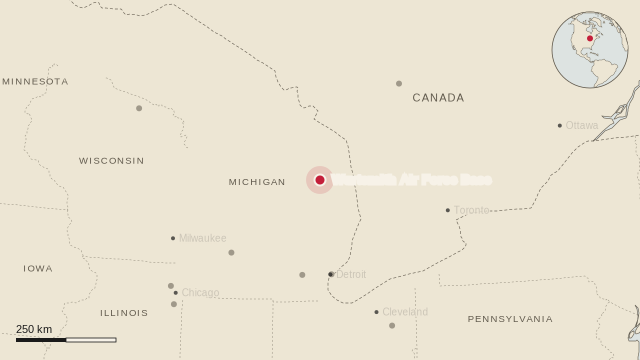
Wurtsmith was a Strategic Air Command (SAC) base for B-52 bombers and KC-135 tanker planes on the shore of Lake Huron, about three miles (five kilometers) northwest of Oscoda, Michigan. It was the home of the 379th Bomb Wing and had its own weapons storage area. Two days after the second night of the unknown aircraft over Loring Air Force Base (↗ Loring), with the northern bases on a security alert, the reports repeated on Thursday, October 30, 1975, this time at Wurtsmith.
According to the book Clear Intent (1984), which summarizes the base's security reports, around 10:10 p.m. police saw near the housing area, in the southeast of the perimeter, the lights of a low aircraft. It looked like a helicopter and moved up and down erratically. Security policeman Martin Tackabury, on duty at the housing area gate, saw it for about five seconds south of his post, with one white light pointing down and two red lights at the rear. He heard no noise because a B-52 was flying nearby. At the motor pool, security policeman Michael Myers saw several lights at the western edge of the base that turned north and appeared to lose altitude, without a sound.
At the same motor pool, Sergeant Robert Anderson saw a KC-135 in the air and, ahead of it and below, another craft with a steady red light, flying more slowly. He thought he heard a helicopter-like sound, and the craft went out of sight after thirty to thirty-five seconds. Security policeman Roger Skipper, from the main gate, went to the motor pool and heard sounds that faded quickly.
According to the same book, at 10:14, 10:20 and 10:25 p.m. police at the back gate told the command post that a helicopter with no lights had come over that gate and stayed over the weapons storage area at low altitude. The police in the area could not make out what kind of craft it was. It then headed for the northern boundary, where its lights came on again. Sergeant James Miller, on duty in the area, heard the noise of a possible helicopter to the north, off the base, until a military jet drowned it out. The control tower saw nothing, and nobody tried to call the craft by radio.
The book adds that the wing commander, Colonel Boardman, and his deputy, Colonel John Doran, went to the flight line. At that moment the base approach radar showed low-flying objects. A KC-135 was returning from a refueling mission and entering the base traffic pattern. Boardman ordered it to identify the object, and air traffic control guided it toward it.
According to the teletype the wing command post sent that same night, at 10:30 p.m. the tanker picked up an aircraft on its radar about 8.5 miles northeast of the base without being able to see it. Around 10:50 it saw it: two aircraft in a line, heading south, and the figure of 155 knots (about 180 mph). The cut edge of the copy leaves it unclear what that figure refers to; the corrected report gives about 150 knots for the aircraft.
The teletype adds that the tanker followed the aircraft toward Michigan's Thumb region and back north several times, and each time lost visual contact. It landed when its fuel reached minimums. The last loss of contact came shortly after 11:00 p.m.
The first operational report, sent at 11:27 p.m. to the Air Force Operations Center, spoke of a helicopter with no lights that hovered over the weapons storage area. The approach radar had it on the screen "for a short period." A tanker at 2,700 feet followed it by radar and by sight for about 20 miles, and thought it had seen a second radar return. The SAC command post notified the National Military Command Center in Washington at 11:42 p.m.
At 12:30 a.m. the SAC senior controller, Lt. Col. Giordano, corrected the report. A low aircraft came over the back gate and was seen near the motor pool. The approach radar showed several aircraft, one of them near the weapons storage area, with "no hovering as previously reported."
The corrected version adds that the tanker followed, at about 150 knots, an aircraft with its lights on, which appeared to be joined by another, and that both turned their lights off simultaneously, "as if on signal." The tanker lost contact about 35 nautical miles (65 km) southeast of the base. The wing's teletype adds that, according to later reports, the aircraft the back gate guard saw "may have been" a KC-135 in the local traffic pattern.
An explanation was sought. The Department of Natural Resources, which sends out aircraft to look for hunters spotting deer, answered that none of its aircraft were in the area. According to Clear Intent, the local police found no evidence of a landing. The FBI office in Saginaw said it knew of no hostile threats against the base. The Air Force tried to confirm the route of an Army helicopter between Wurtsmith and Selfridge, which did not explain the craft.
The book transcribes an entry from the NORAD senior director's log of October 31. It notes that the air defense command learned of the helicopter over the weapons storage area and of the tanker that chased it 35 miles southeast, and that it offered the wing help. It also transcribes the message the NORAD commander sent his units on November 11: the objects at Loring and Wurtsmith "were characterized to be helicopters," and efforts by Air Guard helicopters, SAC helicopters and NORAD F-106s "have failed to produce positive ID." That message includes that morning's radar track at the Canadian station at Falconbridge (↗ Falconbridge).
Clear Intent also reproduces the answers the Secretary of the Air Force gave in 1977 to a newspaper's questions: the overflights of Loring, Wurtsmith and Minot "were not identified as helicopters," and the idea was based on the witnesses' sound and light perceptions.
It also transcribes the wing historian's memorandum. On January 16, 1979, he phoned former Captain Myron Taylor, the tanker's instructor navigator, and recorded his account in a memorandum dated January 18. Taylor recalled lights like strobes that flashed irregularly, which in his judgment were two objects that seemed to pass a signal between them. The tanker, at about 2,000 feet and 200 knots, kept, he estimated, a mile away. Each time it tried to close in, the object moved off. He could paint it on his radar for about ten seconds.
They lost the object over Saginaw Bay among the lights of fishing boats and saw it again at their eight o'clock. They turned away and it followed them, and when they turned back toward it, it "really took off," at about 1,000 knots by his estimate, of which he said: "I know this might sound crazy." Taylor placed the event around November 1; the documents of the period date it October 30.
The approach radar again gave them an object four or five miles over the coast, heading west, but low on fuel the tanker returned. On final approach they saw lights again near the weapons storage area. Taylor also said that a week later the Air Force Office of Special Investigations (OSI) questioned Captain Randy Higginbotham, one of the flight's pilots, and told him not to discuss the incident. According to the historian's log, the draft memorandum went to Col. Doran, then the wing commander, who made changes before the final version. Nobody identified the aircraft.
Where it happened
Why it matters
The case brings together three records of the same moment: the base approach radar, the radar of a military aircraft in flight, and the sight of its crew, along with what several security police saw. All of it was noted that same night in official messages that reached the National Military Command Center. The radar data do not appear in the published documents: what remains is what the units reported about them. The airborne radar, according to the only account that details it (1979), picked up the object for about ten seconds.
The reports of the period describe two aircraft with lights that turn their lights off at once and are lost 35 miles out. The corrected report gives about 150 knots. The extreme figures come from a later account: the speed of 1,000 knots is one crew member's estimate three years afterward. The first report spoke of a craft hanging in the air; the correction says there was no hovering. None of the documents identifies whose they were.
The helicopter label has support in the noise two guards heard and in the lights. The Air Force said in 1977 that the idea came only from what witnesses perceived. Neither the inquiry to the Department of Natural Resources nor the check of an Army helicopter's flights explained it.
The wing's teletype admits that the aircraft the back gate guard saw may have been the tanker itself in the local pattern. But Sergeant Anderson distinguished the tanker from another, slower craft, and the teletype does not explain the two aircraft in a line that the tanker followed over the lake. That they turned their lights off at the same time remains unexplained. That the tanker could not get close appears only in Taylor's 1979 account.
In 2009, the contractor for the Defense Intelligence Agency's AAWSAP program reviewed this incident. It judged it worthy of more attention, because several witnesses on the ground saw it and the tanker crew had visual and electronic confirmation. It added no new documents from the period. In January 1979 SAC asked the wing for everything it had on the incident, following an inquiry from Congressman Stratton. The historian found no mention of it in the wing's history for that quarter.
Documents and sources
Primary documents
NMCC memorandum, operational report and 379th Bomb Wing telex on Wurtsmith (Oct 30-31, 1975)
Four pages of documents from the period. The first is the memorandum of the National Military Command Center (Joint Staff) of October 31, 1975, 4:51 a.m. Eastern, signed by Brig. Gen.
Read more
Donald M. Davis, which records the SAC notice at 11:42 p.m. on October 30. The second is the operational report (OPREP-3) with the first account and the 12:30 a.m. correction, and the third the telex of the 379th Bomb Wing command post, with the KC-135 tanker's times and the note that the aircraft seen over the base may have been a KC-135 in the local pattern. The fourth is the NMCC "DDO UPDATE" at 6:00 a.m. These are scans of low-quality copies: part of the telex text is cut at the edge.
Joint Chiefs of Staff and U.S. Air Force · FOIA copy published by NICAP · US Government work, public domain (17 USC §105) · open original
DOW-UAP-D170 · BAASS monthly report for April 2009, Wurtsmith section (PURSUE Release 07)
Monthly report by the contractor of DIA's AAWSAP program, released by the Department of War on October 23, 2026 with names redacted (a 50-page excerpt; the original is 8 MB).
Read more
Its "Project Northern Tier" section describes the craft's path from the southeast of the base, along the perimeter and the main gate, toward the SAC alert facility, the weapons storage area and Lake Huron, the tanker that followed it to near Bay City and the reappearance as it returned. It says the case would be questionable if only people on the ground had seen it, but that the ground radar detection and the crew's visual and electronic confirmation make it worthy of more attention. It is a 2009 analysis, not a document of the period.
Department of War · PURSUE Release 07 (Oct 23, 2026) · Published by the Department of War (PURSUE Release 07) · contractor report (BAASS): the 17 USC §105 exemption for Government works is not guaranteed · open original
Documented evidence
- National Military Command Center (NMCC) memorandum of October 31, 1975, 4:51 a.m. Eastern, signed by Brig. Gen. Donald M. Davis: the SAC command post reported at 11:42 p.m. on October 30 "low flying aircraft/helicopter sightings" at Wurtsmith, with two operational reports attached
- Operational report (OPREP-3) of the October 30 event, 10:55 p.m., sent at 11:27: helicopter with no lights over the back gate and the weapons storage area, approach radar "for a short period" and a tanker at 2,700 feet with visual and radar contact. Correction at 12:30 a.m. by Lt. Col. Giordano: several aircraft on the radar, "no hovering as previously reported"; two aircraft with lights that turned them off simultaneously; contact lost about 35 nautical miles southeast
- Telex from the 379th Bomb Wing command post (October 31, 0549 Z): a back gate guard saw a low aircraft around 0320 Z (10:20 p.m. local); the KC-135 had radar on an aircraft 8.5 miles northeast at 0330 Z and saw it around 0350 Z, as two aircraft in a line heading south; it followed them toward Michigan's Thumb region and back several times; later reports suggested the aircraft seen over the base may have been a KC-135 in the local pattern. The copy is cut at the edge
- NMCC "DDO UPDATE" (October 31, 6:00 a.m. Eastern): the approach radar showed several objects at once and the tanker obtained visual and radar contact on two aircraft with lights on that went dark together
- Security statements summarized in Clear Intent (1984) from documents obtained under the Freedom of Information Act: security policemen Tackabury, Myers and Skipper and Sergeants Anderson and Miller, between 10:10 and 10:25 p.m., with lights, a possible helicopter noise and the tower without visual contact
Show 3 more facts
- Transcribed in Clear Intent: memorandum of January 18, 1979 by the 379th Bomb Wing historian with the account of former Captain Myron Taylor, the tanker's instructor navigator. Two objects with flashing lights, a mile away by his estimate, a departure speed he put at about 1,000 knots and a later OSI warning to one of the pilots; the wing history for that quarter did not mention the incident
- Transcribed in Clear Intent: NORAD senior director's log of October 31 and NORAD commander's message of November 11, 1975. The objects at Loring and Wurtsmith "were characterized to be helicopters"; efforts by Air Guard helicopters, SAC helicopters and F-106s "have failed to produce positive ID"
- Transcribed in Clear Intent: reply by the Secretary of the Air Force to a newspaper's questions, sent on October 31, 1977. The overflights of Loring, Wurtsmith and Minot "were not identified as helicopters"; the assumption was based on the witnesses' sound and light perceptions; no markings or type identified. According to the operational report, the Department of Natural Resources had no aircraft in the area
Sources
- NMCC memorandum, operational report (OPREP-3) and 379th Bomb Wing telex on Wurtsmith, October 30-31, 1975 (four pages obtained under FOIA, NICAP copy) — Documents of the period: the SAC command post notice, the report with its 12:30 a.m. correction, the wing telex with the tanker's times and the NMCC "DDO UPDATE."
- Fawcett, L. and Greenwood, B. J. — Clear Intent (Prentice-Hall, 1984), ch. 4 "Wurtsmith and Others" and ch. 1 (Internet Archive) — Summarizes the base's security reports and transcribes the January 1979 memorandum with Taylor's account, the NORAD log of October 31, the NORAD commander's message of November 11 and the Air Force's 1977 answers. It is a 1984 book, not the originals.
- NICAP — RADCAT entry "UFO Chased By KC-135 Tanker, October 30, 1975" (secondary summary) — Compilation that quotes the NMCC memorandum and reproduces the Clear Intent text; it links to the copy of the documents.
- Department of War — DOW-UAP-D170, BAASS monthly report for April 2009, "Project Northern Tier" section, PURSUE Release 07 (Oct 23, 2026) — 2009 analysis by the DIA contractor: it describes the craft's path along the perimeter and over Lake Huron and judges it worthy of more attention; it adds no documents from the period.
Referenced by 1 case
Related cases
Cases this case cites and cases with the same likely cause.
Cited in this case · Within 10 years
Falconbridge · radar tracks a sphere that three servicemen see
1975 · Tier S
Helicopter · Same country · Within 10 years
Loring · an unidentified aircraft over nuclear weapons storage
1975 · Tier S
Human-made flying object · Same country · Within 10 years
Hudson Valley · thousands see a large V-shaped object
1983 · Tier A
Helicopter · Within 10 years
Cussac · two children see a sphere and four black figures
1967 · Tier B