Case No. 137·Australia
1966·Pine Gap, near Alice Springs, Northern Territory
Australia.Pine Gap · Joint Defence Facility (program)
Pine Gap Joint Defence Facility, a joint Australia–U.S. intelligence base established in 1966 under the code name 'Rainfall', initially presented as a space research site and later one of the most important satellite nodes of the 5-Eyes alliance. It is the Australian structural equivalent of major U.S. classified programs: signed bilateral agreement, continuous budget, written mandate and sustained institutional recognition over six decades. The recurring UAP reports in the surrounding region (Wycliffe Well, Alice Springs) — including the December 1989 three-witness incident describing a metallic craft emerging from a camouflaged door — are peripheral tracking of its institutional importance, not its core.
Year
1966
Tier
S
Probability
70%
Category
Document
Strong evidence: instrumental sensor record + multiple witnesses (typically military). Three independent axes: the «tier» measures the strength of the evidence; the «probability» estimates how genuinely unexplained the case is —a natural phenomenon can remain unexplained, so it does not equal «non-prosaic»—; and the partition of explanations (below) says what it most plausibly was. So a well-documented case can have a possible hoax as its most plausible cause, and a Tier B is not, for that reason, a hoax.
Primary documents · viewer
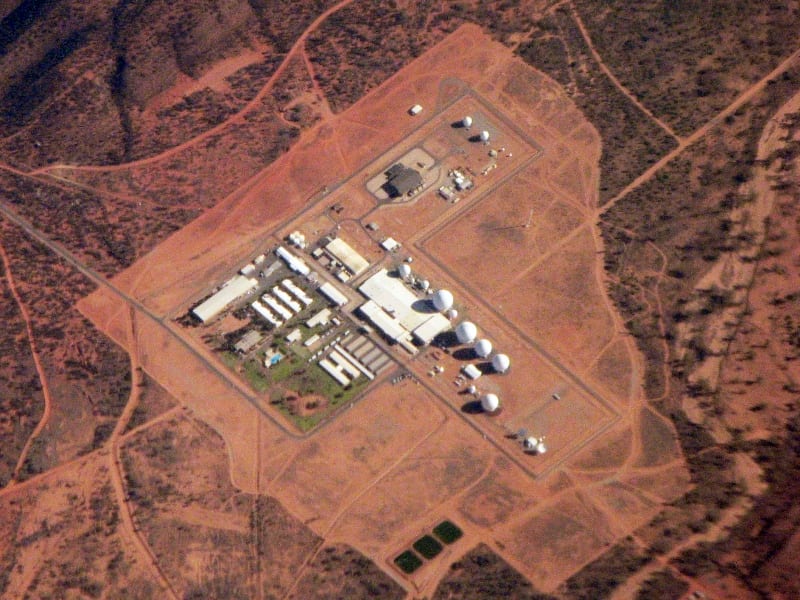
Context · the Pine Gap facility, near Alice Springs (Australia)
Pine Gap by Skyring.jpg · Wikimedia Commons · CC BY-SA 3.0 · open original
Part 01
The file in question
The Pine Gap Joint Defence Facility was established through a bilateral treaty signed between Australia and the United States on 9 December 1966, on a desert plain about 18 km southwest of Alice Springs (Northern Territory). The facility's initial public name was 'Joint Defence Space Research Facility', and its declared justification was 'space research' and upper-atmosphere research — a characterization later sources describe as deliberately misleading, intended to avoid revealing its true mission. The treaty stipulated that, after an initial nine-year period, either party could cancel the agreement with one year's notice; in practice it has been continuously renewed for nearly six decades. The base became fully operational on 19 June 1970 with the launch of its first associated satellite, code-named Rhyolite, dedicated to intercepting Soviet transmissions, including the telemetry of the Soviet missile program. For its first decades the station was run under CIA direction. Today it is one of the central nodes of the 5-Eyes Signals Intelligence (SIGINT) satellite network — Australia signed the UKUSA signals-intelligence sharing agreement in 1956 — along with facilities such as Menwith Hill (UK) and Misawa (Japan).
Visible infrastructure includes more than a dozen characteristic white radomes housing antennas for controlling geostationary satellites and processing SIGINT traffic. Its role was publicly confirmed in documents declassified by Edward Snowden (2013–2014): processing of targeting data for U.S. military operations, support for drone operations and monitoring of southern-hemisphere communications. Combined personnel exceeds 800; the U.S. contingent comes mostly from the National Security Agency (NSA) and the National Reconnaissance Office (NRO), with Australian staff from the Australian Signals Directorate (ASD). On all of this — the institutional plane — Pine Gap is not in dispute: its existence, founding treaty, budget and SIGINT function are documented in verifiable primary and secondary sources.
The UAP dimension of the case is of a different nature and far weaker epistemically, and it is worth marking that clearly. The region around Pine Gap is one of Australia's most sustained UAP hotspots: Wycliffe Well, about 380 km to the north, self-styles as the 'UFO capital of Australia' and has accumulated reports since World War II. In December 1989, three men returning from a hunting expedition near Pine Gap reported observing a 'camouflaged door' opening on a rock formation, revealing a metallic grey disc that departed at high speed — a purely testimonial account, without instrumentation or independent corroboration. Australian journalist Ross Coulthart has publicly maintained in his investigations that the base has been the scene of recurring UAP incidents, citing anonymous Australian Defence Force sources. None of these incidents has been officially acknowledged by the Australian government or the Pentagon. The most parsimonious explanation for a correlation of anomalous reports around a maximum-classification military installation is straightforward: a base with satellites, antennas, possible exercises and restricted air traffic naturally generates observations that are hard for the civilian public to explain, with no need to invoke an exotic phenomenon.
Part 02
Why this case moved the needle
It is Australia's institutional anchor piece in the corpus, the structural equivalent of AAWSAP for the U.S. and Operação Prato/CINDACTA for Brazil. What matters is not a single incident but the continuous existence of a multi-sovereign federal program with signed agreement, sustained budget and sustained recognition over six decades, in a site where UAP reports accumulate chronologically. It closes the corpus's geographical-institutional gap: without Pine Gap, Australia was represented only by individual incidents (Westall, Valentich) with no institutional piece articulating its structural role in the 5-Eyes ecosystem. Pine Gap's recognition as a SIGINT node through Snowden documents makes the base institutionally verifiable; the associated UAP reports are peripheral tracking calibrated accordingly.
Part 03
What's left on paper
Documented evidence
- Pine Gap Treaty signed in 1966 between Australia and the U.S., original code name 'Rainfall', initial public justification 'space research'
- Full operations since 1970, more than a dozen visible radomes, mandate confirmed in documents declassified by Snowden (2013–2014)
- Confirmed role: SIGINT processing in Ka/Ku/X bands, targeting for U.S. military operations, drone coordination, southern-hemisphere communications monitoring
- Combined personnel >800: U.S. contingent from NSA and NRO + Australian staff from the Australian Signals Directorate (ASD)
- Recurring UAP reports in surrounding region (Wycliffe Well, self-styled 'UFO capital of Australia') since World War II
- December 1989 incident: three witnesses report metallic disc emerging from 'camouflaged door' in rock formation near the base
- Investigations by Ross Coulthart (Australian journalist) citing anonymous Australian Defence Force sources about recurring UAP incidents at the base
Sources
- Pine Gap Treaty 1966 — Australia/United States bilateral agreement (texto en archivos federales) — Founding document of the Joint Defence Facility.
- Snowden, E. — NSA documents declassified 2013–2014 (vía The Guardian, Der Spiegel) — Public confirmation of Pine Gap's SIGINT role in the Five Eyes network.
- Coulthart, R. — investigación periodística sobre Pine Gap (multiple outlets australianos) — Sustained reporting on UAP incidents associated with the base.
- UFO Research Queensland — Pine Gap case file — Archive of incidents in the region.
- Australian Geographic — 'Wycliffe Well: Australia's outback UFO hotspot' (jun 2025) — Documentation of the regional UAP hotspot.
Patterns it exhibits (3)
Location
Pine Gap, near Alice Springs, Northern Territory · -23.80°, 133.74°
Related cases
3 patterns
Capitol Press Conference · Grusch + lawmakers (Jun 9, 2026)
2026 · Tier A · 80%
3 patterns
SETKA Program · Soviet state UAP investigation (1978–1991)
1978 · Tier S · 90%
3 patterns
UAP Whistleblower Immunity Initiative · Luna
2026 · Tier B · 68%
3 patterns
Aldo Rebelo · Varginha confirmation and disclosure pledge
2026 · Tier B · 60%