Case No. 126·Switzerland
1954·Switzerland (Air Force Intelligence Service)
Switzerland.Switzerland · UAP reporting directives (Air Force Intelligence)
A 1954 file (code E5465B) of the Swiss Air Force Intelligence Service contains directives for pilots and officials to report UFO sightings systematically. Observation forms in three languages were developed —position, direction, elevation, size, shape, apparent propulsion, speed— which former army pilots confirm were used until the 1990s. Most of those documents were destroyed. Switzerland's first record: the value is the institutional reporting infrastructure, not an anomalous case, in a neutral country.
Year
1954
Tier
B
Probability
35%
Category
Document
Limited evidence: single-witness, local or without primary verification. Three independent axes: the «tier» measures the strength of the evidence; the «probability» estimates how genuinely unexplained the case is —a natural phenomenon can remain unexplained, so it does not equal «non-prosaic»—; and the partition of explanations (below) says what it most plausibly was. So a well-documented case can have a possible hoax as its most plausible cause, and a Tier B is not, for that reason, a hoax.
Primary documents · viewer
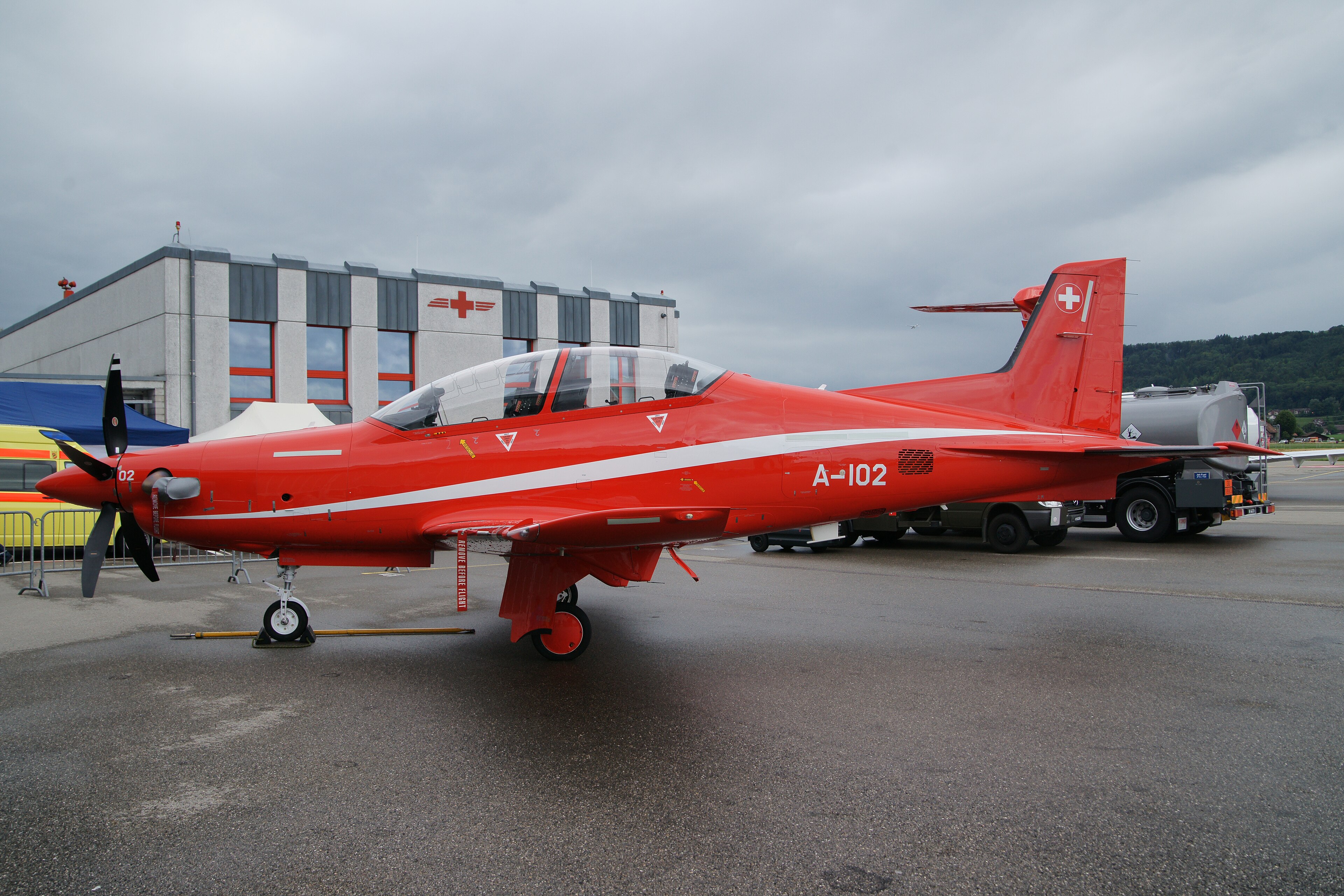
Context · the Swiss Air Force, whose intelligence service gathered the reports
Swiss Air Force PC-21 A-102 parked.jpg · Wikimedia Commons · CC BY-SA 3.0 · open original
Part 01
The file in question
A declassified 1954 file, identified by the code E5465B and held in the Swiss federal archives, shows that the Swiss Air Force Intelligence Service issued formal directives for pilots and officials to report sightings of unidentified aerial phenomena. The year is no accident: 1954 was one of the great European peaks of the postwar UFO wave —in France, that autumn, hundreds of reports were logged— and the Swiss decision fits within the bureaucratic response of several Western air forces to a flood of observations they could no longer ignore. The task stated in the file was to 'record these phenomena systematically', and to that end observation forms were designed in the three national languages (German, French and Italian), with fields for the object's position, its direction, elevation, relative size (referred, for example, to the lunar disk), shape, apparent propulsion —for instance, presence of smoke— and speed. The form's structure reveals a methodological intent: not to collect anecdotes but comparable data.
Former Swiss army pilots confirmed those forms remained in use until the 1990s, extending the protocol across nearly four decades and through the entire Cold War. A parallel file, devoted to 'airspace violations', documented foreign aircraft entering without authorization the skies of a country that made its armed neutrality a principle of state; in some cases the origin could not be determined, and suspicion pointed to Soviet or U.S. spy planes exploiting the Alpine corridor. That neighboring file matters for the framing: it shows that Swiss intelligence operationally distinguished between conventional unidentified air intrusions and reports of genuinely anomalous phenomena, handling them through separate channels.
The corpus framing is deliberately narrow. There is no famous anomalous case here with radar, photograph and a searchable public file in the style of the corpus's major incidents: most of these documents were destroyed at some point, and what survives and has come to light is fragmentary, reconstructed largely from the testimony of former servicemen and journalistic review of the surviving archives. The value of the record is therefore strictly institutional: the confirmation that a neutral country, outside the two Cold War blocs, maintained for four decades a formal, trilingual Air Force Intelligence protocol to collect UAP reports. It is a datum about the bureaucratic normalization of the phenomenon —about how a small, technical state turned it into a routine administrative procedure— not about the nature of what was observed. (It should also not be confused with the Billy Meier case, the famous Swiss contactee fabrication, devoid of all evidential value and deliberately excluded from the corpus; the record that matters here is that of the state apparatus, not of the national ufological folklore.)
Part 02
Why this case moved the needle
It is Switzerland's first corpus record and a clear example of institutional over phenomenological value: not a sighting, but proof that a strictly neutral air force's intelligence maintained for four decades (1954–1990s) a formal, trilingual UAP reporting protocol, with forms designed to capture comparable data. The datum reinforces a central corpus thesis —that serious military processing of the phenomenon is not exclusive to the great powers or to a single geopolitical bloc— and reinforces it from an especially persuasive angle: that of a small, technical state, distrustful of both sides, which nonetheless judged the matter worthy of a standing procedure.
Its weight, moreover, is exactly what the corpus can sustain, no more and no less. It is included with explicit honesty about its limits: most documents were destroyed, no complete public archive exists, and there is no famous anomalous case associated with it that could be offered as evidence of the phenomenon itself. What remains —and what the corpus claims— is the administrative footprint: the bureaucratic normalization of UAP as a reporting category within a neutral air force. It is evidence of institutional behavior, not of non-human technology, and it is catalogued as such.
Part 03
What's left on paper
Documented evidence
- File E5465B (1954): Swiss Air Force Intelligence directives to report UAP systematically.
- Trilingual observation forms (position, direction, elevation, size, shape, propulsion, speed), in use until the 1990s per former pilots.
- Parallel 'airspace violations' file with sometimes undetermined origins (Cold War).
- Honest limit: most documents were destroyed; no public archive or associated anomalous case.
Location
Switzerland (Air Force Intelligence Service) · 46.95°, 7.45°
Related cases