1566·Basilea, Confederación Suiza
Suiza.Fenómeno celeste · Basilea
Al amanecer del 7 de agosto de 1566, numerosos habitantes de Basilea (Suiza) dijeron ver grandes esferas negras que cruzaban veloces el cielo frente al sol, 'como si combatieran', algunas tornándose rojas y consumiéndose. El hecho se sumó a otros prodigios solares y lunares de ese verano. El impresor Samuel Apiarius lo publicó en una hoja volante con grabado, con un texto que firma Samuel Coccius, estudiante en Basilea.
Tier B · Indiciario¿Qué significan? →
Evidencia limitada: un solo testigo, un testimonio recogido años después o un relato sin documentación primaria de la época.
Qué fue
62%causa natural o humana
Explicación más probable: fenómeno natural
Ver el reparto entre las seis explicaciones
Causa natural o humana
Sin causa conocida
Documentos primarios
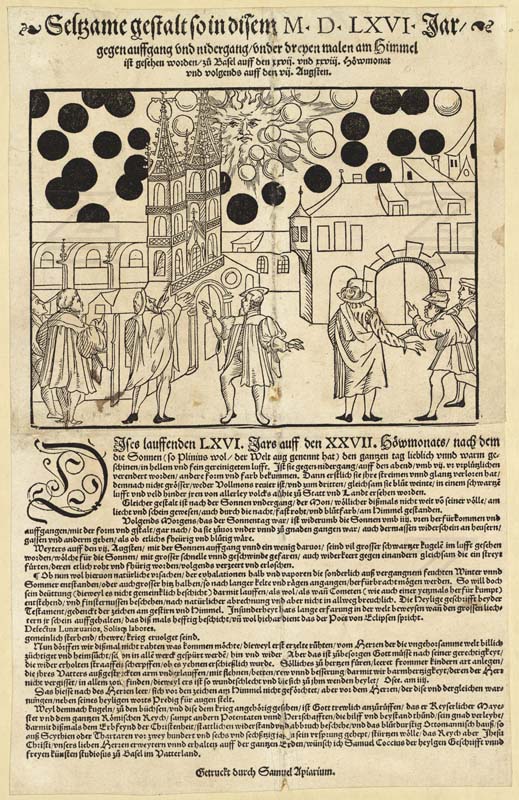
Panfleto de Basilea (1566) · «Seltsame Gestalt» — el fenómeno celeste sobre la ciudad
Grabado de la época (Basler Chronik) vía Wikimedia Commons · Dominio público · obra anterior a 1928 · abrir original
La noche en cuestión
El caso de Basilea pertenece, como el de Núremberg cinco años antes, al género de las hojas volantes (Flugblätter) de prodigios celestes que florecieron en la Europa de la Reforma. Según el texto de la hoja, que firma Samuel Coccius, «estudiante de la Sagrada Escritura y de las artes liberales en Basilea, su patria», los habitantes de Basilea presenciaron a lo largo de varios días (el 27 y 28 de julio y el 7 de agosto de 1566) una serie de fenómenos extraños en el cielo. Los dos primeros se describen como un amanecer anómalo y un episodio en torno al sol y la luna teñidos de rojo; el tercero, el más célebre, ocurrió al alba del 7 de agosto.
Ese día, según el texto, al salir el sol se vieron 'grandes esferas negras' que iban y venían ante el disco solar con gran velocidad y precisión, como si se enfrentaran en un combate. Algunas de esas esferas, relata la crónica, se volvían de color rojo y fuego y parecían consumirse o extinguirse. La escena (esferas oscuras girando y chocando frente a un sol intensamente brillante) quedó plasmada en un grabado en madera que ilustra la hoja volante, mostrando el cielo lleno de orbes blancos y negros en aparente desorden alrededor del astro.
La hoja fue impresa en Basilea ese mismo año por Samuel Apiarius (c. 1530-1590), un impresor itinerante activo entre Berna, Basilea y Soleura; en la ficha de Hellmann la hoja solo nombra al impresor y, como autor del texto, a Coccius. El pliego, una hoja en folio con un grabado de unos 23 por 18 centímetros y 35 líneas de texto, se conserva hoy en la Zentralbibliothek de Zúrich, integrado en la célebre colección Wickiana (el archivo de prodigios, noticias y 'señales' reunido por el clérigo zuriqués Johann Jakob Wick). Como en Núremberg, el suceso se leyó en clave providencial: una advertencia divina en un tiempo de tensión religiosa y política. Carl Jung la citó en 1958, junto al grabado de Núremberg, en su estudio sobre las visiones celestes, y el meteorólogo Gustav Hellmann, que catalogó el pliego en 1921, atribuyó con interrogantes los amaneceres y ocasos rojos a una calima, pero escribió que no sabía interpretar las bolas negras que pasaban junto al sol. La interpretación más citada hoy es que la escena corresponde a fenómenos ópticos atmosféricos (halos, parhelios y efectos de refracción solar al amanecer) traducidos por los testigos al lenguaje bélico y religioso de su época.
Por qué importa
Basilea 1566 importa por la misma razón que Núremberg 1561 y como su complemento: juntos forman el ancla histórica que documenta cómo, mucho antes de la fotografía y el radar, comunidades europeas percibían, narraban e imprimían observaciones de objetos en el cielo organizadas como un 'evento' significativo. Dos pliegos independientes, de ciudades y talleres distintos, separados por cinco años, describiendo enjambres de esferas que se 'enfrentan' frente al sol al amanecer, muestran que el fenómeno-relato tiene raíces profundas y recurrentes en la cultura, no que haya naves. La conservación del original en la colección Wickiana de Zúrich le da, además, una procedencia documental sólida poco habitual para un caso del siglo XVI.
Igual que en Núremberg, la lectura prosaica domina. La explicación de referencia es la óptica atmosférica, aunque los estudiosos han propuesto también lluvias de meteoros, un bólido, un cometa o una aurora: halos solares, parhelios ('soles' y arcos múltiples) y efectos de refracción en cristales de hielo a baja altura del sol producen exactamente discos, orbes y manchas oscuras que un observador del XVI, sin marco físico, traduciría como esferas en combate; a ello se suman la capa interpretativa providencial del impresor y el incentivo comercial de una hoja que se vendía mejor cuanto más portentosa. El texto no dice si Coccius lo vio en persona (habla de lo que «se vio» en Basilea), no podemos interrogar a testigos de hace cuatro siglos y medio, y nada en la hoja da base para inferir tecnología. Basilea es el segundo testigo de la longue durée (el que confirma que Núremberg no fue un unicum sino parte de una tradición) y, con él, un recordatorio de que la antigüedad de un relato refuerza su valor histórico sin convertirlo en prueba de lo que se vio.
Lo que queda en papel
Evidencia documentada
- Hoja volante (Flugblatt) impresa en Basilea en 1566 por Samuel Apiarius, con grabado en madera de unos 23 × 18 cm y texto firmado por Samuel Coccius, estudiante en Basilea
- Texto que data el fenómeno principal al amanecer del 7 de agosto de 1566 y describe 'grandes esferas negras' veloces frente al sol
- Mención de esferas que se tornan rojas y se consumen, sumadas a prodigios solares/lunares del 27-28 de julio
- Original conservado en la colección Wickiana de la Zentralbibliothek de Zúrich
- Caso paralelo y previo de Núremberg (1561), del mismo género de pliegos de prodigios celestes
Ver 3 evidencias más
- Interpretación historiográfica dominante: óptica atmosférica (halos/parhelios) traducida a imaginería bélico-religiosa
- Texto de Coccius sobre el 7 de agosto, citado por Jung: al salir el sol «se vieron en el aire muchas grandes bolas negras» que pasaban delante del sol «con gran velocidad», se volvían unas contra otras «como si libraran un combate», y algunas se pusieron rojas y ardientes y luego «se consumieron y se apagaron»
- Gustav Hellmann (1921), al catalogar el pliego (Zúrich, Ms. F. 17): no sabía interpretar las bolas negras
Fuentes
- Wikipedia — 1566 celestial phenomenon over Basel
- Swiss National Museum blog — 'The celestial event over Basel in 1566'
- Zentralbibliothek Zürich — colección Wickiana (procedencia del pliego)
- Hellmann, Gustav — «Die Meteorologie in den deutschen Flugschriften und Flugblättern des XVI. Jahrhunderts» (Abhandlungen der Preußischen Akademie der Wissenschaften, 1921) (archive.org) — Ficha bibliográfica del pliego: título íntegro, fechas del 27 y 28 de julio y del 7 de agosto, medidas del grabado, autoría del texto (Coccius, estudiante en Basilea), signatura de Zúrich (Ms. F. 17) y el comentario de que no sabía interpretar las bolas negras.
- Wikimedia Commons — escaneo de la hoja volante «Seltsame Gestalt so in disem M.D.LXVI. Jar» — Reproducción del pliego original de la Zentralbibliothek de Zúrich (baja resolución).
- Patrick Gross — «Basel 1566», con el pasaje de Coccius tal como lo cita Jung en «Ein moderner Mythus» (1958) — Secundaria: reproduce en alemán la cita de Jung del texto de Coccius sobre el 7 de agosto.