1973·Mansfield, Ohio
Estados Unidos.Coyne Helicopter
El 18 de octubre de 1973, hacia las 23:05, un helicóptero UH-1H de la reserva del Ejército de EE.UU. que volaba cerca de Mansfield (Ohio) estuvo a punto de chocar con una luz roja que se le echó encima; según la tripulación, el objeto se detuvo un instante sobre ellos y, con el colectivo abajo, el altímetro marcó un ascenso hasta 3.500 pies. El informe que firmaron los cuatro tripulantes el 23 de noviembre de 1973 lo registra como casi colisión con un objeto no identificado.
Tier A · Aceptable¿Qué significan? →
Evidencia institucional: varios testigos independientes identificados, o documentación oficial de la época, sin un registro instrumental que los corrobore.
Qué fue
51%sin causa conocida
La evidencia no alcanza para decidir entre las explicaciones
Ver el reparto entre las seis explicaciones
Sin causa conocida
Causa natural o humana
Documentos primarios
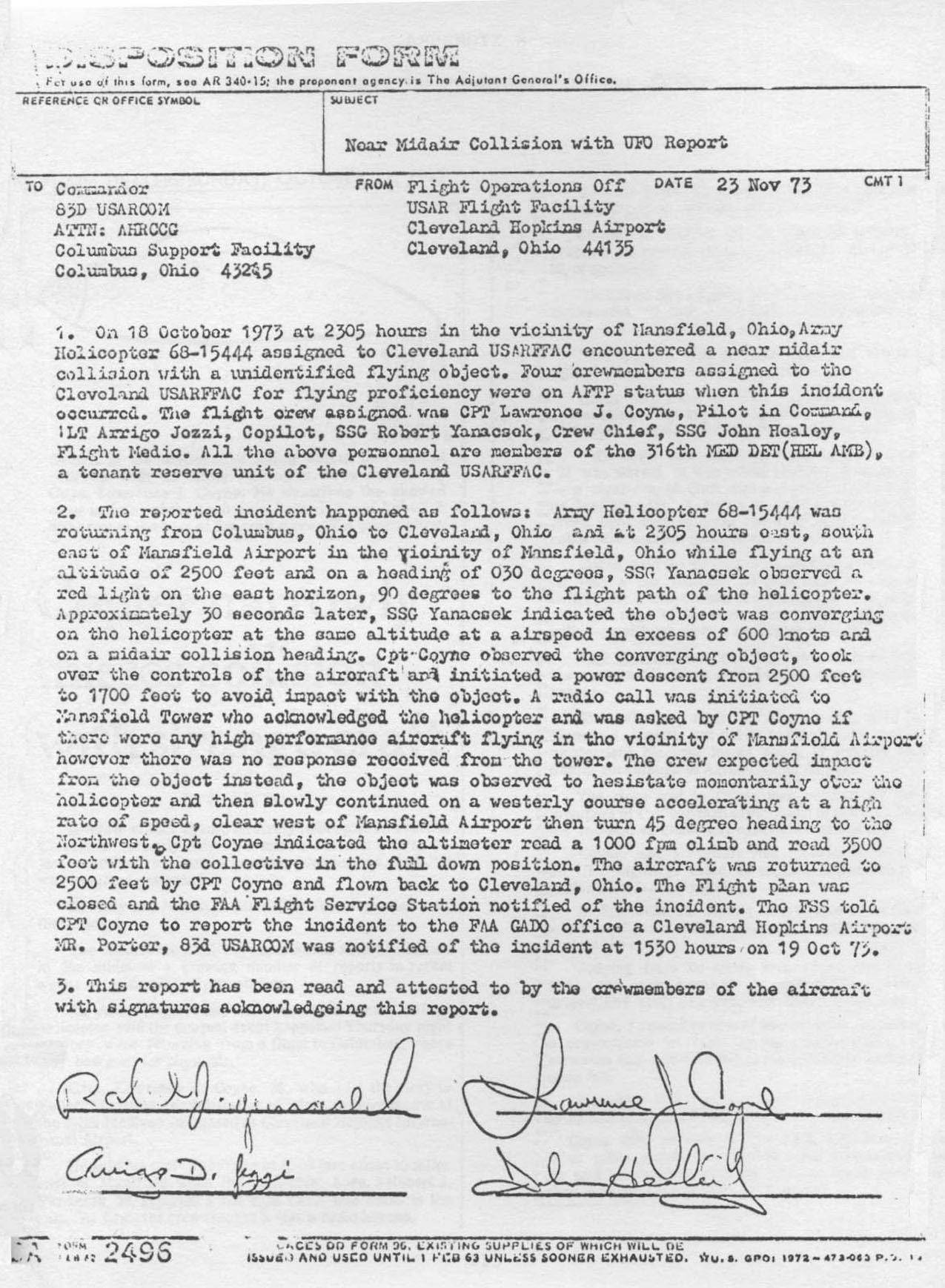
Formulario de disposición del Ejército (DA Form 2496) «Near Midair Collision with UFO Report», 23 de noviembre de 1973, firmado por los cuatro tripulantes
Informe de la Oficina de Operaciones de Vuelo de la instalación de la reserva del Ejército en el aeropuerto Cleveland Hopkins al 83.º USARCOM. Dice que el 18 de octubre de 1973 a las 23:05, cerca de Mansfield (Ohio), el helicóptero 68-15444 volaba a 2.500 pies con rumbo 030 cuando el sargento Yanacsek vio una luz roja al este que convergía a más de 600 nudos; Coyne descendió a 1.700 pies, el objeto «vaciló» sobre el aparato y se alejó al oeste, y el altímetro marcó 1.000 pies por minuto de ascenso y 3.500 pies con el colectivo abajo. La torre de Mansfield acusó recibo y no respondió más. Lo firman Coyne, Jezzi, Yanacsek y Healey.
Ejército de EE. UU., 83.º USARCOM; respuesta FOIA, escaneo publicado por NICAP · Dominio público · obra del Gobierno de EE. UU. · abrir original
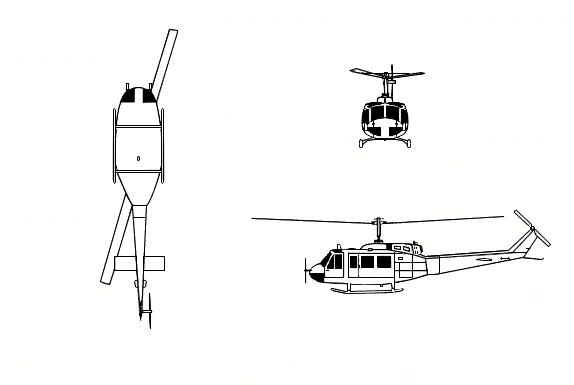
Contexto · un Bell UH-1 Iroquois, el tipo de helicóptero del caso Coyne
Bell UH-1 Iroquois 3-view line drawing.png · Wikimedia Commons · Dominio público · abrir original
La noche en cuestión
El 18 de octubre de 1973, a las 23:05 según el informe oficial (Coyne habló luego de las 23:10), el helicóptero UH-1H 68-15444 de la reserva del Ejército regresaba de Columbus a Cleveland a 2.500 pies, con rumbo 030, al este-sureste del aeropuerto de Mansfield (Ohio). A bordo iban cuatro miembros del 316th Medical Detachment: el capitán Lawrence J. Coyne (piloto al mando), el primer teniente Arrigo Jezzi (copiloto, que llevaba los mandos), el sargento Robert Yanacsek (jefe de tripulación) y el sargento John Healey (sanitario). Era una noche despejada y sin luna. Yanacsek vio una luz roja en el horizonte este, a 90° de la trayectoria, y unos 30 segundos después avisó de que convergía con el helicóptero a la misma altitud, a más de 600 nudos y en rumbo de colisión. Coyne tomó los mandos e inició un descenso con potencia de 2.500 a 1.700 pies; en la reconstrucción de la investigadora Jennie Zeidman, primero a unos 500 pies por minuto y después a unos 2.000.
Según el informe, el objeto, en vez de impactar, «vaciló un momento» sobre el helicóptero y siguió despacio hacia el oeste, acelerando luego mucho, pasó al oeste del aeropuerto de Mansfield y giró 45° hacia el noroeste. La descripción física llegó después: a la agencia UPI, dos semanas más tarde, Coyne le habló de un casco «grande, gris, de aspecto metálico» de unos 60 pies, con forma de perfil alar o de «puro gordo aerodinámico», una luz roja delante, una cúpula central y una luz verde atrás que giró como un reflector y bañó de verde la cabina. El giro descontrolado de la brújula magnética aparece en relatos posteriores de la tripulación recogidos por Zeidman, no en el informe ni en la prensa de 1973. Lo más llamativo sí está en el informe: Coyne vio el altímetro marcando un ascenso de 1.000 pies por minuto y 3.500 pies con el colectivo en la posición más baja. En la reconstrucción de Zeidman, al levantar Coyne el colectivo el helicóptero siguió subiendo hasta 3.800 pies, donde sintió que recuperaba el control. A UPI le dijo que no hubo ruido, turbulencia ni fuerzas g apreciables.
Coyne llamó por radio a la torre de Mansfield para preguntar si había aviones rápidos en la zona; la torre acusó recibo y después no respondió más. Según Zeidman, se perdió el contacto en UHF y VHF y se recuperó más tarde con Akron-Canton. Los F-100 de la Guardia Nacional Aérea basados en Mansfield no estaban en vuelo, según contó Coyne a UPI. Zeidman localizó después a testigos en tierra que no aparecían en el informe: una mujer y cuatro niños que volvían en coche junto al embalse de Charles Mill vieron una luz roja muy brillante y otra verde que convergían con un helicóptero, y cuando se detuvo la roja «todo se volvió verde», los árboles y el coche; y en otra casa, al sureste de Mansfield, un muchacho de 14 años despertado por el estruendo de un helicóptero vio su cuarto iluminado por una luz verde intensa. El informe, un formulario de disposición del Ejército titulado «Near Midair Collision with UFO Report», lo firmaron los cuatro tripulantes el 23 de noviembre de 1973 y lo reprodujeron Fawcett y Greenwood en «Clear Intent» (1984). Zeidman publicó su reconstrucción en el Center for UFO Studies (CUFOS) en 1979.
La explicación escéptica principal la propuso Philip J. Klass: un bólido de la lluvia de meteoros Oriónidas, activa esas fechas, y un ascenso causado por la propia tripulación, que habría tirado de los mandos por reflejo sin registrarlo. El cálculo de efemérides da a esa hipótesis un punto a favor: a las 23:05 hora de verano del Este, el radiante de las Oriónidas estaba a solo 1° sobre el horizonte este-noreste, y un meteoro rasante de ese radiante cruza el cielo precisamente del este hacia el oeste, largo y lento, como la luz que vio Yanacsek. Además, los relatos de 1973 dan una aproximación de unos 10 segundos y una «vacilación» momentánea, no una observación larga. En contra, Zeidman reconstruyó una observación continua de al menos cinco minutos, incompatible con un meteoro; no se conoce ningún registro independiente de un bólido en ese lugar y hora; y los testigos en tierra describen la luz verde sobre el helicóptero. La hipótesis del error de pilotaje sigue siendo la objeción más sólida al componente físico, porque un ascenso por reflejo es difícil de excluir sin un registro instrumental de los mandos.
Por qué importa
Coyne aporta un dato físico específico: la discrepancia reportada entre la posición del control de vuelo (colectivo abajo, ordenando descenso) y la altitud real (un ascenso de ~1,800 pies). Si el dato es correcto, describe una manipulación cinética aparente de una aeronave militar, documentada por cuatro aviadores que firmaron el informe y respaldada, en la parte de la luz verde, por testigos civiles en tierra que Zeidman localizó después.
El contrapeso es central. La objeción de Klass (error de operador, ascenso reflejo del colectivo bajo estrés, más un posible bólido Oriónida para la luz) es la explicación mundana más seria y, sin un registro de los mandos, no puede excluirse: el «ascenso contra los controles» consta en el informe firmado, pero descansa en lo que Coyne leyó en el altímetro, no en un registro instrumental independiente. La geometría le da además una baza al meteoro, porque el radiante de las Oriónidas estaba justo en el horizonte este, de donde vino la luz. Al mismo tiempo, el meteoro encaja mal con el aparente alto del objeto y con la duración de varios minutos que reconstruyó Zeidman, y no se conoce registro del bólido.
Lo que el caso tiene es un rastro institucional (un informe de casi colisión firmado por los cuatro tripulantes y tramitado por la cadena del 83d USARCOM) y testigos que coinciden; no tiene registro de sensores. Ilustra con nitidez una tensión frecuente en estos casos: testimonio profesional consistente y un efecto físico llamativo, pero sin la instrumentación que permitiría cerrar el debate entre interacción anómala y artefacto perceptual-operacional bajo estrés.
Lo que queda en papel
Evidencia documentada
- Formulario de disposición del Ejército «Near Midair Collision with UFO Report» (23 nov 1973), firmado por los cuatro tripulantes
- El informe registra 1.000 pies por minuto de ascenso y 3.500 pies en el altímetro con el colectivo en la posición más baja
- Radio: la torre de Mansfield acusó recibo y luego no respondió; los F-100 de Mansfield no estaban en vuelo (UPI, 4 nov 1973)
- Testigos en tierra localizados por Zeidman: una mujer y cuatro niños junto al embalse de Charles Mill, y un muchacho que vio su cuarto iluminado de verde
- Radiante de las Oriónidas a 1° sobre el horizonte este-noreste a las 23:05, compatible con un meteoro rasante de este a oeste
Fuentes
- «Near Midair Collision with UFO Report», formulario de disposición del 83d USARCOM (23 nov 1973), transcripción de Patrick Gross — Texto íntegro del informe oficial firmado por los cuatro tripulantes, según la reproducción de Fawcett y Greenwood, «Clear Intent» (1984), p. 239
- «Incident named after pilot», UPI, Mansfield News Journal (4 nov 1973), transcripción de Patrick Gross — Prensa de la época con las declaraciones de Coyne
- Transcripción NICAP del expediente FOIA de Coyne (Army Reserve, 1973) — Copia secundaria del informe; el sitio exige verificación de navegador
- Zeidman, J. — 'A Helicopter-UFO Encounter Over Ohio' (CUFOS 1979) — Reconstrucción técnica completa (investigación posterior con entrevistas); no se pudo descargar desde aquí porque cufos.org exige verificación de navegador
- NICAP — Coyne case directory — Agregador secundario
- Klass, P. J., citado en Parabunk, «The 1973 Coyne/Mansfield helicopter UFO incident finally explained» (2018)
Casos relacionados
mismo objeto · mismo país · misma época
Kecksburg
1965 · Tier A
mismo objeto · mismo país
Sandia: bolas de fuego verdes
1948 · Tier A
mismo objeto · mismo país
Chiles-Whitted · dos pilotos de aerolínea y un objeto con ventanas (EE.UU., 1948)
1948 · Tier A
mismo objeto · misma época
Berwyn Mountain · Llandrillo
1974 · Tier A
Actores asociados (1)