1952·Cerca de Norfolk, Virginia
Estados Unidos.Nash-Fortenberry · dos pilotos de Pan Am (Virginia)
El 14 de julio de 1952, los pilotos de Pan American William Nash y William Fortenberry observaron desde su DC-4, cerca de Norfolk (Virginia), seis discos de brillo rojizo volando en formación por debajo de su avión; los discos ejecutaron una inversión abrupta, se les unieron otros dos y partieron a gran velocidad. Project Blue Book lo archivó como «Unknown» (no identificado).
Tier A · Aceptable¿Qué significan? →
Evidencia institucional: varios testigos independientes identificados, o documentación oficial de la época, sin un registro instrumental que los corrobore.
Qué fue
51%causa natural o humana
Explicación más probable: faro o reflector
Ver el reparto entre las seis explicaciones
Causa natural o humana
Sin causa conocida
Documentos primarios
Expediente de Blue Book de Norfolk (julio de 1952): tarjeta, cable AFOIN 53722, informe de inteligencia AF Form 112 del mayor Sharpe con croquis y resumen de ATIC, 7 págs.
Escaneo de NICAP. La tarjeta describe seis objetos en forma de disco de 100 pies que se acercaron al avión de línea a unos 2.000 pies y anota cinco reactores cerca de Langley. El cable AFOIN 53722 del 16 de julio transmite el aviso de la OSI: ocho objetos circulares luminosos en formación, a unas 1.000 millas por hora. El informe AF Form 112 del mayor John H. Sharpe, del 15 de julio, recoge el interrogatorio de Nash y Fortenberry, con sus impresiones (entre ellas, que los objetos «no son de origen terrestre»); Sharpe los juzga fiables y calcula que los vieron de cinco a diez segundos. Cierran el croquis de la trayectoria y el resumen de ATIC, que concluye «Unknown».
Proyecto Blue Book (NARA), escaneo publicado por NICAP · Dominio público · obra del Gobierno de EE. UU. · abrir original
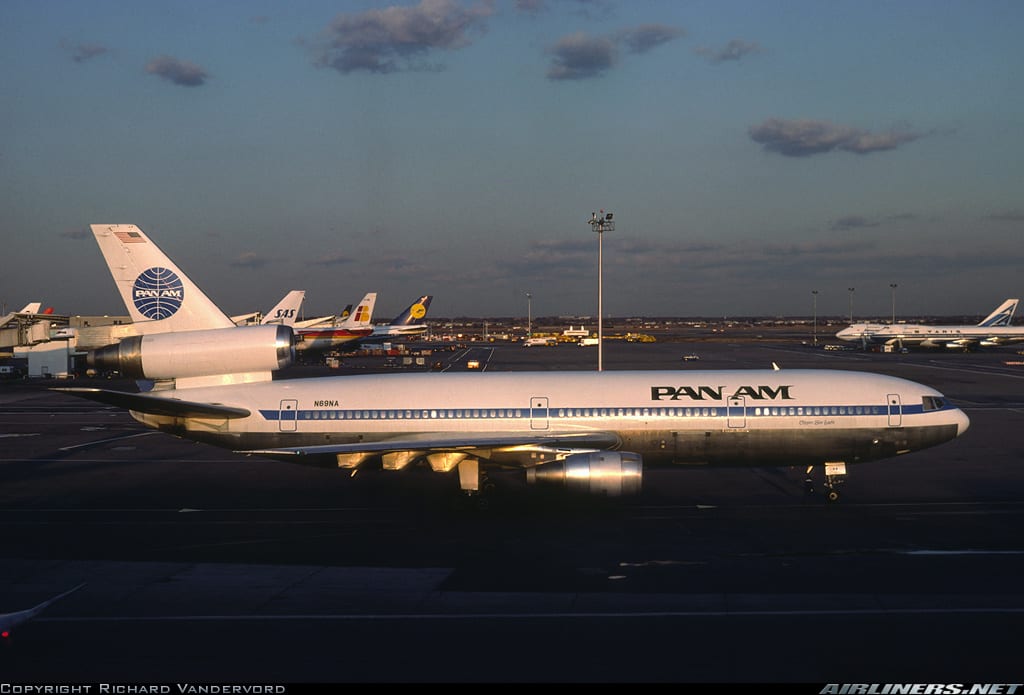
Contexto · un Douglas DC-4 de Pan American, el tipo de avión del avistamiento de Norfolk
Pan American World Airways - Pan Am McDonnell Douglas DC-10-10 N69NA.jpg · Wikimedia Commons · CC BY-SA 4.0 · abrir original
La noche en cuestión
La noche del 14 de julio de 1952, durante la intensa oleada de avistamientos de ese verano (la misma que pocos días después culminaría en los célebres eventos de radar sobre Washington), un DC-4 de Pan American World Airways volaba de Nueva York hacia el sur (el cable de la Fuerza Aérea lo llama vuelo Nueva York–San Juan; el informe de la OSI, Nueva York–Miami) con diez pasajeros y una tripulación de tres. Al mando iba el capitán F. V. Koepke; el primer oficial William B. Nash y el segundo oficial William H. Fortenberry estaban en la cabina. El avión cruzaba a unos 8.000 pies de altura sobre la bahía de Chesapeake, aproximándose a Norfolk (Virginia), con el piloto automático conectado, cuando hacia las 20:12 (hora estándar del Este) Nash y Fortenberry vieron aparecer por debajo de su avión una formación de seis objetos discoidales que brillaban con una intensa luz rojo-anaranjada y mostraban bordes definidos.
Según su reporte (detallado y consistente entre ambos) los discos volaban en línea, ejecutaron una inversión casi instantánea (se «voltearon» mostrando el canto), se les unieron dos discos más para sumar ocho, y todo el grupo aceleró, ascendió y se apagó antes de desaparecer. La estimación de tamaño y velocidad que hicieron los pilotos implicaba una dinámica extrema, con velocidades del orden de miles de kilómetros por hora y un giro en ángulo agudo. El incidente ocurrió unos cuatro meses después de que Project Blue Book recibiera ese nombre y cinco días antes de los primeros eventos de radar sobre Washington. A la mañana siguiente, en Miami, agentes de la Oficina de Investigaciones Especiales (OSI) de la Fuerza Aérea interrogaron a los pilotos; según Nash, les dijeron que ya tenían otros siete informes de discos rojos en formación, que no aparecen en el expediente de Blue Book. El informe del mayor John H. Sharpe (formulario AF 112, 15 de julio) recoge entre las impresiones de los dos pilotos que los objetos «no son, sin duda, de origen terrestre», y estima que estuvieron a la vista al menos cinco segundos, quizá diez. La ficha de Blue Book resume el caso así: seis objetos en forma de disco, de 100 pies de diámetro, que emitían un brillo rojizo, se acercaron al avión de línea a unos 2.000 pies, hicieron un giro errático para evitar una colisión y se alejaron en su formación original. La ficha anota que cinco reactores estaban en las inmediaciones de Langley AFB a esa hora; Blue Book descartó que explicaran el avistamiento y archivó el caso como «Unknown».
Las explicaciones escépticas documentadas son dos, ambas del astrofísico Donald H. Menzel. En su correspondencia de 1962 con Nash, conservada en el expediente de Blue Book, propuso primero un reflejo en las ventanillas de la cabina; Nash respondió que los objetos estaban entre el avión y el oeste, que los habían seguido a través de tres ventanillas distintas y que nadie fumaba en la cabina, cuya puerta estaba cerrada. En su libro «The World of Flying Saucers» (1963), Menzel pasó a una segunda hipótesis: un reflector o faro de la costa de Virginia visto a través de capas de calima concentradas por inversiones térmicas, que se verían como una serie de discos capaces de «rebotar» al girar el haz. Sus críticos objetan que los partes meteorológicos de esa noche no registraban inversiones, que Menzel nunca identificó la fuente de luz y que los objetos se vieron contra el fondo oscuro del agua de la bahía.
Por qué importa
Dos testigos profesionales con la misma observación detallada, archivada por Blue Book como «Unknown» y ocurrida cinco días antes de que la misma oleada produjera los incidentes de radar de Washington. Los dos pilotos describieron una maniobra (inversión instantánea, formación, aceleración) difícil de reconciliar con un fenómeno lumínico trivial. Los pilotos situaron los objetos por debajo del avión, entre este y el oeste, y los siguieron a través de tres ventanillas, lo que debilita la hipótesis del reflejo en el cristal; la del reflector, por su parte, exige inversiones que los partes de esa noche no registraban.
Su límite es que se trata de un caso puramente visual, sin registro de radar ni instrumento independiente que corrobore tamaño, distancia o velocidad. Todas las cifras dramáticas de velocidad son estimaciones de los testigos a partir de un tamaño angular cuya distancia real nunca se determinó, y errores de estimación de distancia en avistamientos nocturnos son la fuente clásica de velocidades aparentemente imposibles.
Lo que queda en papel
Evidencia documentada
- Avistamiento por los pilotos de Pan Am William Nash y William Fortenberry desde un DC-4 a 8.000 pies, 14 jul 1952, hacia las 20:12 EST
- Seis discos de brillo rojizo en formación, con inversión abrupta, a los que se unieron otros dos antes de acelerar y ascender
- Reporte detallado y coincidente entre ambos pilotos profesionales
- Interrogados por la OSI en Miami a la mañana siguiente; Blue Book archivó el caso como «Unknown»
- Ficha de Blue Book: seis discos de 100 pies con brillo rojizo a unos 2.000 pies; los cinco reactores de Langley AFB en la zona se descartaron como explicación
- Explicaciones de Menzel (reflejo en la ventanilla, 1962; reflector a través de capas de inversión, 1963) rechazadas por Nash
Fuentes
- Project Blue Book · expediente de Norfolk, 14 jul 1952 (MAXW-PBB12-168 a 192) — copia en NICAP — Fuente primaria. Ficha del caso (p. 5 del PDF), con la descripción de los seis discos y la nota sobre los cinco reactores de Langley, e informes de la OSI.
- Project Blue Book · expediente de Norfolk (MAXW-PBB12-193 a 217) — copia en NICAP — Fuente primaria. Interrogatorio de los pilotos y correspondencia entre Nash y Donald H. Menzel.
- Project Blue Book · expediente de Norfolk (MAXW-PBB12-218 a 241) — copia en NICAP — Fuente primaria. Cartas de Nash y Menzel de 1962 y las páginas de «The World of Flying Saucers» sobre el caso.
- Cable AFOIN 53722 del 16 jul 1952 (7.º distrito de la OSI) — transcripción en NICAP — Fuente primaria transcrita. Ocho objetos luminosos circulares en formación cerca de Langley AFB; tripulación interrogada por la OSI en Miami.
- Tom Tulien, «Revisiting One of the Classics: The 1952 Nash/Fortenberry Sighting» — NICAP — Secundaria. Reconstrucción basada en el expediente, el artículo de Nash y Fortenberry en True (octubre de 1952) y la correspondencia con Menzel.
Casos relacionados