1947·Roswell, New Mexico
Estados Unidos.Roswell
La oficina de prensa del Roswell Army Air Field, base del 509th Bomb Group, anunció el 8 de julio de 1947 la recuperación de un «disco volador»; esa misma tarde la 8.ª Fuerza Aérea lo identificó como un globo con reflector de radar, y los únicos registros oficiales de 1947 (la historia de la unidad y un teletipo del FBI) dicen lo mismo. La USAF lo atribuyó en 1994 al proyecto secreto de globos Mogul y en 1997 explicó los relatos de cuerpos con maniquíes de prueba.
Tier A · Aceptable¿Qué significan? →
Evidencia institucional: varios testigos independientes identificados, o documentación oficial de la época, sin un registro instrumental que los corrobore.
Qué fue
78%causa natural o humana
Explicación más probable: tecnología humana clasificada
Ver el reparto entre las seis explicaciones
Causa natural o humana
Sin causa conocida
Documentos primarios
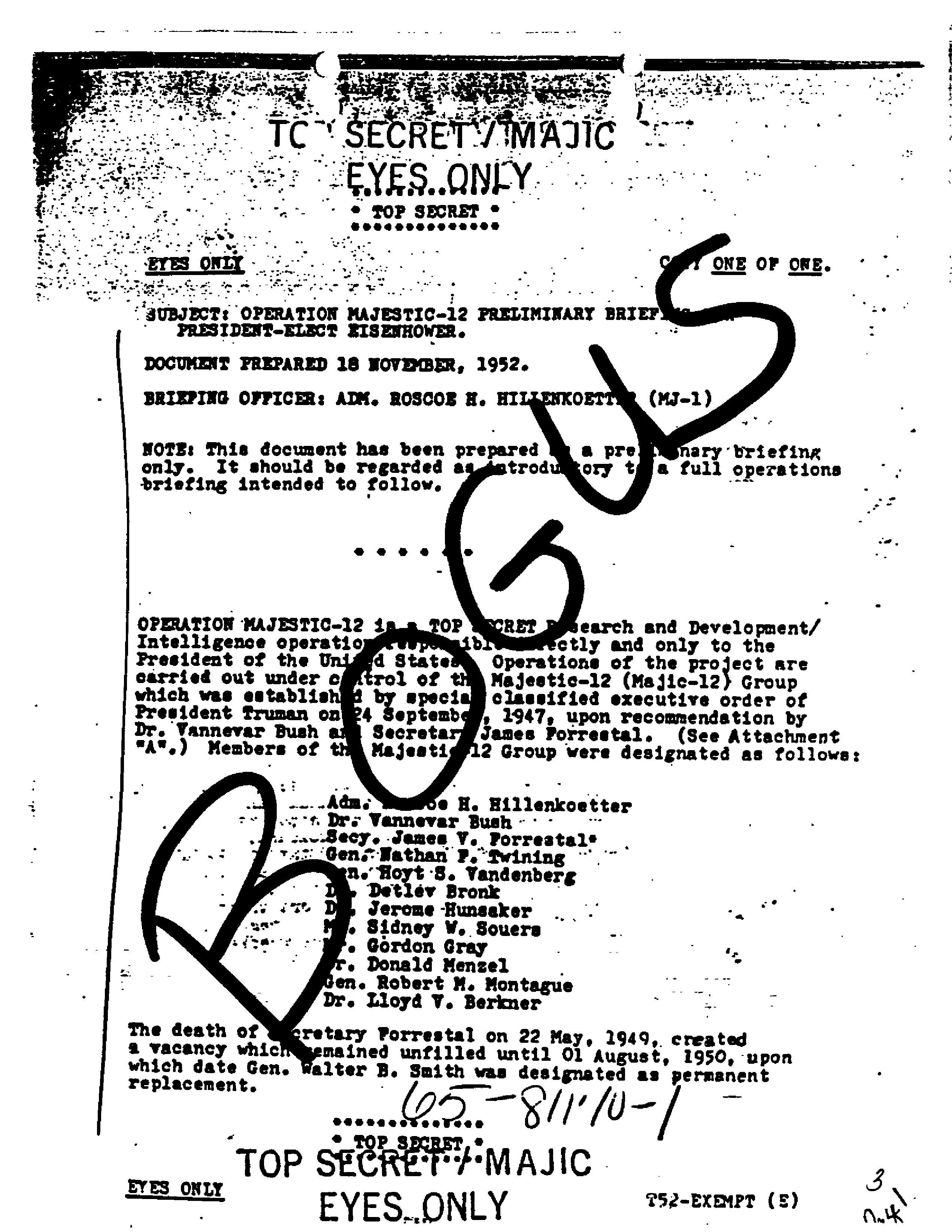
Uno de los documentos Majestic-12 en circulación, investigados por el FBI
Los documentos «Operation Majestic-12» aparecieron entre 1984 y 1987: un rollo de película anónimo recibido por Jaime Shandera en diciembre de 1984, difundido después por él, William Moore y Stanton Friedman. Describen un comité secreto de doce altos funcionarios creado por Truman en 1947 para gestionar ovnis estrellados y cuerpos recuperados, en relación con Roswell. En 1988 dos oficinas del FBI recibieron copias y la AFOSI respondió que eran «completamente falsos» (bogus), veredicto que consta en el expediente de The Vault. Examinadores hallaron una firma de Truman calcada de una carta de 1947, formatos de fecha anacrónicos y membrete inconsistente. No prueban ni el comité ni los ovnis; su origen exacto sigue sin esclarecer.
Majestic 12 Part 1 of 1 (page 4 crop).jpg · Wikimedia Commons · Dominio público · abrir original
La noche en cuestión
En el verano de 1947 (en pleno auge nacional de avistamientos de «discos voladores» tras el reporte de Kenneth Arnold del 24 de junio), el ranchero William «Mac» Brazel encontró restos esparcidos en una propiedad que administraba cerca de Corona, Nuevo México, a unos 120 km de Roswell. Según su propia entrevista, publicada por el Roswell Daily Record el 9 de julio, él y su hijo dieron con los restos el 14 de junio: tiras de goma, papel de aluminio, un papel bastante resistente y varillas, con cinta adhesiva y una cinta estampada con flores, algunas letras sueltas pero ninguna palabra, sin rastro de metal de motor ni de hélices, y en total unas cinco libras de peso. Recogió parte el 4 de julio, oyó hablar de los discos voladores y el 7 de julio fue a Roswell. Allí avisó al sheriff George Wilcox, quien contactó al Roswell Army Air Field (RAAF), base del 509th Bombardment Group, la única unidad de bombardeo nuclear operacional del mundo en ese momento, lo que volvía cualquier objeto caído en su zona un asunto de máxima sensibilidad. El mayor Jesse Marcel (oficial de inteligencia de la base) y un hombre de civil, que décadas después se identificó como el capitán Sheridan Cavitt, del Cuerpo de Contrainteligencia, fueron con Brazel al rancho a recoger el resto y lo llevaron a la base.
El 8 de julio de 1947, el coronel William Blanchard autorizó al teniente Walter Haut a emitir un comunicado de prensa oficial, que afirmaba que el RAAF había recuperado un «disco volador» y que este había sido enviado a un cuartel general superior. La noticia se difundió por teletipo a nivel nacional en cuestión de horas. Esa misma tarde, el general Roger Ramey, comandante de la 8.ª Fuerza Aérea en Fort Worth, Texas, corrigió el anuncio: convocó a la prensa, exhibió los restos y los identificó como un globo meteorológico; la mayor parte de lo que se ve en las fotos es un reflector de radar de los que se colgaban de esos globos. El mismo 8 de julio, la oficina del FBI en Dallas transmitió por teletipo lo que le había dicho el cuartel general: el «disco» era hexagonal y colgaba de un globo de unos seis metros de diámetro mediante un cable, y el objeto hallado «se parece a un globo meteorológico de gran altitud con un reflector de radar». El comunicado original, la retractación y las fotografías de Ramey con los restos son parte del registro periodístico contemporáneo (Roswell Daily Record, Fort Worth Star-Telegram).
El caso permaneció en el olvido casi tres décadas hasta que, en 1978-1980, el físico nuclear Stanton Friedman y los investigadores Charles Berlitz y William Moore localizaron a Jesse Marcel y publicaron 'The Roswell Incident' (1980), reintroduciendo la hipótesis de una nave estrellada. En 1994, mientras la GAO buscaba registros a petición del congresista Steven Schiff, la USAF concluyó en un informe de julio (publicado en 1995 como «The Roswell Report: Fact vs. Fiction in the New Mexico Desert») que los restos procedían con toda probabilidad del Project Mogul, un programa secreto de trenes de globos de gran altitud diseñado para detectar a distancia los ensayos nucleares soviéticos, y señaló el vuelo 4 de la Universidad de Nueva York, que, según la lectura que hicieron Charles Moore y la USAF del diario del geofísico Albert Crary, se lanzó desde Alamogordo el 4 de junio de 1947 y nunca fue recuperado por el equipo; la entrada de ese día solo dice «No balloon flight again on account of clouds. Flew regular sonobuoy mike with cluster balloons». En 1997 publicó 'Case Closed', explicando los relatos posteriores de cuerpos como confusión cronológica con maniquíes de prueba de paracaídas (que en realidad se usaron en los años cincuenta). Ese mismo año, el teniente coronel retirado Philip J. Corso afirmó en su libro «The Day After Roswell» que en julio de 1947 vio en Fort Riley el cuerpo de uno de los ocupantes y que en 1961 heredó restos del choque y los repartió entre contratistas de defensa, de los que según él salieron la visión nocturna, la fibra óptica, el láser y los circuitos integrados. El senador Strom Thurmond se desmarcó del prólogo que había escrito, que se retiró del libro, y el informe histórico de la AARO de 2024 no halló pruebas de ingeniería inversa de tecnología extraterrestre. La GAO (1995) halló solo dos registros oficiales de 1947 sobre el suceso: la historia de julio del 509th Bomb Group y del RAAF, que dice que el objeto «resultó ser un globo de seguimiento por radar», y el teletipo del FBI. Ambas explicaciones de la USAF son disputadas por participantes y por algunos investigadores. En octubre de 2026, Jay Stratton, que dirigió la UAP Task Force del Pentágono, escribió en sus memorias, «Out of the Shadows», que una fuente le aseguró que en 1947 hubo un choque en Roswell, que el objeto «se partió en dos» y que se recuperaron los restos y cuerpos no humanos, algunos de los cuales, «supuestamente», seguían vivos y murieron después. Es un relato de segunda mano: Stratton no nombra a la fuente ni aporta un documento, y no añade evidencia de 1947.
Por qué importa
Combina un comunicado militar oficial que anunciaba la recuperación de un «disco volador» con una rectificación el mismo día. Independientemente de la naturaleza real del material, establece el patrón institucional de anuncio seguido de desmentido (release+walk-back) que se repetiría a lo largo de ocho décadas y que define varios casos posteriores.
La explicación convencional más robusta (y la posición administrativa oficial de Estados Unidos) es Project Mogul. Charles B. Moore, físico que trabajó en el programa NYU de globos, reconstruyó la trayectoria del Flight No. 4 usando datos de viento de junio de 1947 y concluyó que su descenso era compatible con una caída en el rancho de Foster, a unos 137 km al noreste del punto de lanzamiento de Alamogordo. Mogul explica de forma natural los rasgos más citados del material: las láminas reflectantes, los refuerzos de madera de balsa con marcas que parecían 'jeroglíficos' (cinta adhesiva impresa con flores, según los fabricantes) y el carácter inusual y secreto del despliegue, que justificaría tanto la confusión inicial como el hermetismo. El investigador Karl Pflock, partiendo de simpatías pro-OVNI, concluyó en 1994 que los restos del rancho eran probablemente de un globo Mogul, aunque entonces aún sostenía que en otro lugar cercano se había estrellado una nave con tres cuerpos, algo que la USAF no pudo corroborar. El contrapunto serio es doble: algunos registros del Project Mogul son ambiguos sobre si el Flight No. 4 llegó a lanzarse, (el diario de Crary anota el 4 de junio que no hubo vuelo «por las nubes» y, a continuación, que se hizo volar un micrófono sonoboya en un racimo de globos), y el llamado «metal con memoria» (una lámina que volvía a su forma tras arrugarse), descrito por Marcel y por Bill Brazel, excede lo que el equipo de Mogul contenía. Pero ese rasgo solo aparece en testimonios y declaraciones juradas de las décadas de 1970 a 1990; en 1947 el propio Mac Brazel habló de papel de aluminio y goma y dijo que no había rastro de metal, lo que los escépticos leen como deriva de la memoria y los partidarios como evidencia de un material anómalo. La GAO (1995) no resolvió la naturaleza del material, pero documentó que los registros administrativos del RAAF de marzo de 1945 a diciembre de 1949 y sus mensajes salientes de octubre de 1946 a diciembre de 1949 fueron destruidos, sin que el formulario de disposición indique quién los destruyó, cuándo ni con qué autoridad, un hallazgo que alimenta ambos lados del debate. El físico nuclear Stanton Friedman reabrió el caso en 1978 al localizar y entrevistar a Jesse Marcel, el trabajo que devolvió Roswell al debate tras tres décadas de olvido. En suma: los dos únicos registros oficiales de 1947 y la descripción contemporánea del propio ranchero apuntan a un globo con reflector de radar, existe una explicación específica y bien sustentada (Mogul), conviven con ella anomalías documentales no cerradas, y la mayor parte del relato de 'cuerpos' descansa en testimonios secundarios tardíos sin evidencia primaria.
Lo que queda en papel

El general Roger Ramey con el telegrama y los restos. Fort Worth, 8 de julio de 1947: el mismo día en que la base de Roswell anunció un «disco recuperado» y la 8.ª Fuerza Aérea lo identificó como un globo meteorológico con reflector de radar.
US Army Signal Corps · Dominio público · obra del Gobierno de EE. UU.
Evidencia documentada
- Comunicado de prensa del RAAF (8 julio 1947) anunciando la recuperación de un «disco volador», reproducido por el Roswell Daily Record
- Rectificación del general Ramey en Fort Worth el mismo 8 de julio y entrevista a Mac Brazel en el Roswell Daily Record (9 julio 1947): goma, papel de aluminio, papel, varillas y cinta con flores, sin metal
- Teletipo del FBI de Dallas (8 julio 1947): objeto hexagonal colgado de un globo, «se parece a un globo meteorológico de gran altitud con un reflector de radar»
- Historia del 509th Bomb Group y del RAAF (julio 1947): el objeto «resultó ser un globo de seguimiento por radar»
- Informe de la USAF de 1994 (publicado en 1995 como «The Roswell Report: Fact vs. Fiction»): atribución a Project Mogul, vuelo 4 del 4 de junio de 1947
Ver 2 evidencias más
- GAO/NSIAD-95-187 (1995): solo dos registros oficiales de 1947; registros administrativos y mensajes salientes del RAAF destruidos sin constancia de quién ni con qué autoridad
- Declaración jurada de Jesse Marcel Jr. (6 mayo 1991), hijo del mayor Marcel, describiendo el material que su padre llevó a casa
Fuentes
- USAF, The Roswell Report: Fact vs. Fiction in the New Mexico Desert (1995) — copia DTIC ADA326148 — Documento primario: incluye el informe Weaver de 1994, el teletipo del FBI, la entrevista a Brazel de 1947, el diario de Crary y las declaraciones de Cavitt y Moore.
- USAF Roswell Report: Case Closed (1997)
- GAO/NSIAD-95-187, Government Records: Results of a Search for Records Concerning the 1947 Crash Near Roswell (1995) — copia en archive.org — Documento primario: el informe completo de la GAO al congresista Schiff.
- GAO Report B-262046 — ficha en gao.gov
- Roswell Daily Record, 8 jul 1947 — portada escaneada (Wikimedia Commons)
- PEOPLE (Johnny Dodd), «Pentagon's UFO Hunter Reveals Himself and What He Learned», 13 oct 2026 (republicado en Yahoo) — Cita el pasaje de las memorias de Stratton sobre Roswell, atribuido a una fuente sin nombre.
- FBI Records: The Vault — Majestic 12 — Expediente del FBI con el veredicto 'bogus' de la AFOSI sobre los documentos MJ-12.
- Brad Sparks, «Philip Corso's Roswellmania», Skeptical Inquirer, marzo-abril de 1998, pp. 52-54 — Reseña crítica de «The Day After Roswell»: errores de fechas y el prólogo de Thurmond retirado.
- Government Executive (Louis Jacobson), «The Senator and the UFOs», 4 jun 1997 — Prensa de la época: declaración de Thurmond sobre su prólogo al libro de Corso.
- AARO, Report on the Historical Record of U.S. Government Involvement with UAP, volumen I (febrero de 2024; copia de The Black Vault) — Fuente primaria: sin pruebas empíricas de ingeniería inversa de tecnología extraterrestre.
Casos relacionados
mismo objeto · mismo país · misma época
Discos sobre Muroc Army Air Field
1947 · Tier A
mismo objeto · mismo país · misma época
Gorman Dogfight · F-51 vs. luz maniobrante (Fargo)
1948 · Tier A
mismo objeto · mismo país · misma época
Fort Monmouth · el caso que reactivó Grudge
1951 · Tier A
mismo objeto · mismo país · misma época
'Battle of Los Angeles' · barrera antiaérea sobre LA
1942 · Tier A
Actores asociados (3)
