1952·California desert, 10 miles from Desert Center
United States.Adamski case · he says he talked with a man from Venus
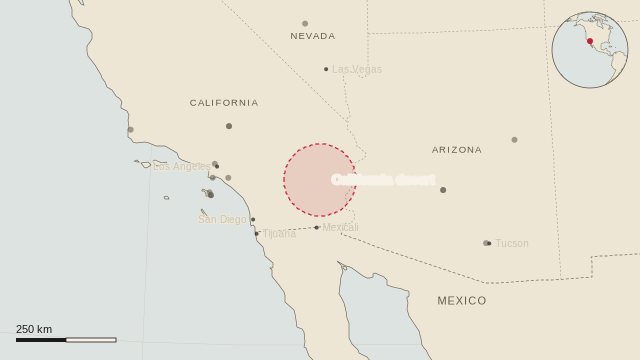
On November 20, 1952, around 12:30 p.m., George Adamski, who worked at the Palomar Gardens cafe, said that in the California desert near Desert Center he talked by gestures with a man who came out of a ship and made him understand he was from Venus. Six companions, half a mile to a mile away, signed months later that they were "a party to, and witnesses to" the event. An FBI memorandum of 1953 records another version by Adamski. The Air Force gave no credence to his statements and the FBI admonished him for saying it had cleared his talks.
Tier B · IndicativeContact accountWhat do they mean? →
Limited evidence: it falls short of what Tier A requires. Any one of these is enough: a single testimony (or several witnesses who saw it together), testimony gathered years later, or an account without contemporary primary documentation.
What it was
82%possible hoax
The most likely explanation.
- 82% possible hoax
- 1% other earthly causes
- 17% no known cause
See the split across the six explanations
Earthly origin (human or natural)83%
No known cause17%
Ordinary cause the sources propose: possible hoax
What happened
George Adamski, born in Poland in 1891 and raised in the U.S. from childhood, worked in 1952 at the Palomar Gardens cafe, at the foot of the Mount Palomar observatory in California. He lectured on philosophy and sold photographs of flying saucers made with his telescope. Harley Marshall, the observatory's acting meteorologist, told the FBI in January 1953 that he had known him since 1943, when he called himself "the Reverend Adamski" and told him he had had a "cult" or colony in Laguna Beach and was interested in metaphysics and astrology.
He considered him more qualified in astrology than in astronomy, had never seen a spaceship and believed him to be an "opportunist." In late August 1952, Mr. and Mrs. Bailey of Winslow, Arizona, came to Palomar Gardens, and then Mr. and Mrs. Williamson of Prescott, as interested in saucers as he was. Adamski writes that he had never heard of them before.
On November 18, Adamski phoned Dr. George Williamson to say he would leave around midnight of the next day for a place near Blythe, California. He left Palomar Gardens around 1 a.m. on Thursday the 20th with Alice K. Wells, owner of Palomar Gardens and operator of the cafe, and Lucy McGinnis, his secretary, who took turns driving because he did not drive on highways. After 8 a.m. they met the Baileys and the Williamsons, who were riding in Alfred Bailey's car. They had breakfast in Blythe, drove back along the highway to Desert Center and took the road to Parker, in Arizona.
According to the book by Adamski, written with Desmond Leslie and published in 1953, the group stopped to eat beside some rocks 10.2 miles (16 km) from Desert Center; that figure came from the odometer of Bailey's car, and Adamski writes that it was the only accurate measurement of the day. Shortly after noon a twin-engine plane passed and, a few minutes later, everyone saw a large silvery cigar-shaped object with no wings. Two pairs of binoculars were passed around among the seven; with them, Williamson said he saw a dark marking on one side, like an emblem. Betty Bailey tried to film it with a rented movie camera but was too excited to set it.
Adamski asked to be driven down the road. Lucy McGinnis, Alfred Bailey and he went down half a mile and drove in over a stony track to about 200 feet (60 m) from the spot he had chosen. There he set up his 6-inch telescope with a camera, and the others went back to the rest, at a distance he estimates at between half a mile and a mile. He asked them to return in an hour, or sooner if he waved his hat. According to his book, less than five minutes later a small ship appeared between two peaks. Adamski says he made seven plates and three photos with a Brownie camera, and saw a man a quarter of a mile (400 m) away beckoning to him from the mouth of a ravine.
Adamski describes the man as about 28 and 5 feet 6 inches (1.68 m), with sandy shoulder-length hair, gray-green eyes and a brown one-piece coverall. He writes that they communicated by gestures and telepathy, with an occasional word of English. According to Adamski, the man indicated that he came from Venus, that his visit was peaceful and that he was concerned about the radioactivity of the bombs; that the small ship had come from a larger one, and that he did not want to be photographed.
As he approached the ship, which looked like a glass bell floating a foot or two off the ground, his right shoulder came under the outer edge of its flange and his arm jerked so hard that he lost feeling in it; he writes that the feeling had returned three months later and that he felt the effects for several weeks. He told the FBI the arm was "momentarily paralyzed." The visitor asked him for a photographic plate and took it away.
After exactly 60 minutes, according to Adamski, he waved his hat. The others walked to the spot, where he says the visitor left three sets of footprints with symbols in the sole. Williamson made plaster casts, one complete set and two partial ones; the two Bettys photographed the prints and Alice Wells sketched them, and Adamski writes that, to his knowledge, none of those photos came out well enough. Williamson says he took several photos of the events. According to the book, Williamson and Bailey went to Phoenix to tell the story to a newspaper. The Phoenix Gazette published it on November 24, 1952, with photos of the four visitors from Arizona.
Keyhoe summarized that article in his 1953 book. According to him, the reporter, Len Welch, told it tongue in cheek. The visitor came down from a round device about 20 feet across, looked about 23 and wore, according to Adamski's friends, a brown jacket, ski pants and reddish-brown shoes. Adamski reportedly saw a boy, or a very beautiful woman, peeping from a porthole, and the ship came from a larger one about 500 miles up. Those details do not match the book, which gives the man's age as about 28, puts him at the mouth of a ravine and does not mention 500 miles. The book says the published report was true except for two points: Adamski is not on the staff of the observatory and does not own the Palomar Gardens business.
On January 12, 1953, OSI (the Air Force's investigations office) agent Hal Landis and FBI agent Robert G. Moore interviewed Adamski at the cafe. The FBI memorandum of January 28 summarizes that Adamski said that on November 20 he had been in the desert with Lucy McGinnis, Alice Wells and his wife Mary, and that he and those with him saw the craft come down to earth. He said a small stairway in the bottom of the craft, which looked like a round disc, opened and a man came down the steps; he believed there were others aboard because the ship was translucent and he could see shadows. The memorandum does not name the Baileys or the Williamsons, and it is the agent's summary, not a transcript. It deals mostly with a security matter involving acquaintances of Adamski, and ends by saying the San Diego FBI considered the case closed.
In March 1953 three sworn statements were signed, reproduced in the book. All three carry the same text, in the singular on those of McGinnis and Wells and in the plural on the third: "We, the undersigned, do solemnly state that we have read the account herein of the personal contact between George Adamski and a man from another world, brought here in his Flying Saucer 'Scout' ship, and that we were a party to, and witnesses to the event as herein recounted."
Lucy McGinnis signed on March 24 before a notary in San Diego, and Alice K. Wells signed before another, also in March. The third, with four signature lines (Alfred Bailey, Betty Bailey, George Williamson and Betty Williamson), was signed on March 6 before a notary in Navajo County, Arizona, who names only three. They came three and a half to four months after the event, and the sheets endorse the account written by Adamski without describing what each person saw.
The FBI and the Air Force dealt with Adamski mostly over his use of their name. Edward Ruppelt, who headed Project Blue Book, the Air Force's project for investigating sightings, writes that in 1953 he went to Palomar and listened to Adamski at the cafe. An FBI memorandum of December 16, 1953 records that the FBI "never investigated Adamski," that a San Diego police lieutenant called him a "crackpot" and that the Los Angeles Better Business Bureau, a private body that monitors business practices, was investigating his book "with a view to branding it a fraud."
Its investigator said that a document with a blue seal and the names of three agents, which Adamski showed as proof that they had cleared him, "looked faked"; the FBI concluded it was a doctored copy of the statement Adamski signed on March 17, 1953. On December 17, FBI and OSI agents admonished him and warned of legal action if he kept saying they had approved his talks.
Where it happened
Why it matters
Six people signed months later that they were "a party to, and witnesses to" Adamski's encounter, but no sheet says what each one saw. Ruppelt writes that Adamski "held the UFO spotlight for some time" and that, after him, "in rapid succession others stepped forward and hesitantly admitted that they too had been contacted." According to the FBI, Adamski claimed he had sold more than 100,000 copies of the book.
The book states that all six watched the encounter from a distance, and reproduces a sketch of the visitor that Wells reportedly made through binoculars; Williamson writes that he and his friends witnessed it. They were at a distance Adamski puts between half a mile and a mile, with two pairs of binoculars among seven. They were from Adamski's circle: Wells was the owner of Palomar Gardens and McGinnis his secretary, the Baileys had known him since late August and the Williamsons since shortly after. The three sheets were signed months later.
No independent analysis of the plaster casts is known. Adamski writes that on December 13 the ship returned the plate holder and that, once developed, it showed an image and a message; no independent examination of that plate is known either. Ruppelt says Adamski and his followers sent the Air Force photos of saucers and that the Wright-Patterson laboratory answered: "they could be genuine, of course, but they also could have been easily faked by a ten year old with a Brownie camera." Of the one picture of the ship from November 20 that Adamski had to show, he writes that it was so out of focus that the ship looked like a desert rock.
The FBI and the Air Force distrusted Adamski, although none of the cited sources calls this encounter a "fraud": they speak of his book, his works and his use of the FBI's name. On December 15, 1953, Lieutenant Robert White, an Air Force press officer at the Pentagon, told the FBI that the Air Force was considering replying that someone, perhaps the Better Business Bureau, should "definitely label Adamski and his works for the fraud they are known to be"; the 1956 memorandum repeats it, attributing it to OSI. The San Diego FBI noted the same day that OSI "lends no credence" to his statements. Marshall believed him to be an "opportunist," and Lieutenant Scott of the San Diego police believed his photos showed a saucer strung on a thin wire.
Ruppelt describes the scene of his visit: Adamski had "the most honest pair of eyes I've ever seen," showed the casts of the footprints and the sworn statements, and nobody in the cafe asked how the weight of a mere man could make such sharp prints in dry, coarse sand. Keyhoe wrote that the Gazette's account "reads like science fiction, and not too good fiction at that." According to Marc Hallet, a critic of Adamski, Alfred Bailey wrote to Jerrold Baker on June 1, 1954 that nobody had been able to see more than he did, that is to say, nothing special, and that, questioned by Moseley, he said he had seen only the cigar and luminous flashes a mile and a half away in Adamski's direction. Hallet also reports what Williamson reportedly told Irma Baker and a radio interview with Wells; all of it secondhand.
Documents and sources
Primary documents
FBI, San Diego memorandum of January 28, 1953 on the interview with Adamski
Memorandum from the FBI's San Diego office to the director, summarizing the interview that an FBI agent and an agent of the OSI, the Air Force's investigative office, held with Adamski on January 12, 1953.
Read more
On page 3 Adamski says that on November 20, 1952, 10.2 miles from Desert Center on the road to Parker, he saw a disc come down and talked by signs with a space man, and he names his wife Mary, Lucy McGinnis and Alice Wells as his companions. These are seven pages of the 398-page file, in grayscale and at reduced resolution.
FBI, George Adamski file, copy on archive.org (george-adamski-final) · Public domain · US Government work · open original
FBI, file on George Adamski (1952-1956)
398-page FBI file on Adamski. It includes the San Diego memorandum of January 28, 1953, summarizing the January 12 interview in which Adamski tells of his November 20 contact; the memorandum of December 16, 1953, recording that the FBI never investigated him and that the Better Business Bureau was examining his book; and the one of July 10, 1956, with OSI's opinion.
Adamski and Leslie, "Flying Saucers Have Landed" (1953)
Book by Adamski and Desmond Leslie. The chapter "The Memorable November Twentieth" tells of the November 20, 1952 encounter in the California desert, and the plates reproduce the three sworn statements of March 1953 and a sketch of the visitor made by Alice Wells.
Documented evidence
- Chapter "The Memorable November Twentieth" of the book by Adamski and Desmond Leslie, "Flying Saucers Have Landed" (1953): Adamski's account, with the time (around 12:30), the place (10.2 miles from Desert Center on the road to Parker), the seven people present and the plates with the sworn statements.
- Three sworn statements of March 1953: McGinnis (March 24, San Diego), Wells (March, San Diego) and the Arizona sheet, with four signature lines (the Baileys and the Williamsons; March 6, Navajo County); they endorse Adamski's account without describing what each person saw.
- FBI San Diego memorandum of January 28, 1953, on the January 12 interview with Adamski: he tells it with his wife Mary, McGinnis and Wells, and with a stairway on the ship; it also carries the opinion of Palomar's acting meteorologist on Adamski and ends with the case closed.
- Phoenix Gazette of November 24, 1952, known from Keyhoe's summary (1953): a visitor of about 23, a mother ship 500 miles up and a boy or a woman at a porthole; it differs from the book.
- FBI memorandum of December 16, 1953: the FBI "never investigated Adamski," a San Diego police lieutenant calls him a "crackpot" and the Better Business Bureau is investigating his book "with a view to branding it a fraud"; a document with a blue seal that he showed "looked faked."
Show 2 more facts
- FBI memoranda of December 16, 1953 and July 10, 1956: an Air Force press officer was considering replying that Adamski and his works should be labeled "for the fraud they are known to be"; the San Diego FBI noted that OSI "lends no credence" to his statements.
- Ruppelt, "The Report on Unidentified Flying Objects" (expanded 1960 edition): his 1953 visit to Adamski's cafe, the laboratories' verdict on the saucer photos his followers sent and his comment on the footprints and the sworn statements.
Sources
- George Adamski and Desmond Leslie, "Flying Saucers Have Landed" (1953), chapter "The Memorable November Twentieth" and plates of the sworn statements — Adamski's account, with the seven people present, the time, the place and the three sworn statements.
- FBI, file on George Adamski (memoranda of September 22, 1952, January 28 and December 16, 1953 and July 10, 1956) — Official documents: his January 1953 interview and the FBI's and OSI's opinion of him.
- Donald Keyhoe, "Flying Saucers From Outer Space" (1953), pp. 157-159 — Summarizes the Phoenix Gazette article of November 24, 1952, which has not been seen.
- Edward J. Ruppelt, "The Report on Unidentified Flying Objects" (expanded 1960 edition), chapters 16 and 19 — The head of Blue Book tells of his 1953 visit to Adamski and the verdict on his photos.
- Marc Hallet, "A Critical Appraisal of George Adamski" (2016) — A critic of Adamski; he cites letters and witness accounts that could not be checked.
Related cases
Cases with the same likely cause.
Possible hoax · Same country · Within 10 years
McMinnville · the Trent disc photographs
1950 · Tier A
Possible hoax · Same country · Within 10 years
Aztec · the alleged crash of a saucer with 16 bodies
1948 · Tier B
Possible hoax · Same country · Within 10 years
Maury Island · a boatman says an object dropped slag
1947 · Tier B
Possible hoax · Same country · Within 10 years
Phoenix · two photos of a gray object circling
1947 · Tier A
Associated actors (1)
