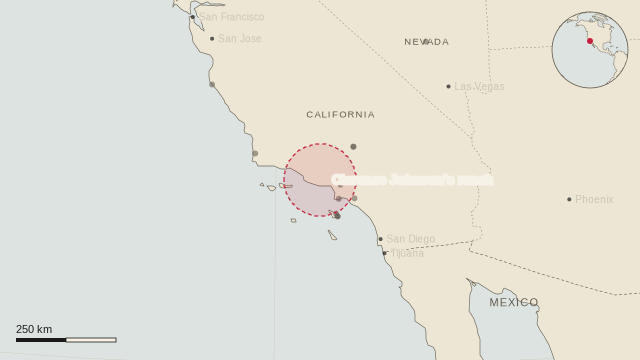
1953·Clarence Johnson's ranch, west of Agoura, California
United States.Agoura · Kelly Johnson and a test-flight crew see a dark object
At dusk on December 16, 1953, Clarence "Kelly" Johnson, Lockheed's chief engineer, saw from his ranch near Agoura, California, a black, elongated object hanging still in the western sky, which then moved off and vanished within about 90 seconds. At the same time, four of the five Lockheed men aboard a test aircraft over the coast saw a dark object to the west that they could not identify either. Their signed statements reached the Air Force; the Blue Book card concludes "lenticular cloud," an idea three of the crew had already rejected in writing.
Tier A · AcceptableWhat do they mean? →
Institutional evidence: several identified independent witnesses, or contemporary official documentation, without an instrumental record to corroborate them.
What it was
45%atmospheric phenomenon
No explanation reaches half.
- 45% atmospheric phenomenon
- 6% other earthly causes
- 49% no known cause
See the split across the six explanations
Earthly origin (human or natural)51%
No known cause49%
Ordinary cause the sources propose: atmospheric
Record of the event
DOW-UAP-D206 — Statements by Kelly Johnson and the Lockheed WV-2 crew, with the Blue Book card
The signed statements of the five Lockheed witnesses to the object of December 16, 1953, with Johnson's sketch and the case's only official evaluation.
Read more
There are 15 pages: the Blue Book card (September 1963 form, conclusion "OTHER: CLOUD / Lenticular Cloud"); the February 15, 1954 letter from Lieutenant General D. L. Putt to Colonel George L. Wertenbaker, commander of the Air Technical Intelligence Center (ATIC); Lockheed's binder and title page, "Sighting of a Flying Saucer by Certain Lockheed Aircraft Corporation Personnel on 16 December 1953"; Johnson's January 20, 1954 cover letter to ATIC (LAC/149536); Johnson's statement of December 18, 1953 (two pages) and his sketch, showing the 1953 ellipse and the blue flame he saw around November 1951; R. L. Thoren's memo of December 17 (two pages); and the statements of Roy Wimmer (January 12, 1954), P. A. Colman (January 11) and J. F. Ware Jr. (January 11, two pages plus the back of the last one). The margins carry pencil notes by an unidentified reader: next to Thoren's memo, a reckoning that the plane covered 18 miles in 5 minutes; under Johnson's statement, "moving directly away"; next to the mention of Giant Rock, "Van Tassel"; next to Johnson's heading, "Any cross motion — or all away?"; next to the 1951 flame, "how many seconds." On the back of Ware's statement, in pencil, are "Needed a fix" and a drawing of a plane with a dashed line toward an X. The map on which Ware marked the positions, cited in the cover letter, is not in this copy.
U.S. Air Force, Project Blue Book; Lockheed Aircraft Corporation (PURSUE Release 08) · Public domain · US Government work · open original
What happened
Clarence L. Johnson, whom his colleagues called Kelly, had been chief engineer since 1952 at Lockheed, the aircraft maker in Burbank, California. He had designed the P-38 fighter and would later be behind the U-2 spy plane and the SR-71. On Wednesday, December 16, 1953, he and his wife, Althea, drove out to their ranch, about three miles west of Agoura and a mile north of Ventura Boulevard. According to his statement, they arrived around sundown, close to 4:45 p.m. Pacific time, and went into the house, which sits on a hill facing southwest.
At about 5:00 p.m., give or take two minutes, Johnson was watching the sunset through a large plate-glass window when he noticed, above a mountain to the west, what he first took for a black cloud. The sun had set and the western sky was gold and red, with several thin layers of cloud or haze fairly high up. He wondered why this one thing was so dark. He thought of an aircraft's smoke trail, but the outline did not change; he then thought of a lenticular cloud, the motionless lens-shaped cloud that forms downwind of mountains. He kept watching, and for three minutes it did not move.
Johnson asked his wife for their eight-power binoculars and ran outside. By the time he had them focused, the object was already moving fast to the west-southwest, on a heading between 240 and 260 degrees, and passing behind the first layer of haze. From how quickly its long axis shortened, Johnson judged it was going very fast. Even through the binoculars it looked black and sharp, with no detail, because he was looking toward the setting sun. Within 90 seconds of starting to move it had vanished in a long, shallow climb. According to his statement, he and his wife studied the object between 5:00 and 5:05 p.m. The clouds, he noted, were coming onshore in the opposite direction to the object.
Johnson always saw it as an ellipse seven to ten times longer than it was high, and he drew it that way in a sketch dated December 18. He could not estimate its size, because he did not know how far away it was, but he placed it roughly over Point Mugu, a headland on the coast lying about 255 degrees from his ranch.
At that same hour a Navy WV-2 Super Constellation that Lockheed was testing was flying over the coast. According to a memo by Rudy Thoren, Lockheed's chief flight test engineer, it took off at 4:29 p.m. with test pilot Roy Wimmer at the controls, Thoren as copilot, Charlie Grugan as flight engineer and Joe Ware as flight test engineer. Thoren left Phil Colman, Lockheed's chief aerodynamics engineer, off that list, but Colman wrote in his own statement that he was also in the cockpit, and Ware says the same. Grugan, the flight engineer, is the only one of the five who left no statement. After a test at 10,000 feet, Wimmer handed the controls to Thoren, who kept climbing toward 20,000 and, at around 14,000, passed through a thin, scattered cloud layer.
Somewhere between 15,000 and 20,000 feet, Wimmer saw, above a cloud layer to the west, something he took for a small cloud. He remembered saying as a joke, "Hey, look at the flying saucer!"; Thoren remembered it as "Look out, there's a flying saucer." Thoren turned slightly toward the object, which seemed to be at the plane's altitude, and held that heading for about five minutes. They did not close on it, even though they were flying at some 225 miles per hour.
Each man described it in his own way. Thoren saw something like a huge flying-wing airplane, with sharp edges and an unchanging look, which is why he stopped thinking it was a cloud. To Wimmer it was a crescent, and to Colman a thin black line that at first reminded him of a B-36 bomber seen head-on. Ware, who first took it for a large transport plane, described a wingless object, thickest in the middle. Thoren and Colman saw it as black, silhouetted against the glowing sunset sky.
Then the object began to shrink. According to Thoren, in about a minute it dwindled to a speck and disappeared almost due west. Wimmer, who kept it in sight throughout, wrote that it was moving away to the west, that it took roughly a minute to disappear and that it kept its sharp outline to the end. Ware put it at one or two minutes. Colman, who saw it hold still for about ten minutes, said it suddenly accelerated due west and was gone in about ten seconds. The flight record showed the plane reaching 20,000 feet at 5:10 p.m., and Thoren worked out from that that the sighting began at about 5:00 or a little earlier. They landed after 6:00.
The crew did not agree on where the plane was. Thoren wrote that they were over the ocean just off Long Beach, and Colman, off Santa Monica. Ware placed them over the Catalina Channel, between Avalon and the Palos Verdes hills, at 15,000 to 16,000 feet. All of them put the object to the west, over the sea: off Point Mugu according to Colman, toward the Channel Islands according to Thoren and Ware. Ware marked the two positions he estimated on a map, and Johnson mentioned that map in his cover letter, but it is not in either of the two published copies of the file.
On the morning of the 17th, Johnson returned to the office after a week away. Thoren went to brief him, and Jack Wassall, the assistant chief engineer, and Carl Haddon, the chief project engineer, sat in. According to Thoren, he mentioned casually, for fear of ridicule, that he had been chasing a flying saucer the evening before, and Johnson immediately told him it had been at 5:05, the end of the window he gave in his statement, and off Point Mugu. Johnson wrote that he broke in on purpose, before Thoren could give the time and place, to check whether they had seen the same thing. Thoren, who had placed the object between Point Mugu and the islands, said this bowled him over.
Thoren dated his memo December 17 and Johnson his statement December 18, addressing it to an "Air Force Investigating Group on Flying Saucers." Colman and Ware wrote theirs on January 11, 1954, and Wimmer on the 12th. On January 20, Johnson signed a cover letter sending all five to the commander of the Air Technical Intelligence Center (ATIC), at Wright-Patterson Air Force Base, Ohio, through the Air Force representative at the plant. He asked for comments and noted that the matter had not been released to the press.
The file holds a second version of how the reports were sent. On February 15, 1954, Lieutenant General Donald L. Putt, head of the Air Research and Development Command, forwarded the report to Colonel George L. Wertenbaker, the commander of ATIC. He wrote that Lockheed personnel had handed it to him, and that Johnson had been most reluctant to write it and then refused to send it on, because people who claim to have seen flying saucers are not usually considered "logical and practical hard-headed engineers." The two versions contradict each other: Putt writes that Johnson refused to send the report, yet Johnson's January 20 letter, in the same file, is addressed to ATIC.
Where it happened
Why it matters
The case brings together two independent groups of identified, professionally trained witnesses who saw something at the same time from different places: an aeronautical engineer on the ground, with binoculars, and a test crew in flight, tens of kilometers away. Johnson checked the match before hearing the crew's account, and the first two accounts were written one and two days later. The rest took almost a month, and across all the accounts the durations and the plane's position do not agree.
The only official evaluation in the file is the card from Project Blue Book, the Air Force program that studied UFOs: "OTHER: CLOUD / Lenticular Cloud." It is on a form whose edition dates from September 1963, so it was filled in no earlier than September 1963, almost ten years after the event. It sums up the case in Johnson's words, an object that first looked like a "black stationary cloud" and then moved fast "in long shallow climb," and gives no analysis. The U.S. Department of War (the name the Department of Defense has used since 2025) released the file in 2026 through PURSUE, its program for publishing files on anomalous phenomena, under the title "Unresolved UAP Report," although the card gives a cause.
The witnesses had argued over that idea before anyone else. Johnson considered a lenticular cloud, but dropped the idea when three minutes passed without the object moving or breaking up; then he watched it move off against the direction of the clouds. Wimmer first took it for a small cloud and ruled that out because it kept its outline until it vanished, and Thoren did so because of its sharp edges and unchanging look. Colman ruled it out because, in his view, the difference in position between the ranch and the plane showed an object with a depth a cloud would not have. These are witnesses' judgments, not measurements: no one measured how far away the object was.
The most detailed study is by the British researcher Martin Shough, from 2014. By crossing the bearing seen from the ranch with the plane's reconstructed route, he places the object at about 17,000 feet, roughly over Anacapa Island, some 62 km from the Johnsons. For Shough, the only conventional explanation with even a little plausibility is an unusually compact, well-defined lenticular cloud, but he judges it unlikely under the weather conditions he could reconstruct, and because such a cloud would not shrink while keeping its shape and outline. He concludes that it all comes down to weighing competing unlikelihoods.
Some of the witnesses did not come to it fresh. Johnson wrote that for at least five years he had believed flying saucers might exist, and that around November 1951 he and his wife had seen at night a blue flame cross silently west of Brents Junction. Ware said he had seen a large circular object over a Christmas holiday (1951 or 1952: the figure is blurred in the copy), and his colleagues teased Wimmer about some lights he had seen over Catalina two years earlier. Thoren, by contrast, called himself very skeptical. Johnson ended his statement by saying that December 16 had left him more convinced than ever that such craft existed.
Documents and sources
Documented evidence
- Statement by Clarence L. Johnson, chief engineer of Lockheed's California Division, dated December 18, 1953 and addressed to the "Air Force Investigating Group on Flying Saucers": at about 5:00 p.m. on December 16 he saw from his ranch west of Agoura a black object that hung still for about three minutes; through eight-power binoculars he watched it move off on a heading of 240 to 260 degrees and vanish within 90 seconds; he placed it over Point Mugu, at about 255 degrees; he wrote that he and his wife watched it between 5:00 and 5:05 p.m.
- Johnson's sketch dated December 18, 1953: an ellipse with the ratio "7:1 to 10:1," labeled "Saucer seen Dec. 16, 1953," and a blue flame he saw around November 1951
- Memo by R. L. Thoren, chief flight test engineer, of December 17, 1953: the WV-2 took off at 4:29 p.m.; between 15,000 and 20,000 feet the crew saw an object at their altitude for at least five minutes, without closing on it at some 225 miles per hour; in about a minute it dwindled to a speck and disappeared almost due west; he first guessed it was some seven miles away, then thought it much farther; the plane reached 20,000 feet at 5:10 p.m.
- Statements by P. A. Colman, chief aerodynamics engineer (January 11, 1954), J. F. Ware Jr., flight test section supervisor (January 11), and Roy Wimmer, test pilot (January 12): the object, to the west and over the sea, held still for five to ten minutes depending on the witness and disappeared to the west over a span ranging from about ten seconds (Colman) to one or two minutes (Ware); Wimmer, who said he was practiced at judging distances, put it at least 50 or 60 miles away Wimmer places the turn west "in the vicinity of Long Beach or Santa Ana."
- Johnson's letter to the commander of the Air Technical Intelligence Center (ATIC), dated January 20, 1954 (LAC/149536), enclosing four copies of each statement and a map; it asks for comments and says the matter had not been released to the press
Show 2 more facts
- Letter from Lieutenant General D. L. Putt to Colonel George L. Wertenbaker, commander of ATIC, dated February 15, 1954: Lockheed personnel handed him the report, and Johnson had been reluctant to write it and refused to send it on
- Project Blue Book card, on a form of the September 1963 edition: December 16, 1953, 5:00 p.m. local time, Agoura; one object, ground and air visual observation lasting 5 to 7 minutes; conclusion "OTHER: CLOUD / Lenticular Cloud"
Sources
- war.gov/UFO — DOW-UAP-D206, "Unresolved UAP Report, California, 1953" (PURSUE Release 08) — 15-page primary document, embedded in the viewer: the signed statements of Johnson, Thoren, Wimmer, Colman and Ware, Johnson's sketch, the cover letters from Johnson and Putt, and the Blue Book card.
- Project Blue Book — file 1953-12-6779005, Agoura, California (archive.org) — Copy of the Blue Book microfilm, 12 pages: the same documents with the names blacked out; it lacks Lockheed's binder, the second page of Johnson's statement and the back of Ware's, and it does not include the map either.
- Martin Shough, "A Study of the Lockheed Sightings" (Project 1947, July 2014) — Secondary source: it reconstructs the plane's route and triangulates the object at about 17,000 feet, near Anacapa Island; it considers a lenticular cloud the only conventional explanation with some plausibility, but unlikely.
- Ben R. Rich, "Clarence Leonard (Kelly) Johnson," Biographical Memoirs, vol. 67 (National Academy of Sciences, 1995) — Secondary context source: Johnson was Lockheed's chief engineer from 1952; he designed the P-38 and led the U-2 and SR-71; his first wife was Althea Louise Young.
- Wikipedia — "Donald L. Putt" (secondary source) — Secondary context source: Putt took command of Air Research and Development Command on June 30, 1953, and in April 1954 became deputy chief of staff for Development.
Referenced by 1 case
Related cases
Cases with the same likely cause.
Atmospheric · Same country · Within 10 years
Levelland · drivers see a light as their engines stall
1957 · Tier A
Atmospheric · Same country
Val Johnson · a light rushes at his patrol car
1979 · Tier A
Atmospheric · Same country
Colorado Springs · five soldiers see an object hanging in the sky
2022 · Tier B
Natural phenomenon · Same country · Within 10 years
Washington · radar and pilots spot objects over the capital
1952 · Tier S