2013·Chelyabinsk, Russia
Russia.Chelyabinsk Meteor
On 15 February 2013, a meteoroid about 20 metres across entered the atmosphere over Chelyabinsk (Russia) and exploded at ~30 km altitude with an energy of about 500 kilotons of TNT, on the order of 30 Hiroshima bombs. The shock wave broke windows in six cities and injured some 1,500 people. It was the first impact of that magnitude documented massively on video (dashcams).
Tier S · SolidWhat do they mean? →
Strong evidence: a contemporary instrumental record (radar, sensor, film or photo of known provenance) that corroborates several independent witnesses.
What it was
96%natural or human cause
Most likely explanation: meteor or fireball
See the split across the six explanations
Natural or human cause
No known cause
Primary documents
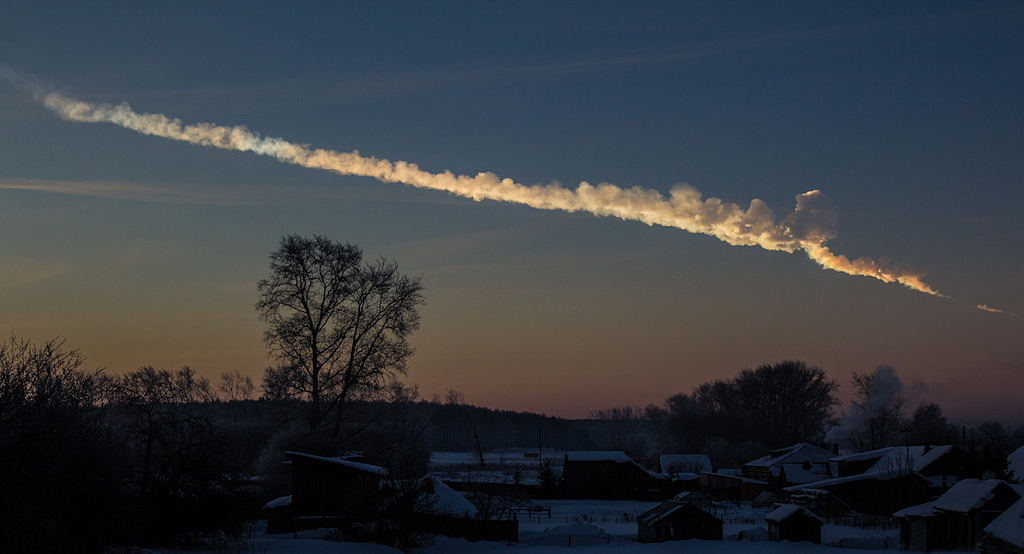
Chelyabinsk meteor · vapour trail after atmospheric entry (15 Feb 2013)
Wikimedia Commons · Alex Alishevskikh (CC BY-SA 2.0) · CC BY-SA 2.0 · open original
The night in question
On the morning of 15 February 2013, shortly after dawn, an extraordinarily bright object crossed the sky over Chelyabinsk Oblast, in the Russian Urals, leaving a long smoke trail. It was a meteoroid roughly 20 metres in diameter that entered Earth's atmosphere at about 19 kilometres per second. At an altitude near 30 kilometres above the surface, the enormous pressure and heat made it explode in an airburst (an explosion in the air) releasing energy estimated at about 500 kilotons of TNT (570 ± 150 kilotons from Russian and Kazakh infrasound data), on the order of 30 times that of the Hiroshima atomic bomb. The reference study (Popova and colleagues, Science, 2013) puts the entry at 19.16 km/s at 18.3° above the horizon, the diameter at 19.8 ± 4.6 metres and peak brightness at 29.7 km altitude, at 03:20:32 UTC.
Unlike a direct ground impact, the high-altitude blast projected a very powerful shock wave that took a few minutes to reach the ground. That wave broke windows and knocked down parts of buildings in six Russian cities; more than 7,300 buildings were affected. Some 1,500 people (by some sources 1,613) sought medical attention, the great majority for cuts from glass shattered as they leaned toward windows after seeing the flash; 112 were hospitalized, two in serious condition. There were no fatalities, largely because of the height of the blast.
It was the first impact of this magnitude recorded massively on video: dozens of dash-cams, very common in Russia, plus security and traffic cameras captured the entry and the blast from multiple angles. Researchers calibrated that footage by taking star-background photographs at the same sites and derived from it the trajectory, the pre-atmospheric orbit and a light curve peaking at magnitude –27.3, accurately reconstructing the blast altitude and the energy deposition; in the city of Chelyabinsk alone, 3,613 apartment buildings (about 44%) had shattered glass. Meteorite fragments were recovered on the ground, including a large one extracted from the bottom of Lake Chebarkul. Analysis confirmed it was an ordinary chondritic asteroid, unrelated to any satellite or rocket and without prior warning, since its orbit had brought it from the direction of the Sun, hidden from astronomical tracking.
Why it matters
Chelyabinsk is resolved: a spectacular aerial event (a flash brighter than the Sun, an explosion of hundreds of kilotons, shock waves that injured fifteen hundred people) with a complete, quantitative natural explanation reconstructed from abundant physical and video evidence. It is a counterexample to the temptation to read every extraordinary aerial phenomenon as anomalous: here science recovered the fragments, computed the orbit and closed the case.
It serves two purposes. First, it calibrates magnitude: it shows what a natural 20-metre object looks like in the sky and on sensors, a pattern against which to contrast reports of unexplained 'fireballs' or 'explosions'. Second, it illustrates a real safety point: Chelyabinsk arrived without warning from the direction of the Sun, a blind angle for telescopes, which revised upward the estimated risk of impacts of that size. Chelyabinsk is the reminder that the sky occasionally produces genuinely apocalyptic spectacles that are, nonetheless, perfectly natural.
What's left on paper
Documented evidence
- Dozens of dash-cam and security/traffic camera videos of the entry and blast (15 Feb 2013)
- Scientific reconstruction of the trajectory and airburst altitude (~30 km) from calibrated videos (Popova and colleagues, 2013)
- Energy estimated at about 500 kilotons of TNT (on the order of 30 Hiroshima bombs); meteoroid 19.8 ± 4.6 m at 19.16 km/s
- ~1,500 injured (mostly from glass) and 7,300+ buildings affected in six cities
- Recovered meteorite fragments, including a large one extracted from Lake Chebarkul
- Analysis confirming an ordinary chondritic asteroid, arriving from the direction of the Sun without warning
Sources
- Wikipedia — Chelyabinsk meteor
- EarthSky — 'Chelyabinsk meteor: February 15, 2013'
- Popova et al. — 'Chelyabinsk Airburst, Damage Assessment, Meteorite Recovery, and Characterization' (Science, 2013)
- Popova, O. P. et al. — «Chelyabinsk Airburst, Damage Assessment, Meteorite Recovery, and Characterization», Science 342 (2013), manuscrito (CAMS/SETI) — Primary study: speed, angle, diameter, peak altitude, energy (~500 kt), damage and LL5 classification.
Related cases