1908·Podkamennaya Tunguska River, Siberia
Russia (Russian Empire).Tunguska Event
On 30 June 1908, a colossal explosion in the air over the Tunguska River, in remote Siberia, flattened some 80 million trees across about 2,000 km² without leaving a crater. The scientific consensus attributes it to the atmospheric burst of a small asteroid or comet. Decades later, a 1946 Soviet novel popularized the idea of an extraterrestrial craft, which science discarded.
Tier S · SolidWhat do they mean? →
Strong evidence: a contemporary instrumental record (radar, sensor, film or photo of known provenance) that corroborates several independent witnesses.
What it was
90%natural or human cause
Most likely explanation: meteor or fireball
See the split across the six explanations
Natural or human cause
No known cause
Primary documents
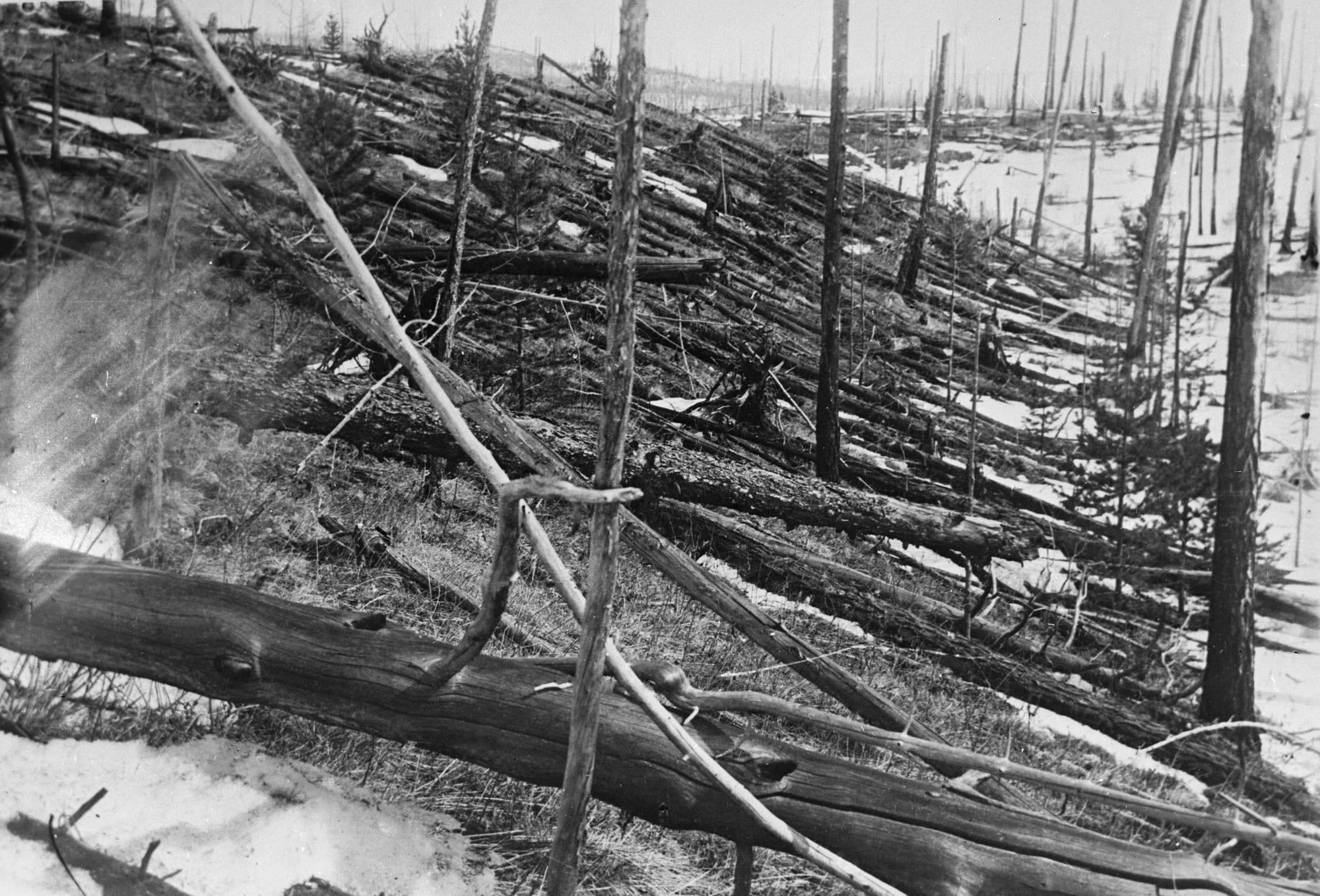
Flattened trees at Tunguska · photograph from Leonid Kulik's expedition
Expedición Kulik (1927-1938) vía Wikimedia Commons · Public domain · open original
The night in question
On the morning of 30 June 1908, over the basin of the Podkamennaya Tunguska River, in an almost uninhabited region of central Siberia, the largest explosion of cosmic origin recorded in history occurred. Distant witnesses described a column of bluish light nearly as bright as the Sun, followed by a flash, a wave of heat and a series of detonations heard hundreds of kilometres away. The shock wave flattened around 80 million trees across some 2,000 square kilometres, arranging them radially around an epicenter. Curiously, at the very center some trees were left standing but stripped of branches and bark (the so-called 'telegraph pole forest') a pattern indicating the force came from above, almost vertically.
The remoteness and the political chaos of early-20th-century Russia delayed scientific expeditions. The first major one, led by Leonid Kulik, did not reach the area until 1927. In his report to the Academy of Sciences, Kulik described the flattened forest lying "in generally parallel rows", tops pointing away from the centre, standing trunks stripped of branches and bark, and traces of a "uniform and continuous burning" over an area several tens of kilometres across. He took the central basin for "a huge crater" and noted dozens of fresh "craterlets", from several metres to tens of metres across, which he proposed to excavate; he also collected the testimony of residents of the Vanovara trading post, some hundred kilometres away: S. B. Semenov said a sudden heat almost burned the shirt off him and the explosion threw him off his porch, and P. P. Kossolapov that something scorched his ears and the blast broke a window pane and tore off the stove door. But he found no meteorite, and no macroscopic fragment of the object has ever been recovered, nor an impact crater confirmed. That absence fed the mystery for decades and a range of exotic hypotheses.
The modern scientific consensus is, however, solid: the event was an airburst, the explosive disintegration of a cosmic body (a small stony asteroid, some tens of metres across, or a cometary fragment) at an altitude of between 5 and 10 kilometres. The high-altitude explosion explains both the massive devastation and the lack of a crater, as well as the telegraph-pole forest pattern. The presence of material rich in elements typical of rocky asteroids supports the asteroid hypothesis, while the noctilucent clouds observed over Europe after the event have been used as an argument for a water-rich comet. The non-human reading (the idea that it was the explosion of a Martian craft's nuclear engine) did not arise from the research, but from a 1946 science-fiction story by the Soviet writer Alexander Kazantsev; a few years later, scientific support for the airburst theory limited that speculation, which today survives only as a historical curiosity of UFO folklore.
Why it matters
Tunguska matters as the historical case that most clearly illustrates how an absence (the lack of a crater) can generate decades of exotic speculation about a phenomenon that, properly understood, is entirely natural. Its value is methodological and pedagogical: it shows that an apparently anomalous feature (massive devastation with no impact point) has a precise physical explanation (an airburst) that initial common sense did not anticipate, and that the extraterrestrial-craft hypothesis arose from no field datum but from a work of fiction that popular culture turned into a 'theory'.
The scale is what makes the missing crater striking: about 80 million trees flattened across some 2,000 square kilometres, in a radial pattern around a single epicentre. The airburst of a small asteroid or comet explains all the observed features: the flash, the detonations, the radial pattern of fallen trees and the central pole forest. What remains open is the genuine (and bounded) scientific discussion about the exact nature of the body (stony asteroid versus cometary fragment) and the fact that no main meteorite was recovered. Tunguska is the anchor that teaches that 'unexplained at the time' is not 'inexplicable', and that the largest cosmic impact in documented history is also one of its best-resolved cases.
What's left on paper
Documented evidence
- ~80 million trees flattened across ~2,000 km² in a radial pattern (30 Jun 1908)
- Central 'telegraph pole forest': trees left standing without branches, indicating force from above (airburst)
- Testimony of a flash nearly as bright as the Sun and detonations audible hundreds of km away
- Instrumental records from the time: the seismographs at Irkutsk, Saint Petersburg and Jena recorded the ground shaking, meteorological stations in Russia and Britain detected pressure fluctuations over about 20 minutes, and the University of Coimbra's Milne seismograph shows, on that week's roll, an oscillation of about 13 minutes that the 1908 technicians did not notice (Lopes, Gomes and Ribeiro, 2025)
- Leonid Kulik's expedition (1927): forest felled in a fan, burn traces and Vanovara testimony; he described "craterlets", but found no meteorite, and no macroscopic fragment has ever been recovered nor a crater confirmed
Show 2 more items
- Material with elements typical of rocky asteroids; noctilucent clouds over Europe after the event (cometary argument)
- Origin of the 'UFO' hypothesis: science-fiction story by Alexander Kazantsev (1946), not field data
Sources
- Wikipedia — Tunguska event
- Scientific American — 'The Tunguska Mystery, 100 Years Later'
- Space.com — 'Russian Alien Spaceship Claims Raise Eyebrows, Skepticism' (origen Kazantsev)
- L. Kulik, «On the Fall of the Podkamennaya Tunguska Meteorite in 1908» (Doklady de la Academia de Ciencias, 1927), trad. de L. La Paz y G. Wiens, Popular Astronomy 43(9), noviembre 1935, pp. 596-599 — Primary source: report of the 1927 expedition, describing the felled forest, the burn traces, the «craterlets» and the testimony of Semenov and Kossolapov.
- F. C. Lopes, A. I. Gomes y P. Ribeiro, «Registo instrumental dos efeitos físicos do Evento de Tunguska no Observatório Geofísico e Astronómico da Universidade de Coimbra», Comunicações Geológicas 112, Especial I (2025), pp. 479-482 (LNEG) — Summarises the 1908 seismic (Irkutsk, Saint Petersburg, Jena) and barometric (Russia and Britain) records and identifies the oscillation on the Coimbra seismogram; the magnetic disturbance does not appear at Coimbra.
Related cases