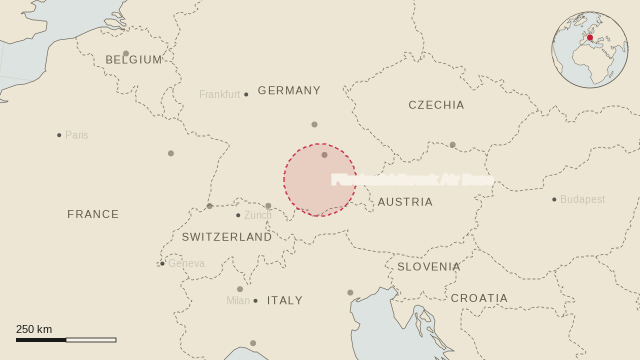
1948·Fürstenfeldbruck Air Base, west of Munich, Bavaria
Germany.Fürstenfeldbruck · two pilots see a reddish light over Munich
At 10:20 p.m. on November 23, 1948, a U.S. Air Force fighter pilot, with another pilot beside him, saw from Fürstenfeldbruck Air Base, west of Munich, a light like a reddish star crossing Munich toward the south. Alerted by phone, the Racecard radar station reported an object at 27,000 ft and then at 40,000 ft, circling south of the city. The 1949 reviews disagreed: the Air Force's weather service thought a balloon unlikely, while an unsigned evaluation filed with astronomer J. Allen Hynek's index called one possible.
Tier B · IndicativeWhat do they mean? →
Limited evidence: it falls short of what Tier A requires. Any one of these is enough: a single testimony (or several witnesses who saw it together), testimony gathered years later, or an account without contemporary primary documentation.
What it was
44%balloon
No explanation reaches half.
- 44% balloon
- 10% other earthly causes
- 46% no known cause
See the split across the six explanations
Earthly origin (human or natural)54%
No known cause46%
Ordinary cause the sources propose: balloon
What happened
On the night of November 23, 1948, at 10:20 p.m. local time, a captain of the U.S. Air Force's 23rd Fighter Squadron, a pilot of the F-80 jet fighter, saw from the ground an object in the sky directly east of Fürstenfeldbruck Air Base, in Bavaria, west of Munich. The base belonged to the 36th Fighter Wing, in Allied-occupied Germany. According to the base's report, the object "looked like a reddish star" and was moving south across Munich, turning slightly to the southwest and then to the southeast. Its altitude was unknown. Its speed could have been 200 to 500 mph, though, according to the captain, the actual speed could not be estimated.
With him was another captain of the same squadron, also an F-80 pilot, who later confirmed the facts. Both names are blacked out in the released copy. The first captain phoned Base Operations from his barracks, and Base Operations alerted the direction-finding station with the call sign Racecard, which had a radar scope. Racecard answered that it had nothing on the scope but would look. It then called Base Operations to report an unidentified object at 27,000 ft, about 30 miles south of Munich. Later it called the captain at his barracks: the object was climbing, was believed to be at 40,000 ft by then, about 40 miles south of Munich, and was circling. The base's report does not give the times of those calls.
According to the base, the sky was clear with the moon shining, no cloud layers, 3 miles' visibility because of ground fog, and winds aloft from the north at 56 knots (about 64 mph), at an altitude the report does not give. No F-80s were flying that night. The incident summary sheet records "1 possibly 2" objects, a detail the report's narrative leaves out, and gives the "estimated" altitude as 27,000 to 40,000 ft, the two radar figures.
On December 8, fifteen days later, Captain L. H. McCormack of the 36th Fighter Wing's Wing Intelligence Office sent the report to the Air Materiel Command at Wright-Patterson Air Force Base, Ohio, home of the Air Force project that studied UFOs, then called Sign. He wrote it from information given to him by the 36th Fighter Group's intelligence officer, a lieutenant whose name is also blacked out. He called the lieutenant and the first captain "completely reliable observers and reporters" and closed by saying that later investigation had turned up nothing further and that more information was unlikely.
In 1949, with the project renamed Grudge, the case went through two reviews. The Air Force's Air Weather Service checked incidents 173 through 233 against routine weather-balloon launches by the Air Force, the Navy and the Weather Bureau, and sent its comments with a letter dated May 11. On No. 222 it noted that it had no winds-aloft charts, that the object was seen two and a half hours after the scheduled release of a weather balloon, the same time the radar station placed it at 27,000 ft, and that shortly afterward the station had it circling at 40,000. It gave the 200 to 500 mph speed as an estimate, without the captain's caveat, and concluded: "Most likely not a balloon."
Astronomer J. Allen Hynek of Ohio State University reviewed the same incidents for the project. An unsigned evaluation of incident 222, kept in the same file as his index, says that the maneuvers described, if correct, and the time the object stayed in sight, long enough to call others, "argue strongly against an astronomical interpretation," and adds: "The object might have been a balloon with a light on it." Hynek's index places No. 222 among the cases of balloons or ordinary aircraft. A later summary card from the Air Technical Intelligence Center records the altitude as "27,000' (Radar)," the course as "S to SW," a single object, and a faded handwritten note that can be read either as "Prob Balloon" (probably a balloon) or as "not Balloon."
Where it happened
Why it matters
The case brings together two military pilots who see a light and a radar station that, alerted by phone, finds something in the same region. But the file holds no radar record, and what Racecard said reaches it third-hand: the station called Base Operations and the captain, and McCormack wrote fifteen days later from what the group's intelligence officer told him. No document in the file says what radar it was or whether what it tracked was the pilots' light: they saw the light cross Munich, while the radar placed its object 30 miles south of the city. Only a telegram from the base links the radar's object to the pilots' light, one that is not in the file: Edward Ruppelt, who later headed Project Blue Book, quoted it in his 1956 book, and in it the captain reported that the object he saw was by then in that area.
In its May 1949 letter, the Air Weather Service recommended changing the Air Force's investigation guide so that reports would separate vertical from horizontal motion and state what type of radar was used. The letter deals with incidents 173 through 233 as a group, not with this one in particular, but the Fürstenfeldbruck report does not say what radar it was.
The two 1949 readings contradict each other. The weather service, without wind data, thought a balloon unlikely because of the altitude and circling the radar reported; the unsigned evaluation thought one possible, and the index classed the case among balloons or ordinary aircraft. The base's report holds a fact that neither note mentions: the winds aloft blew from the north toward the south, the course the light took.
That fact does not settle the case. A balloon would have drifted south at the speed of the wind, about 64 mph, not at the 200 to 500 mph given in the base's report, though the captain himself said the actual speed could not be estimated. The telegram Ruppelt quotes does not fit a balloon either: it gives the radar's object a speed of 900 mph and a climb from 27,000 to 50,000 ft within minutes, figures that the base's report, written fifteen days later, leaves out; that report gives 40,000 ft and no radar speed. Checking against balloon launches, the service had found a weather balloon possible in incident 172, a pilot's chase of a light over Fargo, North Dakota (↗ Gorman dogfight); in this one it judged a balloon unlikely.
There also remain the "1 possibly 2" note on the summary sheet, which no other page of the file explains, and the trust the report places in witnesses whose names are blacked out. With what has been released, the case does not allow a choice between a lighted balloon and an unidentified object.
Documents and sources
Primary documents
Blue Book file on incident 222 (Fürstenfeldbruck, 1948), 9 pp., with the base's report and the 1949 reviews
The Air Force's complete file on the light two pilots saw over Munich on November 23, 1948. It opens with a later Air Technical Intelligence Center card and the unsigned evaluation that proposes a balloon with a light; then come the Air Weather Service's comment and letter (May 11, 1949), the incident narrative and summary sheet, Captain L. H. McCormack's report (December 8, 1948, two pages) and the index of Hynek's evaluations extracted from the Project Grudge report. The witnesses' names are blacked out.
Project Blue Book (NARA), via archive.org · Public domain · US Government work · open original
Documented evidence
- "Unidentified Object" report by Captain L. H. McCormack, Wing Intelligence Office, 36th Fighter Wing, Fürstenfeldbruck Air Base (December 8, 1948), written from information given by the 36th Fighter Group's intelligence officer: at 10:20 p.m. on November 23, a 23rd Fighter Squadron captain saw from the ground an object "like a reddish star" moving south across Munich; another captain of the squadron, who was with him, confirmed the facts
- The same report: the Racecard station first said it had nothing on the scope, then reported an object at 27,000 ft about 30 miles south of Munich, and later that it was climbing, at about 40,000 ft and some 40 miles south, circling; no F-80s were flying that night
- Summary sheet for incident 222: "1 possibly 2" objects, color "like reddish star," estimated altitude 27,000 to 40,000 ft, speed 200 to 500 mph, and winds aloft of 56 knots
- Air Weather Service letter to the Air Materiel Command (May 11, 1949), signed by Lieutenant Colonel W. A. West: incidents 173 through 233 were checked against routine balloon launches; its comment on No. 222 says the winds-aloft charts were missing and concludes "Most likely not a balloon"
- Unsigned evaluation of incident 222 and the index of J. Allen Hynek's evaluations extracted from the Project Grudge report: the maneuvers described weigh against an astronomical explanation, the object "might have been a balloon with a light on it," and the case is listed among balloons or ordinary aircraft
Show 2 more facts
- Later Air Technical Intelligence Center card: source "USAF Capt, (F-80 Pilot)," altitude "27,000' (Radar)," course "S to SW," one object, and a faded handwritten note that can be read as "Prob Balloon" or as "not Balloon"
- Edward Ruppelt, who later headed Project Blue Book, quotes in his 1956 book a telegram from the base that is not in the file: 10:00 p.m., a speed of 200 to 600 mph, a radar target at 27,000 ft moving at 900 mph that then climbed to 50,000 ft, and the captain saying the object he saw was by then in that area
Sources
- Project Blue Book (NARA), incident 222 file: Fürstenfeldbruck, Germany, November 23, 1948, 9 pp., copy at archive.org — Primary source. PDF p. 1: Air Technical Intelligence Center card; p. 2: unsigned evaluation; p. 3: Air Weather Service comment; p. 4: its letter of May 11, 1949; pp. 5 and 6: incident narrative and summary sheet; pp. 7 and 8: McCormack's report of December 8, 1948; p. 9: index of Hynek's evaluations. The names of the witnesses and of the lieutenant are blacked out.
- Project Grudge, "Unidentified Flying Objects" (August 1949), part 8, copy at archive.org — Its Air Weather Service appendix contains the same comment on No. 222 as the Blue Book file (search for "No. 222").
- Project Grudge, "Unidentified Flying Objects" (August 1949), part 1, copy at archive.org — Introduces Hynek as an Ohio State University astronomer, summarizes his study and that of the Air Weather Service, which checked each incident against weather-balloon launches, and records the project's change of name from Sign to Grudge.
- Edward J. Ruppelt, "The Report on Unidentified Flying Objects" (1956), chapter 3, on Wikisource — Published account of the case. It transcribes a telegram sent from Germany in late November 1948 that is not in the Blue Book file, with figures that differ from the base's report (10:00 p.m., 900 mph, 50,000 ft). It gives the Air Weather Service's answer as "not a balloon," without the file's "Most likely."
Related cases
Cases this case cites and cases with the same likely cause.
Cited in this case · Within 10 years
Gorman dogfight · a pilot chases a light for 27 minutes
1948 · Tier A
Balloon · Within 10 years
Mantell incident · a fighter pilot dies chasing a bright object
1948 · Tier A
Balloon · Within 10 years
Roswell · ranch debris the base announced as a “flying disc”
1947 · Tier A
Balloon · Within 10 years
Muroc · airmen see silver objects over the test base
1947 · Tier A