1909·South Island (Southland and Otago), New Zealand
New Zealand.Airship Wave · New Zealand
Between June and August 1909, New Zealand had its own wave of mysterious 'airships', concentrated in the south of the South Island. The most cited case is Kelso (Friday 23 July, at noon): several schoolchildren and a local woman saw a boat- or cigar-shaped craft with a mast and a propeller at the stern pass over the school; an Otago Daily Times reporter interviewed them separately and obtained six drawings he called dumbfoundingly alike, although another paper reported that the drawings had been copied from a magazine.
Tier B · IndicativeWhat do they mean? →
Limited evidence: a single witness, testimony gathered years later, or an account without contemporary primary documentation.
What it was
71%natural or human cause
Most likely explanation: astronomical object
See the split across the six explanations
Natural or human cause
No known cause
Read the full reasoning
But the same article assigns particular sightings to other causes: the moon at Gore, fire balloons and illuminated kites in August, a prank at Temuka by 'some boys who had placed a candle in a hollowed turnip and raised it to the top of the High School flagpole', and 'repeated flights of thousands of starlings' for the object near the Tapanui Hills.Context image (not a document from the case)
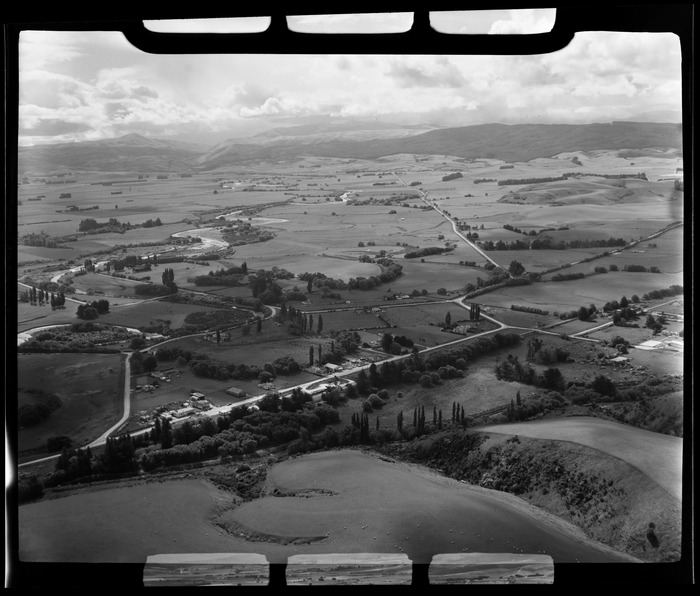
Context · Kelso (Otago) from the air in 1956, the township over whose school the July 23, 1909 airship was seen
Aerial photograph of Kelso and the Pomahaka valley with the Blue Mountains behind, taken in November 1956 by Whites Aviation and held by the Alexander Turnbull Library (WA-42614). It is a context image, not a record of the event.
Kelso, Otago · Whites Aviation, Alexander Turnbull Library, WA-42614 (también en Wikimedia Commons como FL27145622.jp2.jpg) · CC BY 4.0 · open original
The night in question
Almost in parallel with the British 'scareship' panic, New Zealand experienced in 1909 its own wave of sightings of aerial craft impossible for the technology of the time. The activity began (and was most intense) at the far south of the South Island, in the Southland and Otago regions, where many settlements had flourished during the gold rush of earlier decades. There were earlier hints: a correspondent wrote to an Otago newspaper that he and two other men had seen a strange aerial light on three occasions during the winter of 1908, while trapping in Southland. The wave proper broke out between June and August 1909 and, as the weeks passed, the sightings seemed to move northward through the country before 'passing on' to Australia.
The best-investigated episode is Kelso. According to the stationmaster, Mr Gibson, who telephoned the Otago Daily Times, at noon on Friday 23 July 1909 the schoolchildren saw in the air 'a strange machine' shaped like a boat, with what seemed the figure of a man seated in it, which came from the Blue Mountains, circled high over the school and went back the way it came; the correspondent added that it had a pontoon-shaped part above and a short mast, and that at least five people saw it. It was the dinner hour and nearly everyone was indoors; of the adults, Mrs Russell and George McDuff saw it. A special reporter from the paper went to the town on 28 July and, in an exercise remarkable for the time, interviewed the schoolchildren one by one and asked them to draw what they had seen, without seeing each other's drawings. He obtained six drawings whose resemblance he called 'nothing short of dumbfounding to all sceptics': one showed the craft from beneath with two sails on each side, another a wing with a revolving propeller at the rear. Thomas Jenkins said he watched it for about ten minutes, entirely black, with a wheel revolving very fast at the rear and a box underneath. That same week, the Kelso correspondent reported that a father, to test his son, had him draw what he saw and compared it with a picture in the Windsor Magazine, and the Mataura Ensign wrote that the children's sketches were reported to have been made from those published in a recent magazine article. On the night of Saturday the 24th several residents also saw a strong light that went out and left smaller lights moving above the hills.
At its peak, reports flooded the newspapers of the southern half of the South Island; the two Dunedin dailies (the Star and the Otago Daily Times) gave the phenomenon intense coverage. The same press carried explanations: the Clutha Leader spoke of 'human credulity' and of three men who watched a wave-like light over the hills until one of them concluded it was a neighbour's lantern as he went round his rabbit traps, an employee of that paper took one light for a fire balloon sent up as a joke, and in Auckland a fireworks dealer stated that he had recently sold a number of fire balloons. And then, as abruptly as it had begun, in mid-August 1909 the wave ceased in New Zealand. The 'phenomenon' seemed to migrate: from September, sightings were recorded in Australia, and the chain of phantom-airship waves would continue in the United Kingdom in 1912-1913, amid the escalating fear of a war with Germany.
Why it matters
The 1909 New Zealand wave matters because it forms a decisive geographic triad (the United States in 1896-1897, the United Kingdom and New Zealand in 1909) demonstrating that the phantom-airship wave phenomenon was global and almost simultaneous across the Anglosphere, years before any aviation capable of producing it existed. Its distinctive and most valuable feature is the Kelso episode: the reporter who interviewed the schoolchildren separately and obtained six concordant drawings executed, unknowingly, a cross-corroboration protocol that remains the gold standard for evaluating mass sightings. That detail makes Kelso a case study in what witness agreement does (and does not) mean.
Because the drawings' agreement, even if spontaneous, does not imply a real object: it proves the children described the same thing, not that that 'same thing' was a craft, and the press of those days already pointed to a magazine illustration as the model. The most economical explanation for the night-time wave combines the misidentification of celestial bodies, such as the moon Bartholomew points to at Gore, or Venus and Jupiter, visible at nightfall toward the west-northwest in those weeks, with fire balloons, lanterns and pranks that the press itself documented, all inside the cultural frame of 'the airship' already installed by international news. The daylight Kelso sighting, by contrast, has no concrete explanation in the period sources, and witnesses from over a century ago cannot be audited. New Zealand 1909 is the proof that a wave can be international, methodologically well recorded and yet largely explicable as a perceptual and cultural phenomenon.
What's left on paper
Documented evidence
- Wave of 'airship' sightings between June and August 1909, concentrated in Southland and Otago (South Island), with the daily press of the time in Papers Past
- Earlier hint, according to Bartholomew: aerial light seen by three trappers in Southland during the winter of 1908
- Kelso (Friday 23 Jul 1909, noon): schoolchildren, Mrs Russell and George McDuff see a boat-shaped craft with a mast and a propeller at the stern circle over the school (Otago Daily Times, 26 and 29 Jul 1909)
- Six drawings obtained by an Otago Daily Times special reporter after interviewing the children separately (28 Jul 1909)
- Counter-evidence from the same week: a father compared his son's drawing with a picture in the Windsor Magazine, and the Mataura Ensign reported that the drawings had been copied from a magazine
Show 2 more items
- Explanations in the period press: a trapper's lantern, fire balloons sold in Auckland, pranks
- End in mid-August and 'migration' of the phenomenon to Australia (Sept 1909) and then to the United Kingdom (1912-1913)
Sources
- NZ Skeptics — 'The Great Zeppelin Scare of 1909'
- Tony Brunt — 'The New Zealand UFO Wave of 1909' (Haunted Auckland) — Original (dead link): https://hauntedauckland.com/site/the-new-zealand-ufo-wave-of-1909-by-tony-brunt1967/
- UFOCUS NZ — 'The 1909 Kelso Airships of New Zealand'
- Otago Daily Times, «Supposed airship. Seen at Kelso» (26 jul 1909), Papers Past — Primary source: the stationmaster's and the Kelso correspondent's report of the Friday noon sighting.
- Otago Daily Times, «The Kelso airship. Cumulative evidence» (29 jul 1909), Papers Past — Primary source: the special reporter's account of the separate interviews and the six drawings.
- Otago Daily Times, «The supposed airship. Seen again at Kelso» (27 jul 1909), Papers Past — Primary source: the Saturday night sightings and the drawing compared with the Windsor Magazine.
- Mataura Ensign, «Ships in the air» (29 jul 1909), Papers Past — Primary source: reports that the Kelso drawings were copied from a magazine and notes the fire balloons sold in Auckland.
- Clutha Leader, «Human credulity» (30 jul 1909), Papers Past — Primary source: period criticism and the case of a trapper's lantern.
Related cases