1962·Port-au-Prince, Haiti
Haiti.Port-au-Prince · an engineer tracks an object with a theodolite
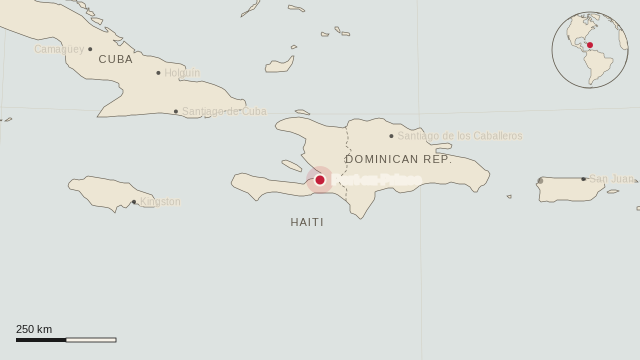
On the night of August 30, 1962, in Port-au-Prince, Haiti, a World Bank consulting engineer sitting outdoors with two friends saw a dazzling light to the west-southwest and followed it with a surveyor's theodolite: he described a silvery object shaped like a double hubcap, with an antenna and a colored halo, that stood still for about ten minutes and left within five seconds. The U.S. Air Force Mission to Haiti sent the case to Washington, and the Air Force concluded it was the planet Venus.
Tier B · IndicativeWhat do they mean? →
Limited evidence: it falls short of what Tier A requires. Any one of these is enough: a single testimony (or several witnesses who saw it together), testimony gathered years later, or an account without contemporary primary documentation.
What it was
85%planet or star
The most likely explanation.
- 85% planet or star
- 3% other earthly causes
- 12% no known cause
See the split across the six explanations
Earthly origin (human or natural)88%
No known cause12%
Ordinary cause the sources propose: planet or star
What happened
At about 7:35 p.m. on Thursday, August 30, 1962, an engineer was sitting outdoors with two friends in Port-au-Prince, the capital of Haiti, when he saw a lighted object in the sky. He worked for the Techint company as a consultant to the International Bank for Reconstruction and Development (the World Bank). He described it in a letter dated in Port-au-Prince in early September, with the day hard to read on the copy, and addressed to the U.S. Air Force Mission to Haiti. The letter survives in the file of Project Blue Book, the Air Force program that studied reports of unidentified flying objects, with the names of all three witnesses blacked out. According to the letter, the observations and measurements were made by the engineer and a second engineer, without saying whether he was one of the two friends.
The engineer had a Wild T-16 theodolite at hand, made in Heerbrugg, Switzerland: a surveying instrument with a 28-power telescope and a 40 mm objective lens, mounted on two graduated circles that measure horizontal and vertical angles. The letter gives the instrument's position, 18° 31′ 18″ north and 72° 22′ 20″ west, and the direction it pointed: a true azimuth of 249° 02′, toward the west-southwest (251° 30′ by compass), and an elevation of 24° 4′ above the horizon. According to the letter, the observation lasted from 7:35 to 7:50 p.m. Haitian time, which the letter equates with U.S. Eastern time. Further on, the same letter says the object left at 7:55, and notes that seeing it at 7:35 did not mean it had just arrived. A closing note certifies the time, the instrument, the site and the bearing as accurate.
To the naked eye the object was "rather dazzling and glaring." Through the telescope it had the shape of a double hubcap and was silvery gray. For about ten minutes it did not move, so the engineer could keep it in the eyepiece without touching the theodolite, although it kept turning on its own axis. On top he saw a kind of antenna, about 3 feet across and 8 to 10 feet high, and on the side he could see, a circular line of dark spots that might have been rivets or exhaust ports. A vaporous jacket about 10 feet wide, showing every color of the spectrum, surrounded it; while the object stood still, this emission came from underneath and seemed to hold it up. Then it gathered speed and vanished within five seconds at most, without any noise. Two attached drawings show the object's positions, with the antenna and the row of spots.
The letter adds figures it presents as estimates, with a 20% margin of error: the object was at 7,000 feet (about 2,100 m), 13,000 feet from the observer (about 4 km), and 70 feet (about 21 m) across. It explains that they are approximate because the instrument could not be set up at a second site. A theodolite gives only a direction: without a second reading from another point, the distance is assumed, and so is the size.
On September 10, Colonel Richard Curtis, chief of the U.S. Air Force Mission to Haiti, based at the embassy, sent the data to Air Force headquarters, with a copy to the Air Technical Intelligence Center (ATIC) at Wright-Patterson Air Force Base, Ohio. His report follows the letter with a few differences: the witnesses were having supper at an outdoor restaurant, the object was watched for twenty minutes, and it left in about five seconds in a straight line away from the observers, toward about 250°. The night was dark and clear, with no moon and no clouds, and visibility of at least ten miles; there were no data on temperature or winds aloft. Curtis had known the engineer for a year and a half, considered him "stable, mature and well educated," and wrote that the optical instrument lent credence to his report. He did not know the other two witnesses.
In the same report, Curtis added another sighting. On the night of Friday, September 7, Captain James Gordon, a Marine helicopter pilot, saw a lighted, motionless object from his home in Pétion-Ville, on the eastern edge of Port-au-Prince. It lay to the southwest, as the copy appears to read, and Gordon followed it with 7 × 50 binoculars. According to the report, the object rose and drifted west, then dropped straight down until it disappeared behind a ridge of mountains; the times, in military notation, are barely legible. Gordon could not make out the antenna, but described a similar shape and confirmed the gas on the underside; the night was clear, with a half moon. Curtis said the mission would keep watch every night.
The evaluation came on October 18, 1962, in a letter from Colonel Edward H. Wynn of the Air Force's Foreign Technology Division (FTD) at Wright-Patterson. It was addressed to a Captain Neill in the International Security Affairs office at the Office of the Secretary of Defense, and answered a telephone request from a Major Hart in the Office of Information of the Secretary of the Air Force. The FTD concluded that the object was the planet Venus. According to the letter, at the start of the sighting Venus stood at a point in the sky that the letter gives in astronomers' coordinates (right ascension 13 h 22 min 24 s, declination −10° 24′ 05″), so that, seen from Port-au-Prince, it closely matched the object's reported position.
The FTD letter put the rest down to the atmosphere. Venus moves about 2.5° every ten minutes, and the telescope, as the FTD read the report, covered about 2°, so watching it for ten minutes without moving the instrument was "quite possible" in its view. With no data on temperature aloft, the weather described made a temperature inversion likely, and near the horizon an inversion flattens the image of stars and planets, tints it with colors, makes it jump, and often makes it shoot upward just before it sets.
According to the FTD, the star Spica was half a degree from Venus, above and to the left. Venus, at magnitude −3.9, was the brightest thing in the sky, with the Moon gone from the sky since 6:54 p.m., and showed slightly more than half its disk lit. The FTD concluded that the cause was a misidentification of Venus, with the atmosphere, Spica and the witness's unfamiliarity with the sky as probable contributing factors, and that the sighting showed no threat to the United States. The Blue Book record card copies that conclusion.
Where it happened
Why it matters
The engineer's own measurements do not fully fit the Venus explanation. According to a calculation done for this case, at 7:35 p.m. (00:35 GMT on August 31) Venus, as seen from the theodolite, stood about 11° above the horizon at an azimuth of 254°, and it was sinking: by 7:50 it was at about 7.5°. The direction matches the measured 249° to within about 5°, but the elevation does not: the theodolite read 24°, more than twice as high.
The reading does match Venus almost exactly an hour earlier: between 6:35 and 6:40 p.m. the planet stood 24° up at an azimuth of 248° or 249°. If the report's time were off by an hour, the measurement would be that of Venus. At that hour, however, the sun was about 8° below the horizon, the sky was not yet fully dark, and the mission's report describes a dark night.
The FTD letter did not compare elevations or directions. It gave Venus's position in astronomical coordinates, which do not depend on where the observer stands, and said it matched the object's. According to the same calculation, one of those coordinates is that of Venus, but the other, the declination, is that of the point the theodolite marked; Venus was actually half a degree farther south. The calculation also puts Spica only about 4 arcminutes from Venus, not half a degree: that night the two were almost touching.
The telescope argument does not hold up with the FTD's own figures either: if Venus moves 2.5° in ten minutes and the field is 2° across, the planet crosses all of it in about eight minutes, less than the ten minutes the engineer said he kept it still in the eyepiece. For the five-second departure, the letter offers only the general rule that stars and planets seem to shoot upward just before they set; at 7:50 Venus was still about 7.5° up, and whether the hills west of the city hid it at that height is an open question.
The Blue Book record card copies the Venus conclusion and mixes up the two sightings: under type of observation it has "7-50 Binoculars" typed in, Captain Gordon's binoculars. What the engineer described, a bright disk that trembles, changes shape and is ringed with colors, fits what the FTD attributes to a low planet seen through magnification. What does not fit is his own measurement of the elevation, which the evaluation never addressed.
Documents and sources
Primary documents
Blue Book file on Port-au-Prince (Haiti, 1962), 12-page extract: record card, witness letter, drawings, mission report and FTD evaluation
The U.S. Air Force papers on the object an engineer followed with a theodolite in Port-au-Prince on August 30, 1962. Page 1: the record card, an undated ATIC Form 329 that checks "Was Astronomical" with "Venus."
Read more
Pages 2 to 4: the engineer's letter from early September, with the instrument, the measured position and bearing, and the description of the object. Pages 5 and 6: the two drawings of the object's positions. Pages 7 to 10: the September 10 report by Colonel Richard Curtis, chief of the Air Force Mission to Haiti, with Captain James Gordon's sighting of September 7. Pages 11 and 12: the FTD letter of October 18, 1962, signed by Colonel Edward H. Wynn and bearing the handwritten signature of Lieutenant Colonel Robert J. Friend, of the same office (TD-E), dated October 17. The civilian witnesses' names are blacked out in the original. This is a grayscale extract of pages 1, 15, 16, 2, 7, 8, 11 to 14, 9 and 10 of the file; the full original, with four hand-drawn maps, is at archive.org.
Project Blue Book (NARA), via archive.org · Public domain · US Government work · open original
Documented evidence
- "Project 10073 Record Card" (ATIC Form 329, undated; p. 1 of the file PDF): date "30 August 1962," time "31/0035-0050Z Aug," ground-visual observation with "7-50 Binoculars" typed in, civilian source, one object, course "stationary," length of observation blank; conclusion checked "Was Astronomical," with "Venus," and a comment copying the FTD conclusion
- The Techint engineer's letter to the U.S. Air Force Mission to Haiti, early September 1962 (pp. 15, 16 and 2 of the PDF): sighting on August 30 from 7:35 to 7:50 p.m. Haitian time, with a 28-power Wild T-16 theodolite; position 18° 31′ 18″ N, 72° 22′ 20″ W; true azimuth 249° 02′, magnetic 251° 30′; elevation 24° 4′; in the general remarks, departure at 7:55; a note certifies sections 2 to 5 (time, instrument, site and bearing) as accurate and calls sections 6 and 7, which include the description, estimates
- The same letter, sections 6 and 7 (pp. 16 and 2 of the PDF): a silvery-gray object shaped like a double hubcap, still for about ten minutes, turning on its axis, with an antenna, a circle of dark spots and a many-colored vaporous jacket; it left within five seconds at most, without noise; estimates, with a 20% error, of 7,000 feet altitude, 13,000 feet distance and 70 feet diameter
- Report by Colonel Richard Curtis, chief of the U.S. Air Force Mission to Haiti, September 10, 1962, to Air Force headquarters with a copy to ATIC (pp. 11 to 14 of the PDF): supper at an outdoor restaurant; twenty minutes of observation; elevation 24° 4′ and magnetic azimuth 251° 30′; dark, clear night with no moon; two other witnesses Curtis did not know; Captain James Gordon's sighting from Pétion-Ville on September 7, with 7 × 50 binoculars
- FTD letter signed by Colonel Edward H. Wynn, October 18, 1962, to Captain Neill (OSD/ISA), at the request of Major Hart (SAFOI) (pp. 9 and 10 of the PDF): Venus at right ascension 13 h 22 min 24 s and declination −10° 24′ 05″; motion of about 2.5° in ten minutes and a field of about 2°; a likely temperature inversion; Spica half a degree away; Venus at magnitude −3.9; moonset at 6:54 p.m.; conclusion: Venus, no threat to U.S. security
- According to a calculation made for this case with PyEphem from 18° 31′ 18″ N, 72° 22′ 20″ W: Venus at 11.0° elevation and 254.4° azimuth at 00:35 GMT on August 31, 1962 (7:35 p.m. in Haiti) and at 7.5° at 00:50 GMT; at 24.5° and 248.1° at 23:35 GMT on August 30 (6:35 p.m. in Haiti), with the Sun at −7.7°; Spica about 4 arcminutes from Venus; the point the theodolite marked had a declination of −10° 23′. Gordon's times seem to read 072345 and 080003: if GMT (6:45 and 7:03 p.m. local), Venus 20° and 16° high, west-southwest; if local, Venus had set and the half moon was setting west-southwest
Sources
- Project Blue Book (NARA), file "1962-08-8723210, Port-au-Prince, Haiti," 16 pp., copy at archive.org — Primary source. PDF p. 1: record card; pp. 15, 16 and 2: the engineer's letter (three sheets); pp. 3 to 8: attached maps and drawings; pp. 9 and 10: FTD letter of October 18, 1962; pp. 11 to 14: the Air Force Mission to Haiti report of September 10. The scan's text layer is poor: figures and quotations were read from the page images. The civilian witnesses' names are blacked out.
- Brandon Rhodes, PyEphem 4.2 (astronomical ephemerides based on the XEphem library) — Tool used to calculate the positions of Venus, Spica, the Sun and the Moon as seen from the theodolite site on August 30 and September 7, 1962, without atmospheric refraction.
- UFOScans, "1962-08-8723210, Port-au-Prince, Haiti," copy and summary of the file — Secondary version: it sums up the case with the theodolite, about twenty minutes of observation and the Venus conclusion, without the measured elevation.
Related cases
Cases with the same likely cause.
Planet or star · Within 10 years
Father Gill · dozens of witnesses see figures on a disc
1959 · Tier B
Planet or star · Within 10 years
Deception Island · lights over the Antarctic bases
1965 · Tier A
Planet or star · Within 10 years
Edwards · tower staff watch colored lights for hours
1965 · Tier A
Planet or star · Within 10 years
Redmond · two men watch a light and seven fighters take off
1959 · Tier A