Case No. 134·United States
1980·Santa Fe, New Mexico (1st Judicial District)
United States.Operation Animal Mutilation (Rommel Report, FBI/DOJ)
Federal investigation of cattle mutilations commissioned in 1979 by Senator Harrison Schmitt (New Mexico) under rural political pressure, funded by a DOJ Law Enforcement Assistance Administration grant and executed by former FBI agent Kenneth Rommel from the 1st Judicial District Attorney's office. The final report (June 1980, 297 pages) examined 15 NM cases with formal veterinary necropsies and field work, and concluded the pattern is explained by death from natural causes followed by predation and decomposition. It found no evidence of surgical instruments, covert helicopters, cults, or anomalous intervention. It is the strongest institutional document in the corpus for the natural-phenomena hypothesis on mutilations.
Year
1980
Tier
S
Probability
8%
Category
Document
Strong evidence: instrumental sensor record + multiple witnesses (typically military). Three independent axes: the «tier» measures the strength of the evidence; the «probability» estimates how genuinely unexplained the case is —a natural phenomenon can remain unexplained, so it does not equal «non-prosaic»—; and the partition of explanations (below) says what it most plausibly was. So a well-documented case can have a possible hoax as its most plausible cause, and a Tier B is not, for that reason, a hoax.
Primary documents · viewer
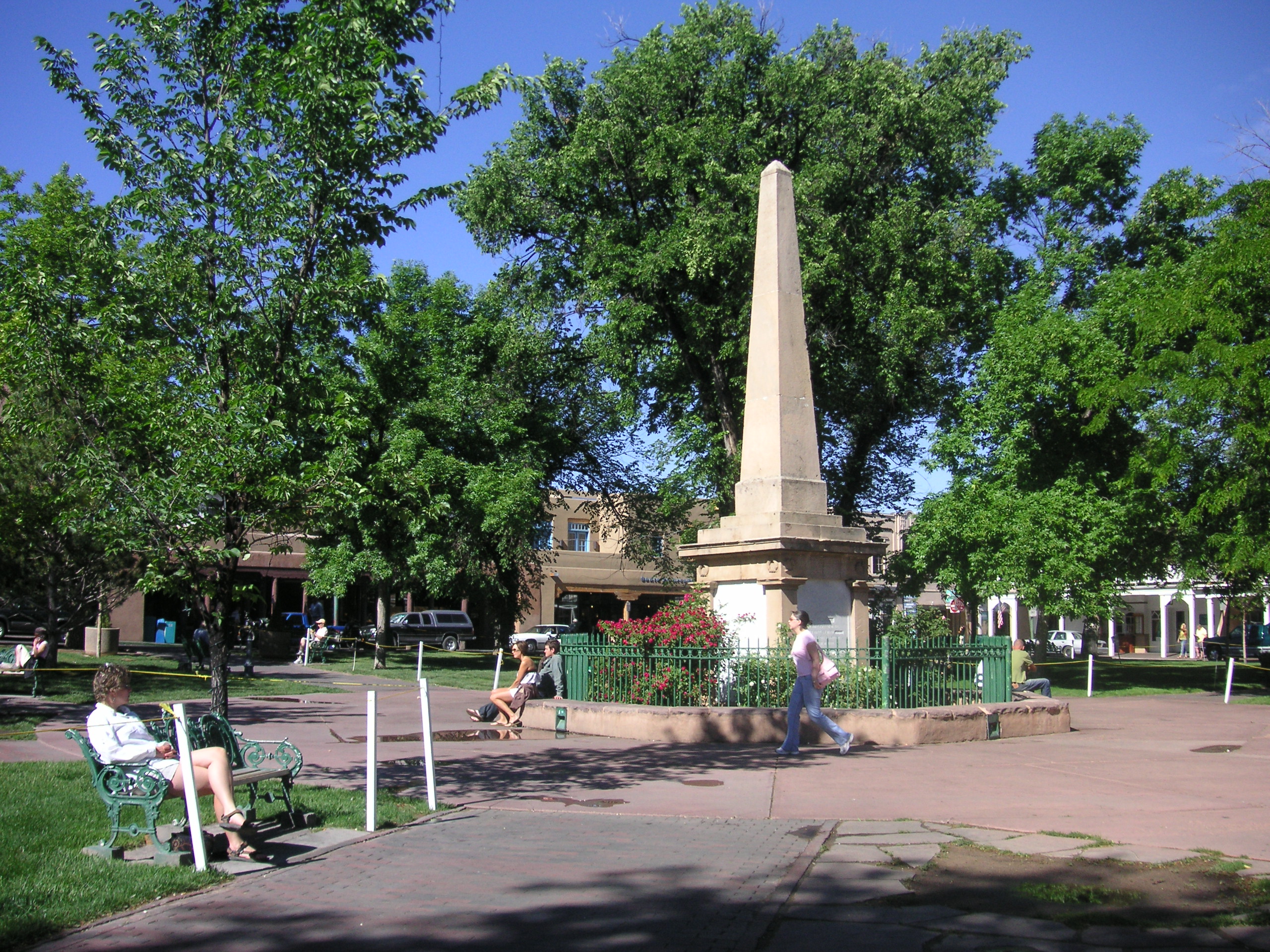
Context · Santa Fe (New Mexico)
Santa Fe Plaza.jpg · Wikimedia Commons · CC BY 2.0 · open original
Part 01
The file in question
In April 1979, facing a persistent wave of reports of cattle found dead with 'surgical' cuts, missing blood and soft tissues —and recurrent attributions to UFOs, black helicopters and cults—, Senator Harrison Schmitt (NM) convened a federal conference in Albuquerque. The FBI, local prosecutors, NM Attorney General Toney Anaya, veterinarians and ranchers attended. The political conclusion was clear: an investigation with executive authority was needed, not more folklore.
The DOJ's Law Enforcement Assistance Administration (LEAA) approved a grant of approximately USD 44,170 to the 1st Judicial District Attorney's office (Santa Fe) to conduct the investigation. The DA hired Kenneth M. Rommel —retired FBI agent with a 28-year career, no stake in the UFO debate— as project director. For twelve months, Rommel and his team responded to every fresh report they could reach in NM, ordered formal veterinary necropsies in state laboratories, interviewed ranchers, sheriffs, veterinarians and witnesses of lights, and reviewed prior files.
The investigation, launched in May 1979 and conducted over roughly a year, was structured around five formal objectives, among them: determining the reliability of the information on which the grant request was based, establishing the cause of as many mutilations as possible —particularly those in New Mexico— and determining whether cattle mutilations constituted a serious law-enforcement problem. On April 15, 1980, Rommel held a press conference previewing his conclusions, ahead of the formal delivery of the report.
The final report, 'Operation Animal Mutilation: Report of the District Attorney, First Judicial District, State of New Mexico', was delivered to the DOJ in June 1980. Its 297 pages examine 15 cases in detail. In each, necropsies documented death from known natural causes —difficult birth, disease, clostridium, lightning, loco weed intoxication— followed by normal predation by coyotes, dogs and scavenger birds that consume soft tissue first (eyes, tongue, anus, genitals), which are also the most exposed parts and the least protected by the animal's extremely tough hide. The 'surgical cuts' result from the combination of small-carnivore bites, post-mortem lividity that drains visible blood from the area, swelling and skin tension from decomposition gases that, when it tears, produces clean-looking edges, and desiccation of those edges in dry climate. Rommel noted that his findings matched those of sheriffs and pathologists in other states. He explicitly ruled out cult intervention, covert military helicopters and clandestine federal agents: he found no instruments, no witnesses of operations, no physical traces compatible with those hypotheses.
The report's reception illustrates why a skeptical case does not automatically settle a cultural debate. Senator Schmitt himself, who had pushed for the investigation, gave it only qualified support: he said the report was 'fairly well written', but that it 'certainly doesn't answer all of the questions'. For part of the cattle-mutilation research community, a sample of 15 cases in a single state was too narrow to generalize to a phenomenon reported across much of the American West; for others, the agreement among necropsies, pathologists and documented predation made the report the reference explanation. The corpus records both positions, but acknowledges that the evidentiary asymmetry favors Rommel: the natural hypothesis is supported by necropsies and pathology, whereas the anomalous hypotheses rest on inference from the appearance of the carcasses.
Part 02
Why this case moved the needle
The Rommel Report is the strongest institutional counterweight in the corpus for an entire category of phenomenon. It is not a single UFO 'debunked'; it is a whole class of anomaly —cattle mutilations, present in folklore, press and film since the 70s— subjected to federal investigation with judicial authority, DOJ funding, standard veterinary methodology and an unbiased director. The conclusion is sharp and verifiable: the pattern is natural. This is worth more than any individual skeptical opinion because it meets the criteria the corpus demands of pro-anomalous cases: primary document, institutional authority, reproducible methodology. Tier S precisely because the methodological rigor is symmetric with what is demanded of cases that weigh in the other direction. If Colares 1977 is Tier S for the FAB investigation, Rommel 1980 is Tier S for the DOJ investigation.
Part 03
What's left on paper
Documented evidence
- April 1979 federal conference in Albuquerque convened by Senator Harrison Schmitt (NM); attended by FBI, AG Toney Anaya, prosecutors and ranchers
- DOJ Law Enforcement Assistance Administration grant (~USD 44,170) to the 1st Judicial District DA's office to conduct the investigation
- Project director: Kenneth M. Rommel, retired FBI agent with 28-year career, hired for his independence from the UFO debate
- 297 pages, 15 cases examined in detail with formal veterinary necropsies at state laboratories (1979–1980)
- Documented conclusion: death from natural causes (difficult birth, disease, clostridium, lightning, loco weed) + normal predation (coyotes, dogs, scavenger birds) + post-mortem lividity/desiccation explain the full pattern
- Explicit refutation of cult, covert military helicopter and clandestine federal operative hypotheses: zero instruments, zero direct witnesses, zero compatible physical traces
Sources
- Rommel, K.M. — 'Operation Animal Mutilation: Report of the District Attorney, First Judicial District, State of New Mexico' (junio 1980) — Primary 297-page report delivered to DOJ.
- FBI Vault — Animal Mutilation files — Declassified FBI archive with correspondence and case-related materials.
Location
Santa Fe, New Mexico (1st Judicial District) · 35.69°, -105.94°
Related cases