2019·Restricted warning area off San Diego, California
United States.USS Omaha — transmedium sphere
On 15 July 2019, in a restricted warning area off San Diego, the Combat Information Center of the USS Omaha recorded with FLIR/night vision a sphere that flew over the sea, stopped, and descended into the water with no visible wake ('transmedium' behavior). According to an intelligence briefing Corbell says he obtained, there were at least 14 objects around the formation. Jeremy Corbell and George Knapp released the material in 2021; in May that year the Pentagon confirmed it was captured by Navy personnel and was under UAPTF analysis: authenticity confirmed, not explanation.
Tier S · SolidWhat do they mean? →
Strong evidence: a contemporary instrumental record (radar, sensor, film or photo of known provenance) that corroborates several independent witnesses.
What it was
53%natural or human cause
Most likely explanation: adversary technology
See the split across the six explanations
Natural or human cause
No known cause
Primary documents
U.S. Navy — FOIA response on USS Omaha records for 15 July 2019 (3 pp.)
Letter from the Department of the Navy (Naval Surface Force, U.S. Pacific Fleet, San Diego) dated 15 September 2021, signed by Captain J. M. Lucci, Force Judge Advocate, answering FOIA request DON-NAVY-2021-005821 from John Greenewald (The Black Vault), which asked for the records of the 15 July 2019 incident off San Diego and USS Omaha's logs for 13–18 July. The Navy explains that on this class of ship the underway deck log is a digital voice recording; that the ship searched for digital, CD/DVD and paper copies and concluded that the prior crew did not retain or create records for 1–18 July 2019; and that NHHC and the Federal Records Center have none either. It releases only the logs for 19–31 July.
Department of the Navy, FOIA DON-NAVY-2021-005821 (vía The Black Vault) · Public domain (US Government work, 17 U.S.C. § 105) · open original
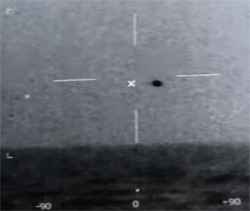
Frame from the USS Omaha video (15 July 2019)
Low-resolution capture (250 × 211 pixels) of the video taken from USS Omaha on 15 July 2019, as published by Wikimedia Commons, which attributes it to the U.S. Navy and takes it from an IBTimes article on the leaked video. It shows a dark round blob just right of a sensor reticle's crosshair, above the sea horizon, with a −90 to +90 scale along the bottom edge.
USS Omaha UFO video - July 2019.png · Wikimedia Commons · Public domain (PD-USGov, US Navy work) · open original
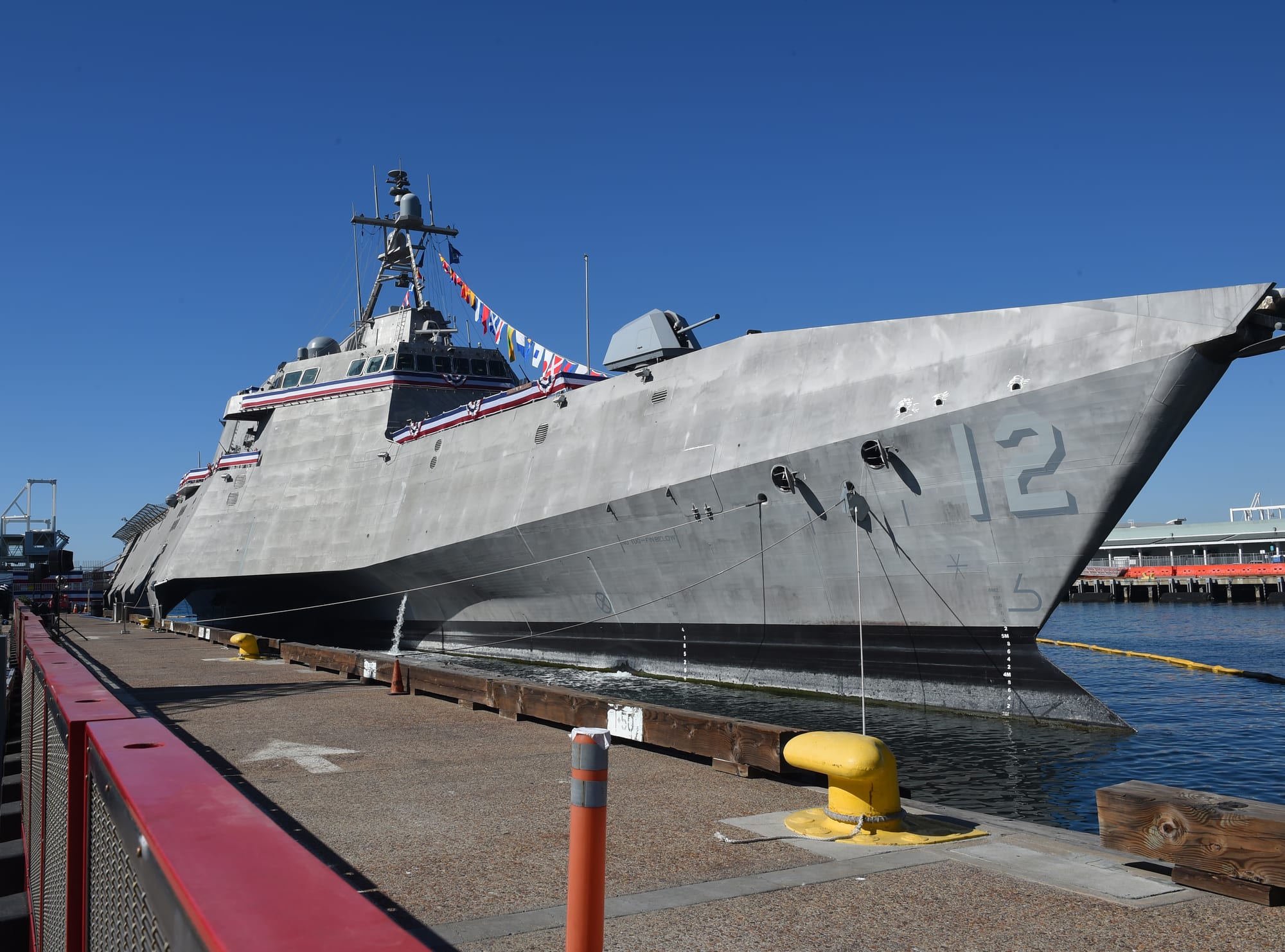
Context · USS Omaha (LCS-12), ship of the 2019 transmedium sphere footage
USS Omaha (LCS 12) Commissioning Ceremony (4119951).jpg · Wikimedia Commons · Public domain · open original
The night in question
On 15 July 2019, in a restricted warning area off the coast of San Diego (California), the littoral combat ship USS Omaha and other U.S. Navy units recorded a series of unidentified spherical objects. From the Combat Information Center (the ship's command hub, where sensor data are fused) a dark sphere was filmed with a FLIR (forward-looking infrared) camera and night-vision devices, moving over the sea, stopping, and finally descending until it touched the water and vanished beneath the surface, with no wake, prolonged splash or visible debris, the behavior UAP literature calls 'transmedium' (air-water transition). In the clip's operational audio the crew is heard narrating the event in real time ('splash'), a detail reinforcing that this was not a later interpretation but something tracked live by trained operators.
The episode was not isolated: it was part of a wave of 'sphere' incursions over several Navy ships off San Diego in July 2019 (USS Omaha, USS Russell, USS Kidd, USS Rafael Peralta, USS John Finn, among others). According to an intelligence briefing Corbell says he obtained, there were at least 14 solid objects about two metres across maneuvering around the formation, with speeds between 74 and 254 km/h (about 40 to over 130 knots). From those same days comes the so-called 'pyramid' video, filmed in night vision from the USS Russell, in which camera optical artifacts may explain at least part of the perceived triangular shape, a reminder that not the whole batch carries equal weight. Corbell also says that after the Omaha incident a submarine searched the area and found nothing ("No wreckage found"); that claim has no official confirmation.
The material came to light in 2021, released by filmmaker Jeremy Corbell alongside investigative journalist George Knapp; according to Corbell, a still from the video had been shown at an Office of Naval Intelligence briefing on 1 May 2020, and the video was recorded off a monitor in the Combat Information Center. In April 2021 the Pentagon confirmed the authenticity of the 'pyramid' video and the photos, and in May, after the Omaha video was released, its spokesperson Susan Gough stated: "I can confirm that the video was taken by Navy personnel," adding that the UAP Task Force (UAPTF) was reviewing it. The confirmation covered the footage's provenance and authenticity, not an explanation of its content: the origin was left undetermined. Among conventional hypotheses, the strongest is an unmanned-systems operation (drones, possibly adversary surveillance) which would account well for the coordinated swarm in a naval exercise area. The sphere's descent into the water with no visible wake, by contrast, remains the element that fits a conventional drone worst and the most debated part of the case; skeptics point to the sensor's low resolution and the difficulty of judging depth and scale from a single monocular camera.
In its response to a FOIA request from The Black Vault (15 September 2021), the U.S. Navy reported that USS Omaha 'did not retain or create records for July 1–18, 2019': the deck log of that class of ship is a digital voice recording, and neither the Naval History and Heritage Command nor the Federal Records Center holds records for those dates.
Why it matters
The USS Omaha case combines two things: a Navy sensor recording (an infrared camera in the Omaha's combat centre, with other ships of the formation involved in the wave; radar data are only claimed by Corbell) and official Pentagon confirmation that the material is genuine and was under analysis by its dedicated task force. It is also part of the 2017-2021 regime shift, when the Navy formalized UAP reporting procedures, serious press (including the New York Times) treated the topic as a flight-safety matter, and Congress began demanding reports: the context that turns these clips into institutional data rather than anecdotes.
At the same time, the case has clear limits. The official confirmation is of authenticity and provenance, not of nature: the Pentagon validated that the Navy recorded something, not what it was. The soberest explanation of the swarm (a drone operation, perhaps adversary surveillance in a sensitive naval exercise area) is plausible, fits the coordinated behavior and should not be dismissed; indeed it would be a serious national-security finding in its own right. What resists that reading is the sphere's descent into the water with no visible wake, narrated live by the crew, together with the fruitless submarine search Corbell reports. That single datum, dependent on a low-resolution monocular sensor whose interpretation is disputed, is what keeps the case open.
What's left on paper
Documented evidence
- FLIR/night-vision video from the USS Omaha's Combat Information Center (15 Jul 2019) of a sphere descending into the water with no wake
- According to an intelligence briefing Corbell says he obtained, at least 14 objects about two metres across around the formation, at 74 to 254 km/h
- Multi-ship wave (Omaha, Russell, Kidd) in July 2019; includes the USS Russell 'pyramid' video
- Pentagon confirmation (Susan Gough, May 2021): "the video was taken by Navy personnel", under UAPTF review
- Released by Jeremy Corbell and George Knapp (2021)
Sources
- Mystery Wire (G. Knapp / J. Corbell) — 'USS Omaha UFO video'
- Wikipedia — 'Pentagon UFO videos' (confirmación de autenticidad, abril 2021) — Secondary source (encyclopedia)
- Global News — 'Leaked video appears to show UFO plunging under water off California' (18 May 2021) — Contemporary press: Susan Gough's statement and Corbell's claims about the 14 objects and the submarine search
Related cases
same country · same period
USS Russell — 'pyramid' video (night vision)
2019 · Tier A
same country · same period
The 28-year aviator's testimony: a small, fast object seen from a civilian aircraft
2019 · Tier A
same country · same period
When the sensor itself explains why the object flickers
2019 · Tier A
same country · same period
Five recordings, one event: lights over the Pacific documented by the UAPTF
2019 · Tier A
Associated actors (2)