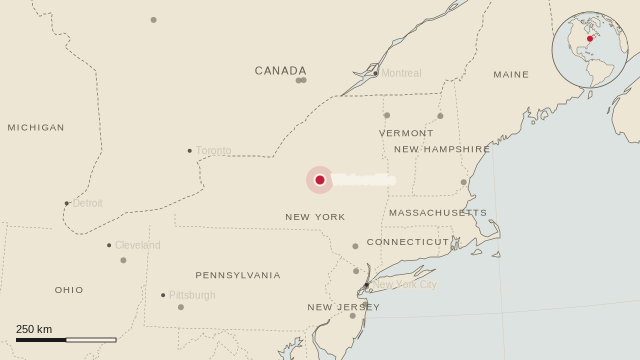
1954·Walesville, near Utica, New York
United States.Walesville · fighter jet crashes into a village, killing four
On July 2, 1954, an F-94C fighter from Griffiss Air Force Base, New York, went up to identify unknown aircraft. It crashed into the village of Walesville after its two crew members ejected when a fire warning came on, and four people died on the ground. Donald Keyhoe said the pilot saw a gleaming object and that a wave of heat filled the cockpit as he closed on it. According to the summary of the Air Force report, one of the aircraft chased was a C-47 and the cause was a failure in the warning circuit, whose origin was never determined.
Tier A · AcceptableWhat do they mean? →
Institutional evidence: several identified independent witnesses, or contemporary official documentation, without an instrumental record to corroborate them.
What it was
84%equipment failure
The most likely explanation.
- 84% equipment failure
- 6% other earthly causes
- 10% no known cause
See the split across the six explanations
Earthly origin (human or natural)90%
No known cause10%
Ordinary cause the sources propose: equipment failure
What happened
On Friday, July 2, 1954, a Lockheed F-94C Starfire interceptor from Griffiss Air Force Base in Rome, New York, took off at 11:05 a.m. Eastern Standard Time on what the U.S. Air Force (USAF) called a routine training mission. The pilot was Lt. William E. Atkins, 24, and the radar observer was Lt. Henry F. Coudon, 26. According to the base, it was one of two planes sent up in a practice scramble, and it carried 48 2.5-inch rockets.
Soon after takeoff, ground control changed the mission: the fighter was to intercept an unidentified aircraft. A Pentagon spokesman said that aircraft was about 75 miles northeast of Rome, on the edge of the zone covered by Griffiss. According to the Post-Standard, that was "when it was detected"; according to the Herald Journal and another AP dispatch, "when the jets intercepted it." An Air Force spokesman in Washington added that the two Starfires were sent up to check it after it was discovered on a radar screen.
The fighter climbed using its afterburner (extra engine thrust) to 12,000 feet. At 10,000 it saw an aircraft flying so slowly that the pilot cut power to about 65 percent and extended his dive brakes and flaps. He identified it by its tail number as a C-47, a transport plane. According to the summary the USAF prepared in October 1967 for its UFO office, ground control then told him of a second unidentified aircraft, probably low and letting down to land at Griffiss.
The summary of the accident report quoted by researcher Kevin Randle and by authors Fawcett and Greenwood orders the events differently. Control gave the fighter a heading of 60 degrees and 10,000 feet of altitude. The first aircraft could not be found, and control sent the fighter toward a second one, which turned out to be an Air Force C-47. According to that summary, neither the fighter pilot nor the C-47 pilot noted any malfunction at that point. Control then gave a heading of 240 degrees to return to the first. The fighter was at 8,000 feet above broken clouds, found nothing above them and began to descend to look below. The summary adds that it was evident the unidentified aircraft was heading for Griffiss.
During the descent, the cockpit temperature rose abruptly. One version of the summary speaks of "intense heat." The pilot scanned the instruments and saw the fire warning light on. He told the radar observer, put the throttle in idle and, as the light stayed on, shut down the engine. Both crew members ejected unhurt. A base spokesman said Atkins ordered Coudon out first and then jumped himself, from about 7,000 feet.
The unmanned aircraft flew about four miles on a heading of 199 degrees. It crashed at 11:27 a.m. Eastern Standard Time according to the USAF summary (12:27 p.m. if an hour of daylight time is added); the press gave "about 12:30 p.m." It came down at the Walesville intersection, about three miles east of Westmoreland. The fuselage went through the roof of the Monroe home, a converted garage the family had moved into a few days earlier. A section the press took to be a wing struck a car passing the intersection.
In the car were Stanley Phillips, his wife Florence and their son Gary, 11, of Hecla. All three died. The burning car crashed into the home of Mary Peck, who escaped. Doris Monroe, 28, was preparing lunch for her children inside the destroyed house and also died. The youngest child, one year old, was hurt; the other three, playing outside, were unharmed. None of the 48 rockets exploded. The base reported that 47 had been recovered, and a wire service said one was unaccounted for.
The Air Force gave partial accounts the same day. The squadron commander, Maj. John A. Recher, said: "We haven't determined anything definite at all. We feel that it must have been an explosion in the aircraft." Under Secretary of the Air Force James H. Douglas said preliminary reports indicated a fire in the forward section of the aircraft and that the heat in the cockpit became so intense that the crew was forced to leave at 7,000 or 8,000 feet.
Base spokesmen added that the pilots had satisfied themselves that the unidentified aircraft was "friendly" and were heading back to base when the fire started. From Washington it was said that the cockpit had become "unbearably" hot. Later, another spokesman said the intercepted plane had probably either filed no flight plan or drifted off its announced route.
That evening, between 6 and 10 p.m., more than a thousand calls jammed the switchboard of a Utica newspaper about a silvery, balloon-like object floating high up. Residents reported it from Rome to Frankfort, east of Utica. Col. Milton F. Summerfelt, commandant of the Air Force depot at Rome, said it looked like a partially deflated plastic balloon about 40 feet long. According to Rome officials, it was not from Griffiss and no plane was seen near it, and neither Rome nor Syracuse had released any balloons. The dispatch said its exact nature remained a mystery, although it was generally believed to be a weather balloon.
The accident report was completed on August 17, 1954. According to the summary quoted by Randle, the primary cause was "a malfunction of the aircraft fire detector circuit," whose origin could not be determined. An inspection of the air-conditioning and pressurization system found no smoke, fuel or oil, which a fire would have left. Fawcett and Greenwood, who received the summary in 1980, quote the same conclusion: the examination of the wreckage disclosed no in-flight fire, and the cause of the malfunction in the fire warning system could not be determined.
The report adds that the pilot had adjusted the cockpit temperature by hand several times on an earlier flight that day. Because he changed power and altitude during the second interception attempt, he interpreted a normal rise in temperature as an overheat. The report also found that the inspection requirements for the fire and overheat warning circuits were inadequate.
The story that the fighter chased an unknown object and suffered a mysterious heat has circulated since Donald Keyhoe's 1955 book, "The Flying Saucer Conspiracy." The synopsis kept in the Blue Book file, made by a civilian research group, summarizes his account. At noon, near Utica, the pilot saw "a strange gleaming object" moving fast above him, and "a wave of heat" filled the cockpit "like the blast of a furnace." Jumping, he watched the plane fall on Walesville. The same synopsis says neither man could accurately describe the object or explain the heat, and it speaks of two children killed, when one died. Randle quotes Keyhoe adding in 1973, citing an unnamed officer at Air Force headquarters, that the pilot had suffered a mental blackout.
The USAF summary and the July 3 press dispatches describe a fire warning and do not mention a gleaming object or a heat ray. Project Blue Book, the Air Force's program to investigate UFO reports, lists Walesville on July 2 in its index with "Stringfield and others" as witnesses, with no evaluation according to NICAP and as "Info" according to Randle. When a citizen asked about the accident, the Air Force replied that it was not in its UFO files.
Where it happened
Why it matters
Four people died on the ground in an accident the Air Force was slow to explain. The report was sealed for years, and Fawcett and Greenwood received only a summary in 1980. In that gap a version spread with a gleaming object and a heat blast aimed at the fighter that the USAF summary and the July 3 dispatches do not mention.
What remains open is narrower than the legend, and some of it is pointed out by the papers themselves. The report speaks of an "active air defense mission" the fighter was diverted to. The Pentagon placed the unidentified aircraft 75 miles northeast of Rome when the jets detected or intercepted it, depending on the press version.
Jan Aldrich, who obtained the report from Air Force files, considers it obfuscated (his word). He says no document clarifies what that mission was, and that pilots usually try to steer the aircraft away from populated areas before ejecting, while the report holds the pilot's procedure to be correct. According to a 2005 email from him, the report's narrative says no heat or smoke was felt or detected in the cockpit, which does not match the 1967 summary, where the temperature rose abruptly. The report also admits that the cause of the warning circuit's failure could not be determined.
According to Frank Reid, Gordon Thayer's chapter in the Condon report separates a July 1 balloon from a July 2 intercept of an ordinary aircraft. The report concludes that "the first object was probably a balloon" and that there was no UFO in the accident. It dates the balloon reports to July 1; the press places them on the evening of July 2, hours after the crash, between Rome and Frankfort, far from where, according to the Pentagon, the unidentified aircraft was. The conventional reading, the official report's, explains the accident by a normal temperature rise from the power changes and a faulty fire warning, and it needs no other object.
Walesville also shows how a version of a case can outlive its document: the 1955 account is still cited in later books, and the report was known only decades later. The Kinross case of 1953 ↗ Kinross has a similar shape, but there the plane was lost with both crew members.
Documents and sources
Primary documents
Summary of circumstances of the July 2, 1954, F-94C accident (USAF, 1967)
Three pages. The first is the letter from the Directorate of Aerospace Safety at Air Force headquarters, dated October 1967, answering an October 18 request from the UFO office of the Foreign Technology Division (TDET/UFO) and attaching the summary.
Read more
The other two are the summary: takeoff and crash times, the impact site, the casualties on the ground, the ground controller's order to intercept an unknown aircraft, its identification as a C-47 by tail number, the second unknown aircraft, and the sudden rise in cockpit temperature with the fire warning light on before the ejection. It comes from a NICAP dossier; only the Air Force pages are reproduced here.
U.S. Air Force, Directorate of Aerospace Safety, via NICAP · Public domain · US Government work · open original
Documented evidence
- USAF Summary of Circumstances (1967): F-94C 51-13559 took off from Griffiss at 11:05 a.m. EST on July 2, 1954 and crashed at 11:27 at the Walesville intersection, three miles east of Westmoreland; both crew members ejected unhurt.
- Same summary: at 10,000 feet the pilot saw a slow-flying unidentified aircraft and identified it by tail number as a C-47; control told him of a second unidentified aircraft, letting down toward Griffiss; during the descent the cockpit heated abruptly and the fire warning came on.
- Press of July 3, 1954 (The Post-Standard and Herald Journal, Syracuse): four dead on the ground (Stanley, Florence and Gary Phillips in a car and Doris Monroe in her home), a one-year-old girl injured, two houses and a car destroyed, 48 rockets aboard.
- Griffiss and the Pentagon, per the press: two planes went up in a practice scramble; the unidentified aircraft was 75 miles northeast of Rome when the jets detected or intercepted it (depending on the paper); the pilots judged it "friendly" before the fire broke out in the cockpit.
- Conclusions of the accident report (August 17, 1954), quoted by Randle and by Fawcett and Greenwood: malfunction of the fire detector circuit, no in-flight fire, cause of the malfunction undetermined; inspection requirements inadequate.
Show 2 more facts
- Evening of July 2: more than 1,000 calls in Utica about a silvery object; the commandant of the Air Force depot at Rome described a plastic balloon about 40 feet long.
- Blue Book lists Walesville on July 2 in its index; the Air Force told a citizen the accident was not in its UFO files.
Sources
- USAF · Summary of Circumstances of the F-94C 51-13559 accident (1967) and other Blue Book file papers on Walesville — Primary source. Six pages from the Blue Book file: a civilian synopsis of Keyhoe's account, a citizen's question with its typed reply ("not contained in Air Force UFO files"), a clipping with the press dispatch, the cover letter from the Directorate of Aerospace Safety and its Summary of Circumstances (takeoff and crash times, the C-47, the second unidentified aircraft, the fire warning).
- The Post-Standard (Syracuse) · "Jet Plane Crashes in Flames, Kills 2 in Auto, One in House," July 3, 1954, pp. 1 and 3 — Primary source. AP dispatch from Utica dated July 2: crew, victims, approximate time of the crash (12:30), 48 rockets, statements from Griffiss and the Pentagon (unidentified aircraft 75 miles northeast of Rome).
- Syracuse Herald Journal · "Probe is Opened in Fatal Jet Crash at Waleswille," July 3, 1954, pp. 1 and 3 — Primary source. Local account (the headline misspells the village's name): 47 of 48 rockets recovered, Under Secretary Douglas's statement, Maj. Recher's quote, the coroner and the victims' obituaries, the investigating team from Norton.
- NICAP · The Walesville Incident (Francis Ridge), with the July 3, 1954 AP dispatch on the Utica balloon — Secondary. Transcribes the July 3 AP dispatch (balloon over Utica, Col. Summerfelt, the state police lieutenant, the amateur astronomer) and records Ridge's argument that the case has no Blue Book file.
- NICAP · Jan Aldrich on Walesville (2005) — Secondary. In a 2005 email, Aldrich, who obtained the accident report from Air Force files, notes that no documents describe the active air defense mission, that the ejection account strikes him as strange and that the report's narrative says no heat or smoke was felt; he dissents from Randle's reading.
- Kevin Randle · "Walesville Revisited," International UFO Reporter (Fall 2000) — Secondary. Quotes the conclusions of the August 17, 1954 accident report (malfunction of the fire detector circuit, no in-flight fire, inadequate inspection requirements) and the version of the summary in which the C-47 was the second aircraft. The same issue carries Frank Reid's article, which reads the Condon chapter as separating a July 1 balloon from a July 2 intercept.
- Fawcett and Greenwood · Clear Intent (1984), pp. 61-62 — Secondary. Reproduces the summary of the accident report the Air Force released to them in 1980, with the pilot's unsatisfactory report form and the conclusion that the examination of the wreckage disclosed no in-flight fire.
- Condon Report (1968), case 19-B, pp. 240-241 — Secondary. University of Colorado study for the Air Force: copies the summary of circumstances, concludes that "the first object was probably a balloon" and that there was no UFO in the accident; it dates the balloon reports to July 1.
Related cases
Cases this case cites and cases with the same likely cause.
Cited in this case · Same country · Within 10 years
Kinross · a fighter vanishes over Lake Superior
1953 · Tier S
Equipment failure · Same country
Malmstrom · ten nuclear missiles shut down within seconds
1967 · Tier A
Instrument artifact · Same country
Apollo 17 · three points of light in a triangle on a Moon photo
1972 · Tier A
Instrument artifact · Same country
STEREO and SOHO · five episodes of supposed craft beside the Sun
2011 · Tier S