1913·Brown Mountain, condados de Burke y Caldwell, Carolina del Norte
Estados Unidos.Luces de Brown Mountain · Carolina del Norte
Sobre Brown Mountain, en los Apalaches de Carolina del Norte, se reportan desde hace más de un siglo luces nocturnas: orbes que ascienden, parpadean y se apagan. Se hicieron famosas a comienzos del siglo XX y motivaron dos investigaciones del Servicio Geológico de Estados Unidos (USGS); la de 1922, de George Rogers Mansfield, atribuyó la mayoría a faros de trenes y autos, fuegos de monte y luces fijas refractadas.
Seguir leyendo el resumen
En 2016, dos cámaras de la Appalachian State University grabaron una luz que sus autores no identificaron, y plantearon como posibilidad un rayo en bola; uno de ellos estima que cerca del 95 % de los reportes son luces de poblados.
Tier B · Indiciario¿Qué significan? →
Evidencia limitada: un solo testigo, un testimonio recogido años después o un relato sin documentación primaria de la época.
Qué fue
78%causa natural o humana
Explicación más probable: luz o actividad humana
Ver el reparto entre las seis explicaciones
Causa natural o humana
Sin causa conocida
Documentos primarios
Mansfield, «Origin of the Brown Mountain Light in North Carolina» · USGS Circular 646 (extracto)
Informe del geólogo George Rogers Mansfield para el Servicio Geológico de EE. UU., emitido en 1922 como comunicado de prensa 14328 y reeditado sin cambios como Circular 646 en 1971. El extracto (portada, pp. 1-6 con el mapa, p. 16 y la conclusión final) recoge la primera visita del USGS, la de D. B. Sterrett en octubre de 1913, que atribuyó las luces a faros de locomotoras; la crónica del Charlotte Daily Observer del 23 de septiembre de 1913; la inundación de 1916, con las luces «vistas como de costumbre» sin trenes a 40 o 50 millas; la propuesta del Weather Bureau de 1919, y la conclusión: 47 % faros de automóviles, 33 % de locomotoras, 10 % luces fijas y 10 % fuegos de monte.
U.S. Geological Survey, Circular 646 (1971), pubs.usgs.gov · Dominio público (obra del Gobierno de EE. UU.) · abrir original
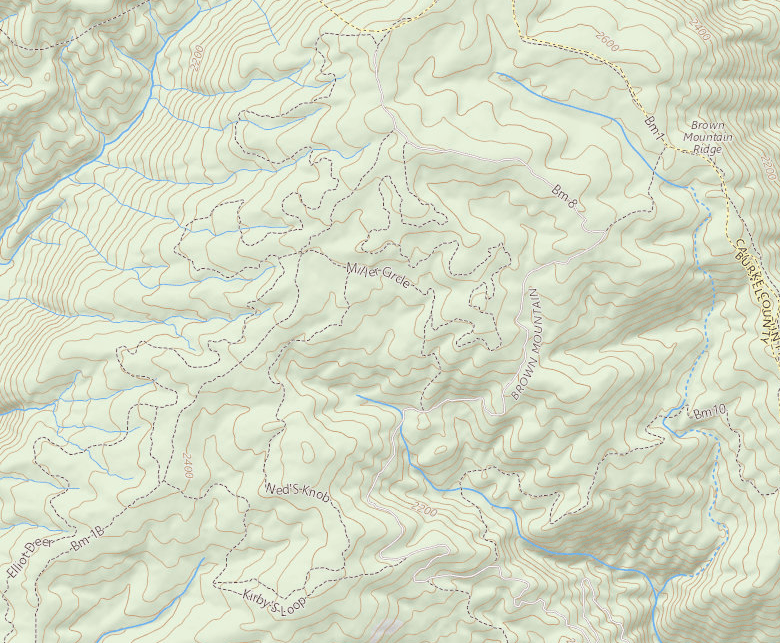
Contexto · Brown Mountain (Carolina del Norte), donde aparecen las 'luces' recurrentes
Brown mountain trails.png · Wikimedia Commons · Dominio público · abrir original
La noche en cuestión
Las luces de Brown Mountain son uno de los fenómenos luminosos recurrentes más antiguos y documentados de Estados Unidos. Se observan en el oeste de Carolina del Norte, sobre Brown Mountain, una cresta boscosa de baja altura entre los condados de Burke y Caldwell, en el borde de los montes Apalaches. Los testigos (observados desde miradores como Wiseman's View o la milla 310 de la Blue Ridge Parkway) describen luces que surgen sobre o cerca de la cresta, ascienden, se mantienen un instante, parpadean y se desvanecen, a veces de color rojizo o amarillo. La tradición actual les atribuye orígenes que van desde leyendas cherokee hasta interpretaciones de tipo paranormal, pero el informe del USGS de 1922 no halló relato publicado anterior a una crónica del Charlotte Daily Observer de septiembre de 1913, según la cual unos miembros de un club de pesca de Morganton la habían visto «hacía más de dos años» y se habían burlado de ellos.
“apareció cuatro veces sobre el horizonte lejano”
La fama del fenómeno creció tanto a comienzos del siglo XX que el propio Servicio Geológico de Estados Unidos (USGS) lo investigó en dos ocasiones. Una primera revisión, en octubre de 1913, a petición del congresista E. Y. Webb, la hizo el geólogo D. B. Sterrett, que tras unos días de observación declaró que las luces eran faros de locomotoras vistos sobre la montaña desde las alturas vecinas. Cuando una gran inundación en 1916 interrumpió durante semanas el tráfico ferroviario de la zona y las luces, según los reportes, siguieron apareciendo, surgió la objeción de que los trenes no podían ser la causa. Eso motivó un segundo y más exhaustivo estudio: el informe de George Rogers Mansfield, publicado por el USGS en 1922. Mansfield realizó observaciones instrumentales con una alidada telescópica y mapas, cotejadas con los horarios de los trenes, y concluyó que, de las luces que pudo estudiar con instrumentos, alrededor del 47 % correspondían a faros de automóviles, el 33 % a faros de locomotoras, el 10 % a luces fijas y el 10 % a fuegos de monte, todas ellas elevadas, desdobladas o hechas titilar por la refracción diferencial en la atmósfera del valle, una cuenca a la que al anochecer baja aire frío de distinta temperatura y densidad, sobre todo en los claros que siguen a la lluvia; la neblina y el polvo, escribió, dan a la luz los tonos rojizos o amarillentos que tanto se describen. Entre tanto, en 1919, el Weather Bureau había propuesto, a partir de cartas de testigos, una descarga eléctrica del tipo de la «luz de los Andes», y un entomólogo del Museo Nacional consideró posible pero improbable que fueran luciérnagas, por lo tardío de la hora.
La explicación de Mansfield es la dominante hasta hoy, pero el caso conserva una cola no completamente cerrada. El propio Mansfield aceptó que, durante las semanas de 1916 en que la inundación cortó todo el tráfico ferroviario a 40 o 50 millas de distancia, las luces, según los reportes, se siguieron viendo «como de costumbre», y escribió que eso mostraba que no podían atribuirse solo a los faros de locomotoras; su respuesta fue sumar los automóviles, las luces fijas y los fuegos de monte. La noche del 16 de julio de 2016, dos cámaras de lapso de tiempo de Daniel Caton y Lee Hawkins, de la Appalachian State University, registraron una luz que 'apareció cuatro veces sobre el horizonte lejano' y que 'no se mueve durante la exposición'; según Caton, se encendió y se apagó 'casi al instante cuatro veces en varios minutos'. Dijo haber descartado las fuentes humanas y naturales probables y planteó el rayo en bola como una posibilidad, no como conclusión. El mismo Caton estima que 'del orden del 95 %' de los reportes son luces de poblados, como las balizas de las antenas de telefonía. El cuadro resultante es el de un fenómeno mayoritariamente prosaico con un posible residuo natural genuino, todavía no consolidado.
Por qué importa
Brown Mountain importa como el caso de luces recurrentes con la mejor pedigrí institucional escéptica: es uno de los pocos fenómenos paranormales populares que motivó no una sino dos investigaciones del Servicio Geológico de Estados Unidos, con medición instrumental. El informe de Mansfield de 1922 es un modelo temprano de desmontaje metódico (cuantificar qué fracción de las luces corresponde a cada fuente convencional) y la luz sin identificar que registraron las cámaras de 2016 deja abierto un residuo.
Su valor metodológico está en la estructura del debate. El episodio de la inundación de 1916 ('las luces siguieron pese a que no había trenes') muestra cómo se refina una explicación: Mansfield no lo descartó, lo aceptó como prueba de que los trenes no bastaban y amplió el inventario de fuentes de luz en lugar de abandonar la explicación prosaica. A la vez, el trabajo de Appalachian State (2016) muestra la postura opuesta: no todo en un caso de luces tiene que ser identificación errónea, y un residuo natural genuino (un rayo en bola, como planteó Caton) es una hipótesis legítima y comprobable, distinta tanto del faro confundido como de lo no-humano.
Una lectura atenta sitúa a Brown Mountain en el mismo eje que Marfa, Min Min y Hessdalen, pero en una posición intermedia: más resuelto que Hessdalen, menos cerrado experimentalmente que Min Min. Junto con los otros, ancla el principio de que las luces recurrentes sobre relieve y valles (con tráfico, poblados e inversiones térmicas) son, por defecto, óptica atmosférica sobre fuentes ordinarias, y que la carga de la prueba para cualquier residuo natural exótico recae en la medición, no en la tradición.
Lo que queda en papel
Evidencia documentada
- Reportes recurrentes documentados desde comienzos del siglo XX, con miradores establecidos (Wiseman's View, milla 310 de la Blue Ridge Parkway)
- Primera revisión del USGS (D. B. Sterrett, octubre de 1913): atribuye las luces a faros de locomotoras
- Informe de George Rogers Mansfield para el USGS (1922, publicado como Circular 646 en 1971): de las luces estudiadas con instrumentos, 47 % faros de autos, 33 % locomotoras, 10 % luces fijas y 10 % fuegos de monte
- Inundación de 1916: según los reportes, las luces se siguieron viendo sin trenes, y Mansfield lo aceptó como prueba de que no bastaban los faros de locomotoras
- Appalachian State University (Daniel Caton, julio de 2016): dos cámaras registran una luz no identificada, con el rayo en bola como posibilidad; Caton estima que ~95 % de los reportes son luces de poblados
- Primer relato publicado según Mansfield: Charlotte Daily Observer, 23 sep 1913; en 1919 el Weather Bureau propuso una descarga eléctrica tipo «luz de los Andes»
Fuentes
- George Rogers Mansfield, 'Origin of the Brown Mountain Light in North Carolina', U.S. Geological Survey (1922; Circular 646, 1971) — Informe instrumental que atribuye la mayoría de las luces a fuentes convencionales refractadas.
- WFDD — 'Mysterious Brown Mountain Lights Caught On Tape, Questions Remain' (10 ago 2016), con Daniel Caton (Appalachian State University) — Registro de una luz no identificada en julio de 2016 y estimación de Caton de que ~95 % de los reportes son luces de poblados.
- WLOS — 'ASU scientists capture rare images of WNC's Brown Mountain Lights' (2016) — Las dos cámaras de lapso de tiempo de Caton y Hawkins y la descripción de la luz que se encendió cuatro veces.
- U.S. Forest Service / Pisgah National Forest — registro de los miradores de Brown Mountain — Documenta los puntos oficiales de observación y la tradición del fenómeno.
Casos relacionados
misma explicación · mismo país
Luces de Marfa · Texas
1883 · Tier B
misma explicación · mismo país
Nash-Fortenberry · dos pilotos de Pan Am (Virginia)
1952 · Tier A
misma explicación · mismo país
Haynesville · luz pulsante y corteza quemada
1966 · Tier B
misma explicación · mismo país
Esfera Betz · Isla Fort George
1974 · Tier B