1965·Isla Decepción, Islas Shetland del Sur (Antártida)
Antártida · Isla Decepción (bases AR/CL/UK).Isla Decepción · luces sobre las bases antárticas (1965)
El 3 de julio de 1965 la base chilena Aguirre Cerda y la base naval argentina Decepción, en la misma isla, informaron de una luz multicolor que se desplazaba y se detenía; ese día, en la base argentina de las Orcadas del Sur, dos meteorólogos vieron un cuerpo blanco-azulado durante 15 segundos mientras dos variómetros registraban una perturbación. Pero el intento de fotografiar la luz fracasó, el Informe Condon halló la perturbación dentro de las fluctuaciones diarias normales, y un estudio posterior atribuye los avistamientos clave a un meteoro, al satélite Echo II y a estrellas o planetas brillantes.
Tier A · Aceptable¿Qué significan? →
Evidencia institucional: varios testigos independientes identificados, o documentación oficial de la época, sin un registro instrumental que los corrobore.
Qué fue
74%causa natural o humana
Explicación más probable: planeta o estrella
Ver el reparto entre las seis explicaciones
Causa natural o humana
Sin causa conocida
Leer el porqué completo
Las otras dos observaciones clave de ese día tienen otra causa según el mismo informe: la de la base chilena a las 19:20, el satélite Echo II «o, en todo caso», Spica o Arcturus, y la de las Orcadas, un fenómeno «asimilable a un meteoro». El informe advierte que subsisten contradicciones de peso en los datos y presenta sus explicaciones como las más probables, no como demostradas.Documentos primarios
Aerograma A-208 de la embajada de EE. UU. en Buenos Aires, «Celestial Body Observed over Antarctica» (4 de septiembre de 1965), 1 pág.
Aerograma confidencial, hoy desclasificado, que la embajada en Buenos Aires envió al Departamento de Estado en respuesta a una consulta del 16 de agosto; lo firma Albert Mayio, consejero para asuntos comerciales y económicos. Remite a un informe de inteligencia del Departamento de Defensa del 16 de julio con la traducción de cuatro mensajes recibidos por el Servicio de Hidrografía Naval argentino sobre objetos no identificados. Dice que la agregaduría naval pidió más datos a la Armada, pero que no los habrá hasta el relevo de verano de las bases antárticas, y que el Observatorio de La Plata declaró no tener teoría sobre los objetos, aunque señaló que se vieron cuando el satélite Echo II orbitaba sobre la zona antártica.
Departamento de Estado de EE. UU. (publicado por la NSA en su colección sobre ovnis; espejo de archive.org) · Dominio público · obra del Gobierno de EE. UU. · abrir original
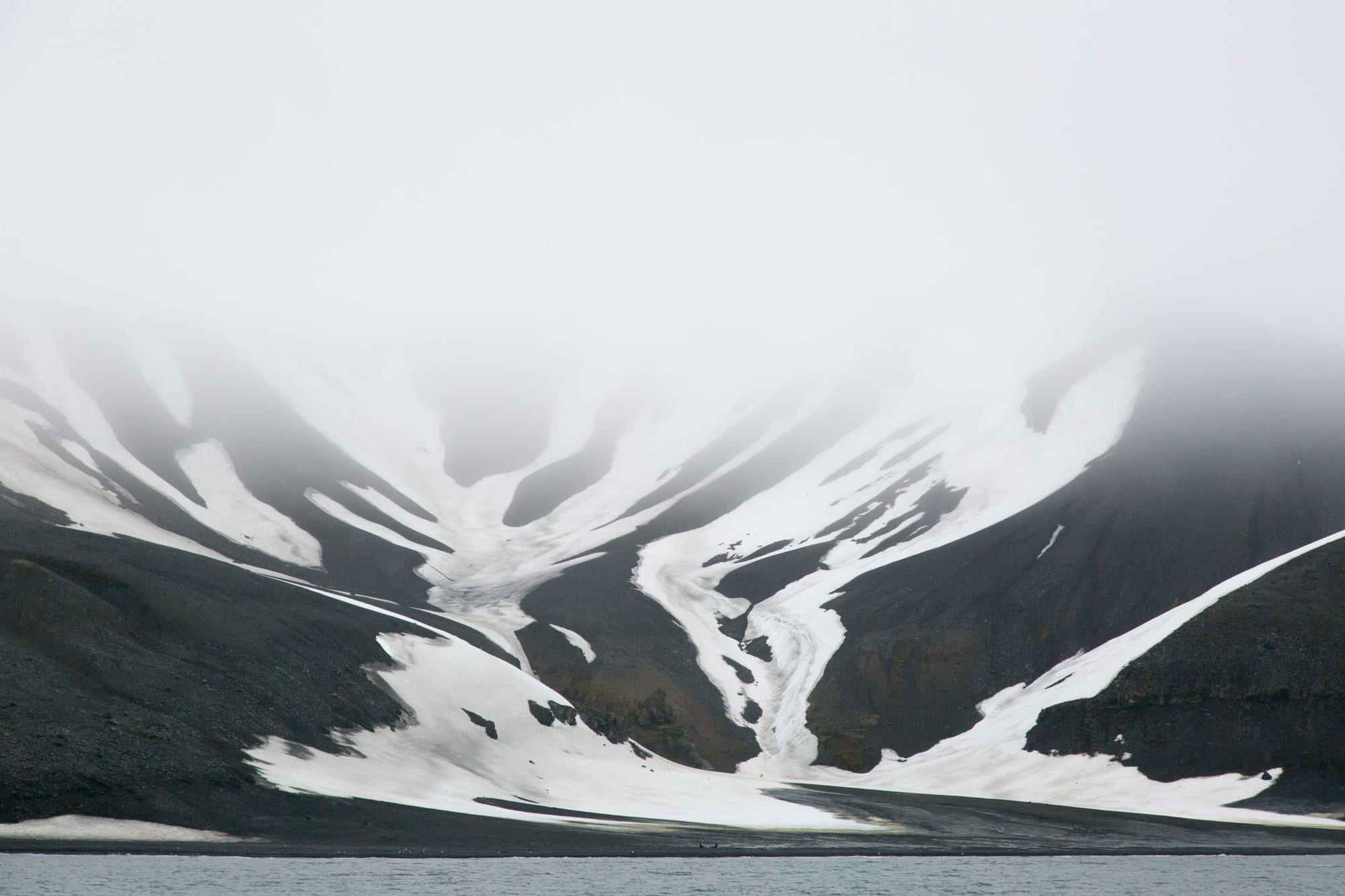
Contexto · isla Decepción (Antártida), la caldera volcánica donde tres bases informaron de luces en 1965
Deception Island (195760163).jpeg · Wikimedia Commons · CC BY-SA 3.0 · abrir original
La noche en cuestión
La Isla Decepción, una caldera volcánica activa de las Islas Shetland del Sur, fue durante la Guerra Fría un punto de fricción soberana: argentinos, chilenos y británicos mantenían bases científico-militares a corta distancia unas de otras, en un solapamiento de reclamos antárticos. Ese contexto (tres dotaciones vigilantes y mutuamente desconfiadas en un mismo enclave) es lo que da interés al episodio. En las semanas previas se habían reportado luces de colores en movimiento sobre el cielo antártico; la estación británica recibió noticia de avistamientos vistos desde la estación argentina los días 7 y 20 de junio (un estudio posterior sitúa el segundo el 18 de junio y solo desde la base chilena).
El 3 de julio de 1965, en plena noche polar austral, hacia las 19:20, la base chilena Presidente Pedro Aguirre Cerda informó de una luz que cruzaba el cielo; según su comunicado la vieron nueve personas, y el astrónomo Erich Paul Heilmaier, de la Universidad Católica de Chile, pidió tomar ese relato con reserva por tratarse de observadores sin formación. Dos minutos después de que terminara la observación chilena, a las 19:42, el observador meteorológico de la base naval argentina Decepción vio una luz de aspecto sólido y forma lenticular, roja y verde con destellos amarillos, azules y blancos, que avanzaba, se detenía y cambiaba de rumbo; la siguieron a simple vista, con binoculares y con un teodolito, tomando una estrella como referencia. El formulario de la Armada habla de 17 testigos, pero tres eran suboficiales chilenos que estaban de visita en la base argentina, y el comandante, el teniente de fragata Daniel Perissé, dio 62 minutos de observación, mientras que el comunicado dice de 15 a 20. El meteorólogo Jorge Stanich intentó fotografiarla sin éxito, porque la película era de baja sensibilidad, estaba oscuro y la luz se veía lejana; nunca se publicó una fotografía. El componente instrumental que más se cita no es el de Decepción, sino el del destacamento naval de las Orcadas del Sur, en la isla Laurie, a casi 900 km: ese día, a las 17:03, dos meteorólogos vieron durante 15 segundos un cuerpo redondo blanco-azulado y dos variómetros acusaron una perturbación del campo magnético. El Informe Condon examinó en microfilm los magnetogramas de las Orcadas y concluyó que la desviación fue pequeña, «un orden de magnitud» menor que las de una tormenta magnética y dentro de las fluctuaciones diarias normales; en Decepción también se habló de variaciones magnéticas (el astrónomo Heilmaier dijo que las habían registrado los magnetómetros de la estación argentina), pero el capitán José María Cohen, de la Armada Argentina, informó que las registradas por los instrumentos de la isla no excedían los límites de la variación normal. Una publicación de la propia Armada reconoce además que las mediciones geomagnéticas de las Orcadas no pudieron hacerse entre febrero y junio de 1965 por fallas de los instrumentos.
La Secretaría de Marina argentina difundió el 6 de julio un comunicado titulado «Avistaje de objetos voladores no identificados en la Antártida Argentina» y después un segundo comunicado sobre el intento fotográfico y las Orcadas, un reconocimiento oficial poco habitual para la época. Del lado británico, el jefe de la base, C. D. Walter, informó a los investigadores del Informe Condon que el único avistamiento de su dotación lo hizo el cocinero y que se tomó «como una broma», que ningún científico de la isla observó nada, que los chilenos situaban el fenómeno sobre la base argentina y los argentinos sobre la chilena, y que se sospechaba de bromas al comandante argentino. El Servicio Antártico Británico fechó la observación de ese cocinero, Bernard Chappel, en la noche del 2 de julio, aunque Chappel dijo décadas después que fue la misma noche que la de los argentinos. Walter añadió que, a comienzos de julio, en la base británica F de las islas Argentinas, una nube nacarada coincidió con una avería de los instrumentos magnéticos, y que los partes de radio mal interpretados pudieron alimentar la idea de efectos magnéticos. El Observatorio Astronómico de La Plata declaró a la prensa, tras el despacho de Reuters del 7 de julio, que no tenía teoría sobre los objetos, aunque señaló que los avistamientos ocurrieron cuando el satélite Echo II orbitaba sobre la zona antártica, según un aerograma de la embajada de Estados Unidos en Buenos Aires del 4 de septiembre. El Informe FOTOCAT n.º 3 recoge además un cálculo del observatorio publicado el 31 de julio: el Echo II, un globo metalizado de 41 m que a simple vista se veía más luminoso que las estrellas más brillantes, pudo verse desde Decepción desde las 19:21 hasta poco después de las 19:30, antes de entrar en la sombra de la Tierra. FOTOCAT halló correctos los horarios y direcciones de ese cálculo, pero no las elevaciones, y descartó el satélite para la luz de la base argentina, que apenas se movió durante una hora; el comandante Perissé ya había dicho que su objeto no coincidía con el Echo II, y, según escribió Roberto Banchs, citado en el mismo informe, tras hablar con la Armada el jefe de Astrometría del observatorio terminó reconociendo su «precipitada opinión». El documento de la CIA que suele citarse es un resumen del servicio de monitoreo de prensa FBIS que reproduce un cable de la agencia ANSA del 6 de julio, no un informe de inteligencia. El Informe FOTOCAT n.º 3, de Vicente-Juan Ballester Olmos y otros tres investigadores, reunió los formularios de la Armada, los cables y los archivos británicos desclasificados, entrevistó a testigos y concluyó que los tres avistamientos clave del 3 de julio fueron muy probablemente un meteoro, el Echo II y astros como Marte, Spica o Arcturus; el ingeniero civil Pablo Justo, que estaba en la base argentina, sostiene que solo vio una estrella que titilaba.
Por qué importa
Es un ejemplo temprano de una armada que difunde oficialmente un avistamiento de su propio personal, en un enclave donde tres Estados rivales tenían bases a pocos kilómetros. Esa estructura es la que la leyenda del caso explota: tres naciones, fotografía y registro magnético. Leído contra el registro primario, cada pilar se debilita: no hay fotos, la perturbación magnética más citada ocurrió en otra base, a casi 900 km, y fue normal, las variaciones de las que se habló en Decepción tampoco salieron de lo normal según la Armada, y las observaciones de las tres bases no son independientes ni simultáneas, con testigos chilenos dentro de la base argentina y un informe británico fechado en otra noche.
El comunicado oficial existe, los testigos de la base argentina fueron numerosos y describieron avances y detenciones, y el estudio que propone explicaciones prosaicas las presenta como las más probables, no como demostradas. Pero la latitud antártica y la larga noche de mediados del invierno austral favorecen justo los estímulos que ese estudio identifica (astros bajos que titilan y parecen cambiar de color por la turbulencia, el paso del Echo II, un meteoro), el efecto autocinético explica bien una luz que parece moverse sin referencias, y la instrumentación de 1965 (teodolito y película de baja sensibilidad) no permite discriminar. El caso sirve como lección sobre cómo un comunicado oficial y la cobertura de prensa convirtieron luces dispersas en un «avistamiento tri-nacional» con fotos y efectos magnéticos que el registro no contiene. Conserva su peso histórico e institucional, con la masa concentrada en la misidentificación astronómica.
Lo que queda en papel
Evidencia documentada
- Avistamientos del 3 de julio de 1965 en la base chilena Aguirre Cerda (19:20, nueve testigos según su comunicado) y en la base naval argentina Decepción (19:42, 17 testigos, tres de ellos chilenos de visita; 62 minutos según el formulario de la Armada, de 15 a 20 según el comunicado)
- Intento fallido de fotografiar la luz por la baja sensibilidad de la película, la distancia y la oscuridad; nunca se publicó una foto
- En la base argentina de las Orcadas del Sur, a casi 900 km, un cuerpo blanco-azulado visto 15 segundos coincidió con una perturbación en dos variómetros; el Informe Condon la halló «un orden de magnitud» menor que una tormenta magnética y dentro de la variación diaria normal
- Comunicados oficiales de la Secretaría de Marina argentina (6 de julio de 1965) y de la Fuerza Aérea de Chile
- Única observación británica: la del cocinero de la base, fechada el 2 de julio y tomada «como una broma» por el jefe de la base; ningún científico de la isla vio nada (Informe Condon)
Ver 2 evidencias más
- El Observatorio de La Plata dijo no tener teoría, pero señaló que el Echo II orbitaba entonces sobre la Antártida (aerograma de la embajada de EE. UU., 4 sep 1965), y según FOTOCAT calculó que pudo verse desde Decepción entre las 19:21 y hacia las 19:33, antes de la observación argentina; el Informe FOTOCAT n.º 3 atribuye los tres avistamientos clave a un meteoro, al Echo II y a astros como Marte, Spica o Arcturus
- El documento de la CIA es un resumen de prensa del FBIS que reproduce un cable de ANSA del 6 de julio de 1965
Fuentes
- Informe Condon — Scientific Study of Unidentified Flying Objects, vol. 1 (DTIC AD0680975), sección III, cap. 4 «Indirect Physical Evidence» (Roy Craig), pp. 148-149 — Magnetogramas de las Orcadas examinados en microfilm: desviación dentro de las fluctuaciones diarias normales; testimonio del jefe de la base británica (el cocinero, «una broma», ningún científico vio nada), del astrónomo Heilmaier y del capitán Cohen.
- CIA / FBIS — resumen de prensa argentina de julio de 1965, «Antarctic flying saucers» (DOC_0000015255) — Copia en archive.org del documento de la sala de lectura de la CIA: un resumen del servicio de monitoreo FBIS que reproduce un cable de la agencia ANSA del 6 de julio de 1965, no un informe de inteligencia.
- Embajada de EE. UU. en Buenos Aires, aerograma A-208 al Departamento de Estado, «Celestial Body Observed over Antarctica», 4 sep 1965 (colección NSA UFO) — El Observatorio de La Plata no tenía teoría sobre los objetos, pero señaló que el Echo II orbitaba entonces sobre la Antártida; la Armada no tendría más datos hasta el relevo de verano.
- Ballester Olmos, Borraz, Janosch y Victorio Uranga — Informe FOTOCAT n.º 3, «Avistamientos OVNI en la Antártida en 1965» (análisis secundario con documentos primarios) — Estudio que reúne los formularios de la Armada argentina, los cables de las bases, la correspondencia británica desclasificada (AIR 2/17982) y entrevistas a testigos; atribuye los tres avistamientos clave a un meteoro, al satélite Echo II y a astros.
- CEFORA — transcripción del comunicado de la Secretaría de Marina del 6 de julio de 1965 (fuente secundaria) — Fuente secundaria que transcribe el comunicado oficial argentino y resume el intento fallido de fotografiar la luz.
Casos relacionados
mismo objeto · misma época
Edwards AFB · las cintas de 1965
1965 · Tier A
mismo objeto · misma época
Minot AFB B-52
1968 · Tier S
mismo objeto · misma época
Puente Almuhey · la luz del suroeste y el disco que se partía en tres
1968 · Tier B
mismo objeto · misma época
Vuelo IB-435 Palma–Madrid · la luz que era Venus (1969)
1969 · Tier A