Caso Nº 136·Suecia
2025·Palomar Observatory, California (data set); Stockholm University / IAC Canarias (análisis)
Suecia.POSS-I Transients ↔ tests nucleares + UAP (Bruehl & Villarroel)
Paper revisado por pares en Nature Scientific Reports (oct 2025) por Bruehl y Villarroel. Dataset de 2,718 días (19 nov 1949 a 28 abr 1957, completamente pre-Sputnik) con transitorios identificados en placas del Palomar Observatory Sky Survey. Dos asociaciones estadísticamente significativas: los transitorios son 45% más probables ±1 día de un test nuclear (p=0.008) y por cada UAP report adicional el mismo día hay 8.5% más transitorios identificados (p=0.015). Es la correlación peer-reviewed más fuerte del corpus entre actividad nuclear, registros UAP de la época y observaciones astronómicas independientes.
Año
2025
Tier
S
Probabilidad
60%
Categoría
Documento
Evidencia fuerte: registro de sensor instrumental + múltiples testigos (típicamente militar). Tres ejes independientes: el «tier» mide la fuerza de la evidencia; la «probabilidad» estima cuán genuinamente inexplicado está el caso —un fenómeno natural puede seguir sin explicación, así que no equivale a «no-prosaico»—; y la partición de explicaciones (abajo) dice qué fue más plausiblemente. Por eso un caso bien documentado puede tener como causa más plausible un posible fraude, y un Tier B no es, por eso, un fraude.
Documentos primarios · visor
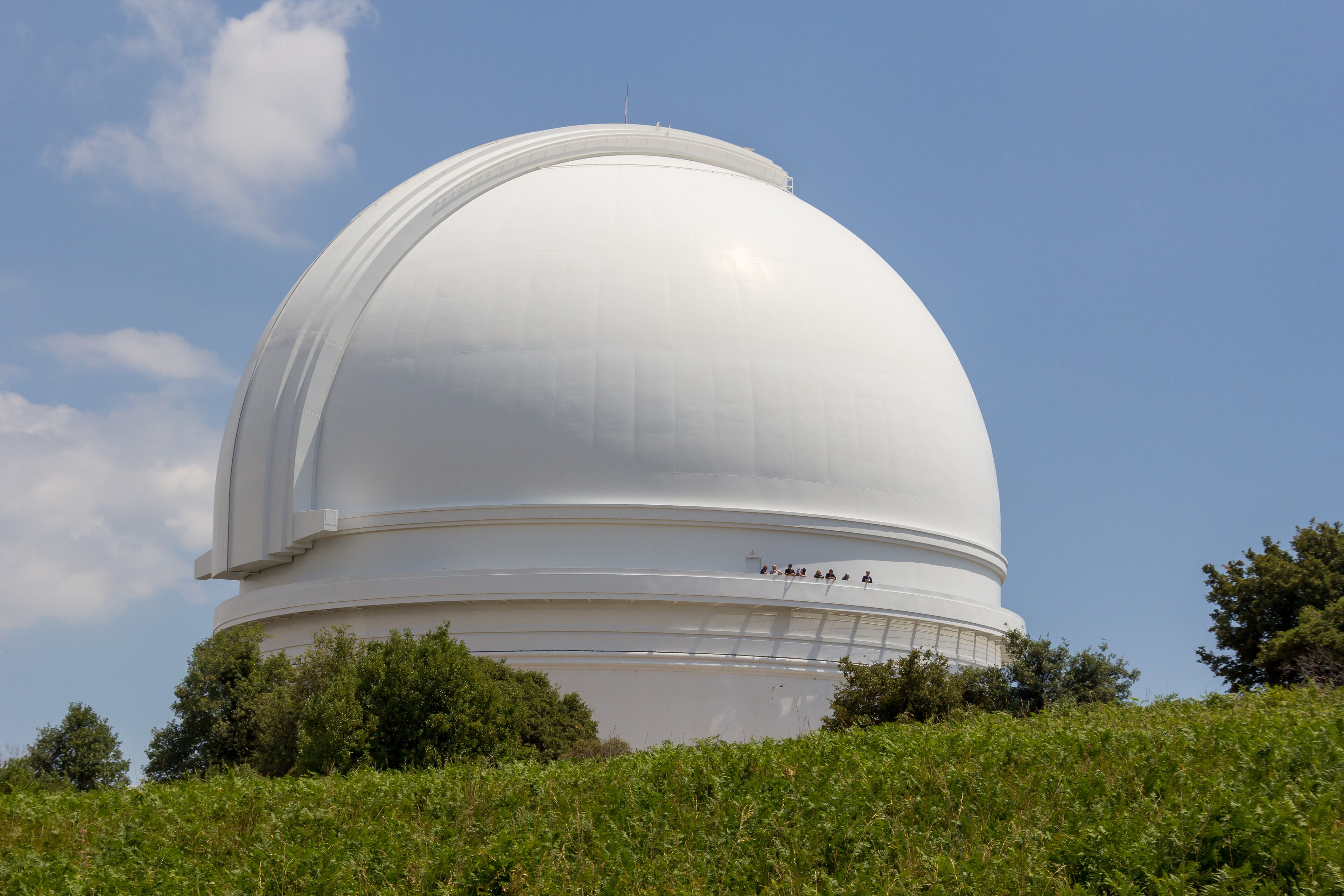
Contexto · el Observatorio Palomar (California), fuente del conjunto de datos
Palomar Observatory 2012 01.jpg · Wikimedia Commons · CC BY-SA 4.0 · abrir original
Parte 01
El expediente en cuestión
El POSS-I (Palomar Observatory Sky Survey, primera campaña) es el primer mapeo fotográfico sistemático del cielo nocturno del hemisferio norte, ejecutado por el Mount Palomar Observatory entre 1949 y 1958 con el telescopio Schmidt de 48 pulgadas. La campaña capturó miles de placas de archivo que hoy permiten comparación pixel-a-pixel con surveys CCD modernos.
Desde 2019, la astrofísica Beatriz Villarroel (Nordita / Stockholm University / IAC Canarias) lidera el proyecto VASCO (Vanishing & Appearing Sources during a Century of Observations) sobre estas placas. En 2021 publicó en Nature Scientific Reports el primer paper identificando nueve fuentes puntuales que aparecen en media hora en una placa del 12 de abril de 1950 y desaparecen en placas anteriores, posteriores y en surveys CCD modernos varios magnitudes más profundos. La pregunta crítica: ningún satélite humano podía generar esos puntos —Sputnik se lanzó en octubre de 1957, 7 años después.
En octubre de 2025, Bruehl y Villarroel publicaron en Nature Scientific Reports el paper que el corpus registra como caso ancla. Construyeron un dataset diario de 2,718 días (19 nov 1949 a 28 abr 1957, completamente pre-Sputnik) cruzando tres fuentes: transitorios identificados en placas POSS-I, registros públicos de detonaciones nucleares atmosféricas (Trinity follow-ups, Operation Greenhouse, Operation Buster-Jangle, etc.) y reportes UAP independientes de la época (Project Blue Book, archivos militares desclasificados). El análisis estadístico mostró dos asociaciones significativas: los transitorios son 45% más probables en una ventana de ±1 día de un test nuclear (p=0.008), y por cada UAP report independiente adicional en el día hay un 8.5% más transitorios identificados (p=0.015). El paper es cuidadosamente conservador en su interpretación: documenta la correlación, no afirma causalidad, y enumera explícitamente hipótesis competidoras (contaminación de placas, sesgo de búsqueda, fenómeno atmosférico inducido por radiación, artefactos en órbita anteriores a 1957).
La hipótesis nula más fuerte que el debate científico ha opuesto al trabajo de VASCO es la contaminación de placas: las emulsiones fotográficas del POSS-I se procesaron y almacenaron durante décadas, y partículas radiactivas, defectos de revelado, polvo o asteroides cercanos pueden producir puntos espurios que imitan 'transitorios'. Que estos artefactos aparezcan más cerca de fechas de pruebas nucleares —cuando la atmósfera y los propios laboratorios manejaban más material radiactivo— es una explicación competidora que no requiere ningún objeto en el cielo. El propio equipo ha intentado responder a esto: la réplica independiente publicada en arXiv introduce el llamado 'Earth Shadow Deficit' como control de sesgo de selección — la idea de que objetos reflectantes genuinos en órbita deberían escasear cuando entran en la sombra de la Tierra, un patrón que el ruido de placa no debería exhibir. El tamaño del efecto, en cualquier caso, es modesto, y ninguno de los autores afirma haber probado la existencia de objetos físicos; lo que el corpus registra es la calidad del aparato, no la fuerza de la conclusión.
Parte 02
Por qué este caso movió la aguja
Es el caso ancla del corpus para evidencia científica rigurosa peer-reviewed sobre el fenómeno UAP. Estructuralmente comparable al Battelle Special Report 1952 (estadística sobre Blue Book) y al Informe Rommel 1980 (federal, escéptico, riguroso): paper publicado, dataset reproducible, metodología auditable, intervalos de confianza explícitos. Su importancia es triple. Primero, es pre-Sputnik: elimina la hipótesis 'satélites humanos' que cierra rápidamente las correlaciones post-1957. Segundo, articula la línea histórica nuclear–UAP (Malmstrom 1967, Loring 1975, Hessdalen) con un dato cuantitativo independiente de testimonio militar. Tercero, viene de astronomía profesional, no de UAP-research: la corroboración sería más fuerte por venir de un dominio metodológico distinto. Sus límites también son nítidos: correlación no es causalidad, el size del efecto es modesto, las hipótesis competidoras (contaminación de placas, sesgo de búsqueda) están en la mesa. Tier S no por la fuerza de la conclusión, sino por la calidad del aparato evidencial: peer review en Nature SR, datos públicos, código y placas accesibles para replicación.
Parte 03
Lo que queda en papel
Evidencia documentada
- Paper Bruehl & Villarroel — 'Transients in the Palomar Observatory Sky Survey (POSS-I) may be associated with nuclear testing and reports of unidentified anomalous phenomena' — Nature Scientific Reports (oct 2025), DOI 10.1038/s41598-025-21620-3
- Dataset diario de 2,718 días (19 nov 1949 – 28 abr 1957), completamente pre-Sputnik (lanzado oct 1957)
- Asociación 1: transitorios 45% más probables ±1 día de test nuclear (p=0.008)
- Asociación 2: 8.5% incremento de transitorios por cada UAP report adicional el mismo día (p=0.015)
- Paper anterior Villarroel et al. 2021 (Scientific Reports 11, 12794) que identifica los 9 transitorios simultáneos del 12 abr 1950, base metodológica del paper 2025
- Cobertura científica independiente: phys.org (oct 2025), Newsweek (2025), Sciety Labs (preprint pre-publicación)
- Réplica independiente publicada en arXiv (2604.00056) corroborando correlación nuclear-transient con metodología distinta + Earth Shadow Deficit como check de selection bias
- Sitio web público del proyecto VASCO con datos, código y procedimiento de citizen science para validación cruzada
Fuentes
- Bruehl, R. & Villarroel, B. — 'Transients in the Palomar Observatory Sky Survey (POSS-I) may be associated with nuclear testing and reports of unidentified anomalous phenomena' (Scientific Reports, 2025) — Paper ancla. Nature Scientific Reports, octubre 2025.
- Villarroel, B. et al. — 'Exploring nine simultaneously occurring transients on April 12th 1950' (Scientific Reports 11, 12794, 2021) — Base metodológica. DOI 10.1038/s41598-021-92162-7.
- Independent Replication of Nuclear Test-Transient Correlations and Earth Shadow Deficit in POSS-I Photographic Plates (arXiv 2604.00056) — Replicación independiente con metodología distinta + Earth Shadow Deficit como control de selection bias.
- phys.org — 'Mysterious transient objects in sky linked to nuclear testing and unidentified anomalous phenomena' (oct 2025) — Cobertura científica del paper en prensa especializada.
- VASCO project — Vanishing & Appearing Sources during a Century of Observations — Proyecto liderado por Villarroel. Datos públicos, código abierto, citizen science.
Patrones que exhibe (2)
Ubicación
Palomar Observatory, California (data set); Stockholm University / IAC Canarias (análisis) · 33.36°, -116.86°
Casos relacionados
Actores asociados (1)