2025·Angren, Tashkent Region, Uzbekistan
Uzbekistan.Angren · a line of about 25 lights filmed crossing the sky
At about 2:30 a.m. on July 3, 2025, a line of points of light was filmed crossing the sky over an area of Angren near the mountains, in Uzbekistan's Tashkent Region. Subscribers of the online newspaper Kun.uz sent the newspaper videos, and the people who saw the lights compared them to a rocket. Ahror Agzamov, of the state space agency Uzbekcosmos, told Kun.uz that the line, of about 25 points, was most likely Starlink satellites from the batch SpaceX had launched from Florida on July 2.
Tier B · IndicativeWhat do they mean? →
Limited evidence: it falls short of what Tier A requires. Any one of these is enough: a single testimony (or several witnesses who saw it together), testimony gathered years later, or an account without contemporary primary documentation.
What it was
95%satellite
The most likely explanation.
- 95% satellite
- 2% other earthly causes
- 3% no known cause
See the split across the six explanations
Earthly origin (human or natural)97%
No known cause3%
Ordinary cause the sources propose: satellite
What happened
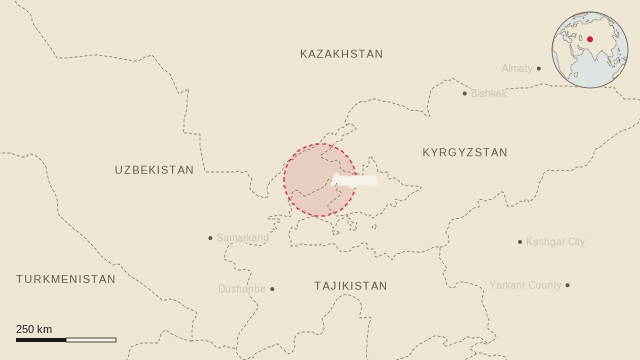
On the night of July 2 to 3, 2025, at about 2:30 a.m. Uzbekistan time, a line of lights was filmed crossing the sky over Angren, a city in the Tashkent Region at the foot of the mountains, about 80 km southeast of the capital. According to the Uzbek online newspaper Kun.uz, its subscribers sent in the videos, filmed in an area of the city near the mountains, and the people who saw the lights compared them to a rocket. Kun.uz does not name the people who filmed.
On the evening of July 3, Kun.uz's video channel on Telegram posted a 13-second clip carrying the newspaper's logo. At the start, a hand points at the sky above some trees, and high up there is a short streak of light. When the camera zooms in, the streak turns out to be a straight, tight row of points of light, which the camera follows as it crosses the sky diagonally.
Kun.uz asked Uzbekcosmos, Uzbekistan's state agency for space research and technologies, created in 2019 by presidential decree. Ahror Agzamov, head of its department for introducing new technologies, told the newspaper that the video showed a chain of about 25 bright points moving in a single line, and that they were most likely Starlink communications satellites, made by the American company SpaceX. He noted that on July 2, at 2:28 a.m. Eastern Time, SpaceX had launched 27 of those satellites from Florida.
Agzamov explained that in the first few days after launch the satellites travel very close together, in a low orbit of about 500 km, so from the ground they look like a chain of lights following the same line; later they spread out to their working orbit and become much less noticeable. He added that they move at about 27,000 km/h and circle the Earth in about 90 minutes, and that the speed in the video was normal for objects in low orbit.
According to Agzamov, the best time to see them is after sunset, while the sky is not yet fully dark: it is already night on the ground, but the satellites, higher up, still catch the Sun's light. Kun.uz added that the video was filmed close to dawn, with the sky growing lighter and the ground still dark, and that this resembled what the specialist described. Agzamov concluded that what was seen over Uzbekistan was most likely the Starlink satellites launched on July 2, and called it a beautiful but scientifically understandable phenomenon of the modern space age.
The GCAT catalog of space objects, published by astrophysicist Jonathan McDowell of the Harvard-Smithsonian Center for Astrophysics, records that launch. A Falcon 9 rocket lifted off from Cape Canaveral at 06:28 UTC on July 2, 11:28 a.m. in Uzbekistan, carrying the Starlink 10-25 group of 27 satellites. The satellites were released an hour later into an orbit inclined 53 degrees to the equator, and for July 4 the catalog gives them an altitude of about 270 km, lower than the 500 km Agzamov cited. When the video was filmed in Angren, about 15 hours had passed since liftoff.
Where it happened
Why it matters
Uzbekcosmos based its identification on the launch date, the shape of the line and its speed. The time and the place fit too. To check this, the group's path was worked out from the launch time and the orbital inclination given in the GCAT, assuming a circular orbit between 270 and 350 km high: depending on the altitude assumed, the group passed near Angren between 2:30 and 3:00 a.m. It crossed the sky from west-southwest to northeast, north of the city, climbing halfway up the northwestern sky. The calculation does not use the measured positions for those days that the U.S. Space Force publishes on Space-Track, so the time of the pass has a margin of several minutes.
A satellite can be seen only when sunlight reaches it. At 2:30 a.m. the Sun was almost 20 degrees below Angren's horizon, to the north-northeast, the side it passes under at night in midsummer. Above the city, the Earth's shadow reached higher than the satellites, so they crossed the southern half of their pass in darkness. To the north, on the Sun's side, the shadow was lower: there the satellites caught the sunlight and a witness could see them in a line.
The calculation and the GCAT qualify two details of the explanation. The first is the time. Agzamov spoke of the period after sunset, and Kun.uz wrote that the video was filmed as the sky was growing lighter. At 2:30 a.m., however, it was still full night in Angren: the sky did not begin to lighten, and then almost imperceptibly, until about 2:46 a.m., and the Sun rose at 4:53 a.m. The satellites did not need a light sky; they only had to pass to the north, where the shadow was lower. The second is the altitude: Agzamov gave about 500 km, the GCAT about 270. At the GCAT altitude the group passes Angren at the time of the video, so the difference does not change the conclusion.
SpaceX has launched Starlink satellites in groups since May 2019, according to the GCAT, and in its first days each group travels together and low, like the line over Angren. In Uruguay, in 2026, the Air Force's UFO commission attributed to Starlink and other low-orbit satellites 25 reports of lights received over one month (↗ Uruguay). In Angren the explanation came the same day, from the state space agency and through the press, though without a published calculation of the path or an identification of each point.
Documents and sources
Documented evidence
- Kun.uz, July 3, 2025 (11:34 p.m. Uzbekistan time): the newspaper's subscribers sent videos filmed at about 2:30 a.m. on the night of July 2 to 3 in an area of Angren near the mountains; the people who saw the lights compared them to a rocket. The article does not name the people who filmed.
- Kun.uz's video channel on Telegram posted on July 3, 2025, at 13:35 UTC, a 13-second clip with the same title as the article: a hand points at the sky above some trees, and the camera zooms in on a straight row of points of light.
- Ahror Agzamov, head of Uzbekcosmos's department for introducing new technologies, told Kun.uz that the video showed about 25 bright points in a line, most likely Starlink satellites, and that SpaceX had launched 27 from Florida on July 2 at 2:28 a.m. Eastern Time; he spoke of an initial orbit of about 500 km, a speed of 27,000 km/h and one orbit in about 90 minutes.
- McDowell's GCAT records launch 2025-144: a Falcon 9 lifted off from Cape Canaveral (pad LC40) at 06:28:10 UTC on July 2, 2025, carrying the Starlink 10-25 group of 27 satellites.
- The GCAT satellite catalog gives the group's 27 satellites (2025-144A onward) separation at 07:32:27 UTC on July 2, an inclination of 53.16 degrees and, for July 4, orbits between 265 and 270 km high.
- By a calculation made for this case from the launch time, the GCAT inclination and circular orbits 270 to 350 km high, the group passed near Angren between 2:30 and 3:00 a.m. local time, from west-southwest to northeast, peaking 35 to 50 degrees high toward the northwest; the Sun was 19.6 degrees below the horizon at 2:30 a.m., and the satellites were in sunlight only on the northern part of the pass, by then lower in the sky.
Sources
- Kun.uz, "O‘zbekiston osmonida qatorlashib uchayotgan jismlar ko‘rindi. «O‘zbekkosmos» holatni tushuntirib berdi" (Jul 3, 2025) — In Uzbek ("Objects flying in a line were seen in Uzbekistan's sky; Uzbekcosmos explained what happened"). Place and time of the videos, and statements by Ahror Agzamov of Uzbekcosmos.
- Kun.uz Video, Telegram channel, post No. 202 (Jul 3, 2025, 13:35 UTC) — 13-second clip of the lights, the one that goes with the article; the person who filmed is not named.
- Jonathan McDowell, General Catalog of Artificial Space Objects (GCAT), launch list, entry 2025-144 — Falcon 9 from Cape Canaveral, July 2, 2025, at 06:28:10 UTC, Starlink Group 10-25 mission with 27 satellites.
- Jonathan McDowell, General Catalog of Artificial Space Objects (GCAT), satellite catalog, entries 2025-144A to 2025-144AC — Separation at 07:32:27 UTC on July 2, 2025, an inclination of 53.16 degrees, and orbits between 265 and 270 km high as of July 4.
- Uzbekcosmos, "History of the creation of the Space Research and Technology Agency," gov.uz — The agency was created on August 30, 2019, by presidential decree PF-5806.
Related cases
Cases this case cites and cases with the same likely cause.
Cited in this case · Within 10 years
Uruguay · residents in nine departments see lights in formation
2026 · Tier A
Satellite · Within 10 years
Caleta Lobos · three airline crews see lights below Orion's Belt
2024 · Tier A
Satellite · Within 10 years
Paposo · three airline crews see lights over the desert
2023 · Tier A
Satellite · Within 10 years
Calama · the light “following” an Argentine Learjet
2023 · Tier B