1897·Aurora, Wise County, Texas
United States.Aurora, Texas · a newspaper reports an airship crash
On April 19, 1897, the Dallas Morning News printed a dispatch by S. E. Haydon, datelined Aurora, Texas, April 17. It said an airship had hit a judge's windmill and exploded, and that its only occupant, dead, "was not an inhabitant of this world." No source from the time confirms it. The story came back in 1973, with very elderly witnesses, metal fragments found with a detector and a grave the cemetery would not let anyone open. The Handbook of Texas calls the article "fictional."
Tier B · IndicativeWhat do they mean? →
Limited evidence: it falls short of what Tier A requires. Any one of these is enough: a single testimony (or several witnesses who saw it together), testimony gathered years later, or an account without contemporary primary documentation.
What it was
89%possible hoax
The most likely explanation.
- 89% possible hoax
- 11% no known cause
See the split across the six explanations
Earthly origin (human or natural)89%
No known cause11%
Ordinary cause the sources propose: possible hoax
What happened
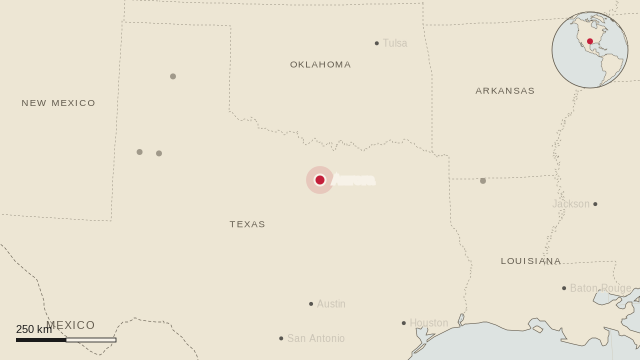
In April 1897 the mystery airship wave, which had begun in California in November 1896 (see ↗ United States), reached Texas. According to Walter Andrus, director of MUFON (Mutual UFO Network, a civilian UFO research group), the Dallas and Fort Worth papers published more than 500 reports between April 14 and 27. According to the British magazine Magonia, not a few reporters invented sightings. On Monday the 19th, the Dallas Morning News printed a page full of airship stories. One came from Aurora, a town in Wise County about 30 miles north of Fort Worth.
The dispatch was headed "A Windmill Demolishes It," datelined Aurora, April 17, and signed S. E. Haydon. It said that about six in the morning the early risers of the town saw the airship that had been sailing through the country. It was heading north, closer to the ground than before, at ten or twelve miles an hour, as if some of its machinery was out of order. It crossed over the public square, hit the tower of Judge Proctor's windmill and went to pieces in a terrific explosion that scattered debris over several acres, wrecked the windmill and water tank and destroyed the judge's flower garden.
The pilot, supposed to have been alone on board, was badly disfigured, but enough had been picked up to show that he "was not an inhabitant of this world." T. J. Weems, the U.S. Signal Service officer in town and "an authority on astronomy," gave it as his opinion that he was a native of Mars. Papers found on his person, "evidently the record of his travels," were written in unknown hieroglyphics and could not be deciphered. The ship, made of an unknown metal resembling a mixture of aluminum and silver, must have weighed several tons. The town was full of people gathering specimens of the metal, and the pilot's funeral would be at noon the next day.
According to the Handbook of Texas, Haydon was a cotton buyer in Aurora, a declining town. The Handbook calls his article "fictional," an apparent attempt to bring attention to the community. The surname is also spelled Hayden, as in Time. According to Magonia, no other newspaper carried or commented on the account, and according to MUFON's 2021 web page Haydon never followed up, not even on a burial.
Mike Cox, a Texas history journalist, writes that no one in 1897 took the story seriously, because fiction in the guise of news was as common as patent medicine ads. Time says it was "generally ridiculed at the time."
The account lay dormant for almost seventy years. In 1966 Frank Masquelette of the Houston Post reprinted it and checked with the Wise County Messenger. All that turned up was that a Judge Proctor had lived in the area, and Masquelette concluded it was "pure fiction." In 1966 and 1967 UFO enthusiasts and reporters came to town, found no witnesses, and their metal detectors turned up no wreckage. Investigators tied to Flying Saucer Review pronounced the story a hoax. According to Cox, Dr. Alfred E. Kraus quietly looked into the case in 1966 for the Condon Committee, searched with a metal detector and told Condon there was nothing.
Etta Pegues, a local writer, declared the account a hoax in articles published in the county press between 1966 and 1972, based on interviews with two former residents who had known Proctor and Haydon. According to them, Haydon, a cotton buyer, hoped the story would bring some life to a failing town, and he was remembered for satirical verses. Pegues added that the judge had no windmill and that every grave in the cemetery was on a map with a record for each burial, with no Martians among them. She told Time in 1979, at age 86, "Hayden wrote it as a joke and to bring interest to Aurora. The railroad bypassed us, and the town was dying."
The story returned in the spring of 1973. In March, Hayden Hewes, director of the International UFO Bureau of Oklahoma City, arrived in Aurora. Bill Case, aviation writer for the Dallas Times Herald and MUFON's state director for Texas, covered the search. According to Magonia, Case's paraphrase of the dispatch contained errors and details from other 1897 accounts. On May 24, UPI (United Press International) quoted Hewes: after checking the grave with metal detectors and gathering facts for three months, they were "certain as we can be" that he was the pilot of a UFO. According to Magonia, Hewes withdrew afterward and said it was a hoax.
In 1973 very elderly witnesses appeared. According to Skylook, MUFON taped Charlie Stephens, who said his father, James, saw the crash; the father mentioned no body and did not go to the site until the next day. Magonia describes an unnamed local man, five years old in 1897, whose father saw the crash and whose account matched Case's version, errors included. He seems to be the same man, but Magonia does not name him; MUFON's 2021 page gives Stephens as 10 and says he saw the airship trailing smoke.
Mary Evans, 91 (15 in 1897), told Case that her family and friends talked about the crash and that her parents went to the site, but she was not allowed to go. In a second interview she added that a body was recovered and that a piece of the craft was stuck up as a marker in the cemetery. According to UPI, she remembered the pilot as "a small man" and had all but forgotten the incident until it appeared in the papers.
Skylook says a grave with a triangular marker of local sandstone was found with a metal detector, in a part of the cemetery where the records were incomplete and did not identify the owner of the plot or the person buried. The stone had a scratched drawing that looked like the front of an object with three portholes. Magonia credits MUFON with the find and says two former residents over ninety led researchers to a grave under an oak. Town marshal H. R. Idell and other residents said the stone had been there "at least 65 to 70 years and probably longer." It disappeared on June 14, 1973, after the Times Herald published its photo.
According to Cox, on March 25 a team of ufologists was already searching for a grave under a large oak, marked by a rock with an unusual design. According to Magonia, the grave Hewes wanted to open, turned out to belong to the Carr family, as the cemetery association showed. The sources do not make clear whether it is the same grave as the marker's, or how that squares with Pegues saying every grave was on a map with records, and Skylook saying the records in that area were incomplete.
In May, according to Cox, a treasure hunter found more than a dozen fragments on the windmill hilltop and at the cemetery. A 1973 AP (Associated Press) story says a North Texas State University professor found fragments near the Oates gas station, on the former Proctor farm. One was "most intriguing": mostly iron, not apparently magnetic, "shiny and malleable instead of dull and brittle like iron."
The July Skylook says a MUFON consultant analyzed one fragment and found an aluminum alloy not developed in U.S. laboratories until 1908-1910 or sold commercially until 1920, and that it had been subjected to "great heat," which indicates an explosion could have taken place. It adds that there is not enough carbon in the sample for a carbon-14 test, so the year of manufacture cannot be pinned down, and asks whether the metal was left there in 1897 or some years later, "perhaps even recently by someone hoping to 'profit' from 'discovering' it."
In September Andrus reported other pieces found with a detector about four inches down, embedded in the limestone. According to MUFON they appeared to have been molten, because they conformed to the shape of the stone, and the preliminary investigation indicated a high probability of an explosion on Proctor's homestead. The results of August 17, from five labs in four states, were aluminum alloys of 65% to 95% with iron from 25% down to 5%; the uniqueness of the metal had excited the metallurgists' interest.
MUFON acknowledged "a few slight discrepancies" in the dispatch but said it could not be considered a complete hoax. MUFON asked the cemetery association to open the grave; through its attorney, the association refused and barred ufologists from the cemetery. Its president and another member told Andrus on July 14 that they believed the whole story was a hoax, and one pointed out that the written history of the county had no record of the crash. According to Magonia, the association took the analysis as proof the fragments had been planted and went to district court to block the exhumation.
According to Magonia, a MUFON investigator said in July that persons unknown had probed the grave and removed the metal, and in August MUFON suspended the investigation without a conclusion. Also according to Magonia, Case privately admitted it was probably a hoax. In 1976 the Texas Historical Commission put a marker at the cemetery that speaks of "the legend" that a spaceship crashed nearby in 1897.
Where it happened
Why it matters
The only 1897 account is Haydon's dispatch. The witnesses, the metal and the grave marker date from 1966 onward. The 1973 witnesses spoke after months of press coverage, and neither said they saw a body: according to Skylook, Stephens told what his father saw, and the father mentioned no dead man; Evans told what she was told.
Among the arguments of those who see an invention are the Handbook of Texas calling it "fictional," Pegues's testimony, and the dispatch's own phrase, "the airship which has been sailing through the country," which places it inside the wave. Barbara Brammer, a former mayor of Aurora, called Haydon "a bit of a jokester," according to MUFON's 2021 web page. Magonia points out that the crash, the explosion, the pilot's body and his Martian origin already appeared in other reports; on April 13 the Cleveland World printed one from Michigan about an airship that exploded and left wire and bones, and according to Magonia the Dallas Morning News published variants. Haydon's motive is known from interviews made decades later.
Of Pegues's arguments, the windmill one is qualified by MUFON's page: a 2008 television program found the base of a windmill near the well, without dating it, and Oates bought the property around 1945. The well water tested normal except for large amounts of aluminum, and the well had no significant contents. A 1998 KDFW investigation found no conclusive evidence.
The origin of the metal remains open. MUFON could not date it with carbon-14 and asked whether it was left in 1897 or years later. In 2018 the Dallas Morning News wrote, without naming who determined it, that the alloy was used in the 1920s for cooking pot lids, and that some townspeople sold tourists "rusted cans and other aged alloys." The cemetery association did not allow the grave to be opened in 1973 or in 2008, and that year's ground-penetrating radar could not say what remains were there.
Documents and sources
Primary documents
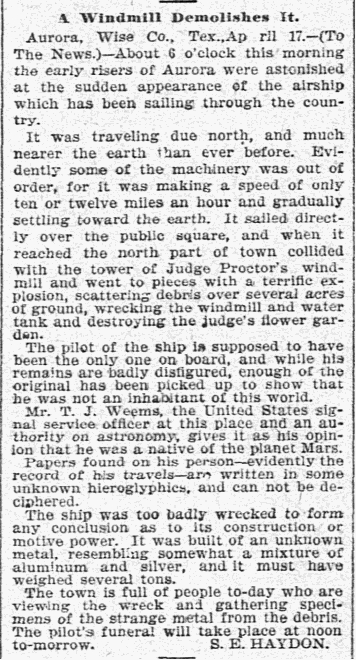
S. E. Haydon, "A Windmill Demolishes It," The Dallas Morning News, April 19, 1897, p. 5
Haydon's original dispatch, datelined Aurora, April 17: the airship strikes Judge Proctor's windmill, the pilot dies, T. J. Weems judges him "a native of the planet Mars," his papers are in "hieroglyphics," and the funeral is announced for the next day. According to Magonia, no other newspaper of the time printed the story.
Haydon article, Aurora, Texas, UFO incident, 1897.jpg · Wikimedia Commons · Public domain · published in 1897 · open original
Walter H. Andrus, "Report on 1897 Aurora, Texas, Investigation," SKYLOOK no. 70, September 1973
Report by the MUFON network on the Aurora investigation, on pages 7 to 9 of the September 1973 issue of its magazine. It covers the tape-recorded statements of Charlie Stephens and Mary Evans, the grave found with a detector and its stone, the samples of metal sent to laboratories, the cemetery association's refusal to open the grave and, at the end, the composition of the samples as of August 17, 1973.
MUFON, SKYLOOK no. 70 (September 1973), copy on archive.org · view source
H. Michael Simmons, "Once Upon a Time in the West," Magonia 20, August 1985
Article from a 1985 British magazine that transcribes in full the dispatch S. E. Haydon signed in Aurora on April 17, 1897 and the Dallas Morning News printed on the 19th, and summarizes what happened to the story between 1966 and 1973.
Magonia 20 (August 1985), copy on archive.org · view source
Documented evidence
- Dispatch by S. E. Haydon datelined Aurora, April 17, 1897, printed in the Dallas Morning News on April 19 under the headline "A Windmill Demolishes It": airship hits Judge Proctor's windmill, pilot "not an inhabitant of this world," papers in hieroglyphics, funeral announced for the next day. Magonia 20 (August 1985) transcribes it; that version says "tower" where Skylook, Cox and Choron say "water tank," and "out of control" where Cox says "out of order."
- Context of the wave: according to MUFON (Skylook, September 1973), the Dallas and Fort Worth papers published more than 500 airship reports between April 14 and 27, 1897. Magonia quotes a Cleveland World dispatch of April 13 about an airship that exploded at Galesburg, Michigan.
- Handbook of Texas (David Minor): Haydon was an Aurora cotton buyer; his article was "fictional," an apparent attempt to bring attention to a declining town. Texas Historical Commission marker at the cemetery, 1976: "the legend" that a spaceship crashed in 1897.
- Etta Pegues in Time, March 12, 1979 (age 86): Hayden "wrote it as a joke and to bring interest to Aurora"; the judge "never even had a windmill." In articles from 1966 to 1972 she relied on two former residents who had known Haydon and Proctor.
- 1973 statements (Skylook, September 1973): Charlie Stephens, taped by MUFON, whose father saw the crash and mentioned no body; Mary Evans, 91, interviewed by Bill Case, whose parents went to the site and who was not allowed to go; in her second interview she said a body was recovered.
Show 3 more facts
- MUFON metal analysis (Skylook, July and September 1973): fragments found with a detector, an aluminum alloy of 65% to 95% with iron from 25% down to 5%, molten when deposited. A consultant said such an alloy was not developed in the U.S. until 1908-1910; there was not enough carbon to date it with carbon-14, and Skylook asked whether it was left in 1897 or years later.
- Exhumation: the Aurora Cemetery Association, through its attorney, refused in 1973; two of its members told Andrus they believed the whole thing was a hoax and that the county's history records no crash. MUFON suspended the investigation in August 1973 without a conclusion.
- Grave marker: according to town marshal H. R. Idell and other residents, the stone had been in place at least 65 or 70 years; it disappeared on June 14, 1973 (Skylook, September 1973).
Sources
- H. Michael Simmons, «Once Upon a Time in the West, or the Mystery of the Aurora Graveyard», Magonia 20 (agosto de 1985) — Secondary source with the full transcript of Haydon's dispatch and a summary of 1966 to 1973: Masquelette, Pegues, Hewes, Case, the denied exhumation and MUFON's suspension.
- SKYLOOK n.º 68 (julio de 1973), «Did That Mysterious 1897 Airship Crash in Aurora, Texas?», pp. 3 y 14 — Primary source from MUFON: quotes the dispatch, announces the analysis of one fragment (aluminum alloy, "great heat"), says it could not be dated with carbon-14 and asks whether the metal was left in 1897 or later, perhaps recently.
- Walter H. Andrus, «Report on 1897 Aurora, Texas, Investigation», SKYLOOK n.º 70 (septiembre de 1973), pp. 7-9 — Primary source from MUFON: Stephens's and Evans's statements, the grave and the stone, the composition of the samples (August 1973), the cemetery's refusal and two of its members' view.
- David Minor, «Aurora, TX (Wise County)», Handbook of Texas Online, Texas State Historical Association — History of the town: Haydon, a cotton buyer, and his "fictional" article, an apparent attempt to attract attention. Fixes the case's class.
- «Americana: Close Encounters of a Kind», Time, 12 de marzo de 1979 — Primary press source: Etta Pegues, 86, says Haydon wrote the dispatch as a joke; the story was "generally ridiculed"; the town marshal speaks of the stolen tombstone.
- Texas Historical Commission, Atlas: «Aurora Cemetery», marcador n.º 240 (1976) — Official text of the cemetery marker: "the legend" that a spaceship crashed nearby in 1897 and the pilot was buried there.
- Mike Cox, «Alien Airship at Aurora», Texas Tales, Texas Escapes (23 de enero de 2014) — Secondary source by a Texas history journalist: that no one took the story seriously in 1897, Kraus's visit for the Condon Committee (1966) and Case's 1973 stories, including a treasure hunter.
- James L. Choron, «The Aurora Incident», página 2, Texas Escapes (5 de agosto de 2004) — Secondary source that argues the event is genuine; reproduces the text of the UPI (May 24, 1973) and AP stories on the grave, the 91-year-old witness and an iron fragment.
- Jen Graffunder, «"Fake News" from Wise County brought UFO believers to Aurora, eventually», The Dallas Morning News (16 de abril de 2018) — Secondary press source: Haydon, the declining town and the claim, with no named source, that the alloy was used in the 1920s for cooking pot lids.
- MUFON, «Aurora, TX Crash, 1897» (14 de mayo de 2021) — Secondary source from MUFON: summarizes Brammer ("a bit of a jokester"), Haydon's lack of follow-up and the 1998, 2005 and 2008 television investigations (windmill base near the well, well water, radar).
Related cases
Cases this case cites and cases with the same likely cause.
Cited in this case · Same country · Within 10 years
United States · newspapers report airships with searchlights
1896 · Tier B
Possible hoax · Same country
Maury Island · a boatman says an object dropped slag
1947 · Tier B
Possible hoax · Same country
Phoenix · two photos of a gray object circling
1947 · Tier A
Possible hoax · Same country
Aztec · the alleged crash of a saucer with 16 bodies
1948 · Tier B