1904·North Pacific Ocean, about 540 km west of California
United States.USS Supply · three red objects seen from a Navy ship
On February 28, 1904, three people aboard the U.S. Navy ship Supply saw three red objects advance in echelon and climb above the clouds. It was 6:10 in the morning and the ship was sailing from Honolulu to San Francisco, about 540 km (290 nautical miles) west of California. The objects vanished almost overhead after two or three minutes. The ship's log records it over the signature of the officer of the deck. Lt. Frank H. Schofield reported it to the Secretary of the Navy, called the objects "meteors" and pointed out what did not fit. The Army and Navy Journal printed his report on March 12.
Tier A · AcceptableWhat do they mean? →
Institutional evidence: several identified independent witnesses, or contemporary official documentation, without an instrumental record to corroborate them.
What it was
55%meteor or fireball
The most likely explanation.
- 55% meteor or fireball
- 1% other earthly causes
- 44% no known cause
See the split across the six explanations
Earthly origin (human or natural)56%
No known cause44%
Ordinary cause the sources propose: meteor or fireball
Record of the event
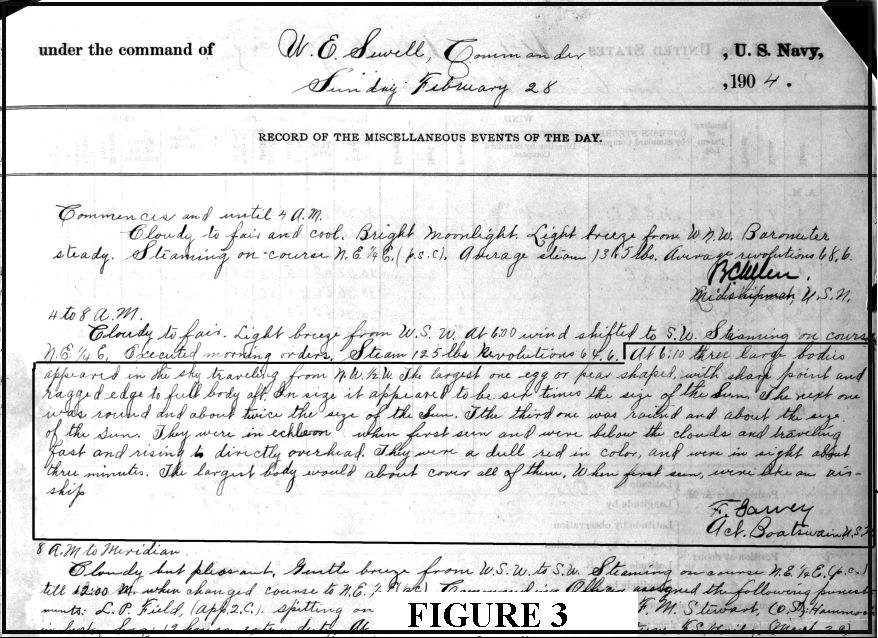
Log of the Supply, Sunday, February 28, 1904: the 6:10 entry, signed by Acting Boatswain F. Garvey
Page of the Supply's log, under the name of W. E. Sewell as commander, for Sunday, February 28, 1904. In the box, the entry for the 4 to 8 watch: at 6:10 three large objects appeared from the northwest by a half point toward the west, the largest egg or pear shaped and about six suns in size, the others about two suns and one, in echelon, below the clouds, "a dull red in color" and in sight about three minutes; it is signed by F. Garvey, Acting Boatswain. It is the entry for that morning's watch, signed by the witness, separate from Schofield's report.
U.S. National Archives, reproduced by Bruce Maccabee · Public domain · 1904 US Government record · open original
What happened
The Supply was a U.S. Navy supply ship serving as the station ship at Guam. In February 1904 she was heading home: her log records, under the date Sunday, February 28, that she was making the passage from Honolulu to San Francisco. On board, gravely ill, was William E. Sewell, a former governor of Guam, whom the log lists as commanding officer; on arrival, the Army and Navy Journal described him as "critically ill." The report on what happened that morning was signed by Lt. Frank H. Schofield, as the officer in charge of the ship.
The ship was steaming northeast, about 540 km west of the California coast by a calculation made for this case. The report places the event at 35°58′ N, 128°36′ W. For the 4 to 8 a.m. watch the log records a sky "cloudy to fair" and a light breeze from the west-southwest that shifted to the southwest at 6. The hourly table gives cloud cover of 9 out of 10 at 5 and 6, with stratus at 6. Until 4 there had been "bright moonlight," and by a calculation made for this case the Moon set around 4:30 at that position.
At 6:10 three objects appeared in the sky. According to the report, they appeared near the horizon and below the clouds. They traveled as a group from the northwest, somewhat toward the north, directly toward the ship. At first they moved quickly across the sky and were "a rather bright red." As they approached the ship they "appeared to soar," passing above the clouds at an elevation of about 45°. Then their motion across the sky slowed until it stopped, when they seemed to be moving straight away from the earth at about 75° elevation, toward the west-northwest. As they gained altitude the color faded.
The largest of the three was in the lead; the second followed at less than twice its diameter and the third at a similar distance behind the second. They stayed that way, "in echelon," for as long as they were in sight. The largest had an apparent area of about six suns and was egg-shaped: the sharper end forward and jagged in outline, the rear end regular and full. The other two were round and without imperfections, the second about two suns in size and the third about one. When they rose they did not change position relative to each other, and the largest showed no rotation or tumbling at any time. The log adds that the largest "would about cover all of them" and that, when first seen, they "were like an airship."
According to the report, three people observed them carefully, and "their accounts agree as to details." The officer of the deck, Acting Boatswain Frank Garvey, sighted them and watched them until they disappeared. Garvey sent a messenger to alert Schofield. The message arrived unintelligible; the messenger went back to clarify it and returned to the lieutenant's room saying the object was then "stationary in the clouds." Schofield gave these details to show that the estimated time was not overestimated. When he reached the bridge, the objects had been hidden by clouds for about half a minute. The report does not say that he saw them himself: it records what the three observers told him. The duration it gave was "over two minutes."
Schofield called what was observed "meteors," but pointed out what did not fit. In his judgment, the near approach to the surface and the subsequent flight away from it were remarkable, especially since their actual size "could not have been great." He put the clouds at not over one mile (1.6 km) high. In the Army and Navy Journal text he added that it was "beyond question" that the objects came below the clouds and "equally certain" that they rose above them and soared, instead of continuing on their southeasterly course, because the motion across the sky ceased and the color faded as they ascended. The Monthly Weather Review text merges the two statements into one ("equally certain"). He added that the clouds, passing between the objects and the ship, "completely obscured" them, and that blue sky could be seen between the clouds.
The log records the event over Garvey's signature: "At 6:10 three large bodies appeared in the sky traveling from N.W. ½ W.," "a dull red in color" and "in sight about three minutes." The two versions differ in three points. Direction of origin: northwest by a half point toward the west (about 309°) in the log, northwest by north (about 326°) in the report. Color: "dull red" against "a rather bright red" at first. Duration: three minutes against over two. They agree on the sizes, the echelon, the egg shape of the largest, the passage below the clouds and the climb toward overhead.
The Supply reached San Francisco on the evening of February 29 and the next day moved up to Mare Island, where Sewell was taken off to the hospital. Schofield had addressed his report to the Secretary of the Navy. The Army and Navy Journal of March 12 printed it in full under the title "Meteors Seen at Sea." The Monthly Weather Review ran it in its March 1904 issue as "Remarkable Meteors," shortened and under Schofield's byline, with the text communicated by the editor of the Pilot Chart.
By researcher Bruce Maccabee's account, nobody had consulted the log until he tracked it down in 1976 at the U.S. National Archives. In 2003, in a text updated in 2005, he concluded they were not meteors. His argument has three parts. The log records stratus at 9 out of 10 cover. The objects changed direction and moved away from the earth almost in a straight line. And they were seen for over two minutes, up to three, when by his calculation a meteor takes under a minute to go from the horizon to overhead.
Brad Sparks, an evaluator for the National Investigations Committee on Aerial Phenomena (NICAP), reached the opposite conclusion in 2006. For him, "below the clouds" means below the cloud layer in angular elevation, not in front of it. Schofield's sentence about clouds that "completely obscured" them shows that the objects were behind. He adds that nobody timed anything and that the log gives only the round hour of 6:10, so the duration could have been one minute, and that the objects burned out as they fell almost vertically. Maccabee answers that reading in advance: by its place in the text, the sentence about the clouds refers to what happened after the objects passed 45° of elevation. He adds that a meteor that looked "six suns" across would have to have been extremely bright, and that the report does not say it was hard to look at.
By a calculation made for this case, at the log's 6:10, taken as local time, Venus (very bright), Saturn and Mercury were low in the east-southeast. Jupiter and Mars were still below the horizon and the Moon had already set. None was in the northwest, where the objects appeared. The Sun was about 5° below the horizon, in civil dawn, and rose around 6:36. A one-hour error in the ship's clock does not change the positions of the planets.
Where it happened

Why it matters
Unlike the 1909 British airship reports ↗ Britain, which are known only from the press, this case has three documents from the time: a signed report sent to the Secretary of the Navy, a log signed by the principal witness and a scientific publication. They make it possible to compare two first-hand versions and see where they differ.
The record includes no instrument. Nobody measured or timed anything, and the estimates of size, cloud height and duration were made by eye. Of the three observers only Garvey is named, and Schofield reached the bridge when clouds already hid the objects. Whether other ships or the California coast saw the same light remains to be documented.
Schofield titled his report "Remarkable Meteors" and called the objects "meteors," but found it remarkable that they came near the surface and flew away from it. Sparks supports the reading as a fragmented fireball. Maccabee admits that the echelon of the three objects could fit a meteor that is breaking up, and that the report would be consistent with a meteor if the low trajectory, the halt of the motion across the sky and the duration were set aside. Those three features appear in the report, and the log supports two of them, the path below the clouds and the duration. They are the ones Maccabee and Sparks read in opposite ways. Neither the report nor the log mentions sound, a trail or an explosion.
Two readings of the same text reach opposite conclusions because the phrase "below the clouds" admits two meanings and because the duration rests on an estimate: two minutes in the report, three in the log.
Documents and sources
Primary documents
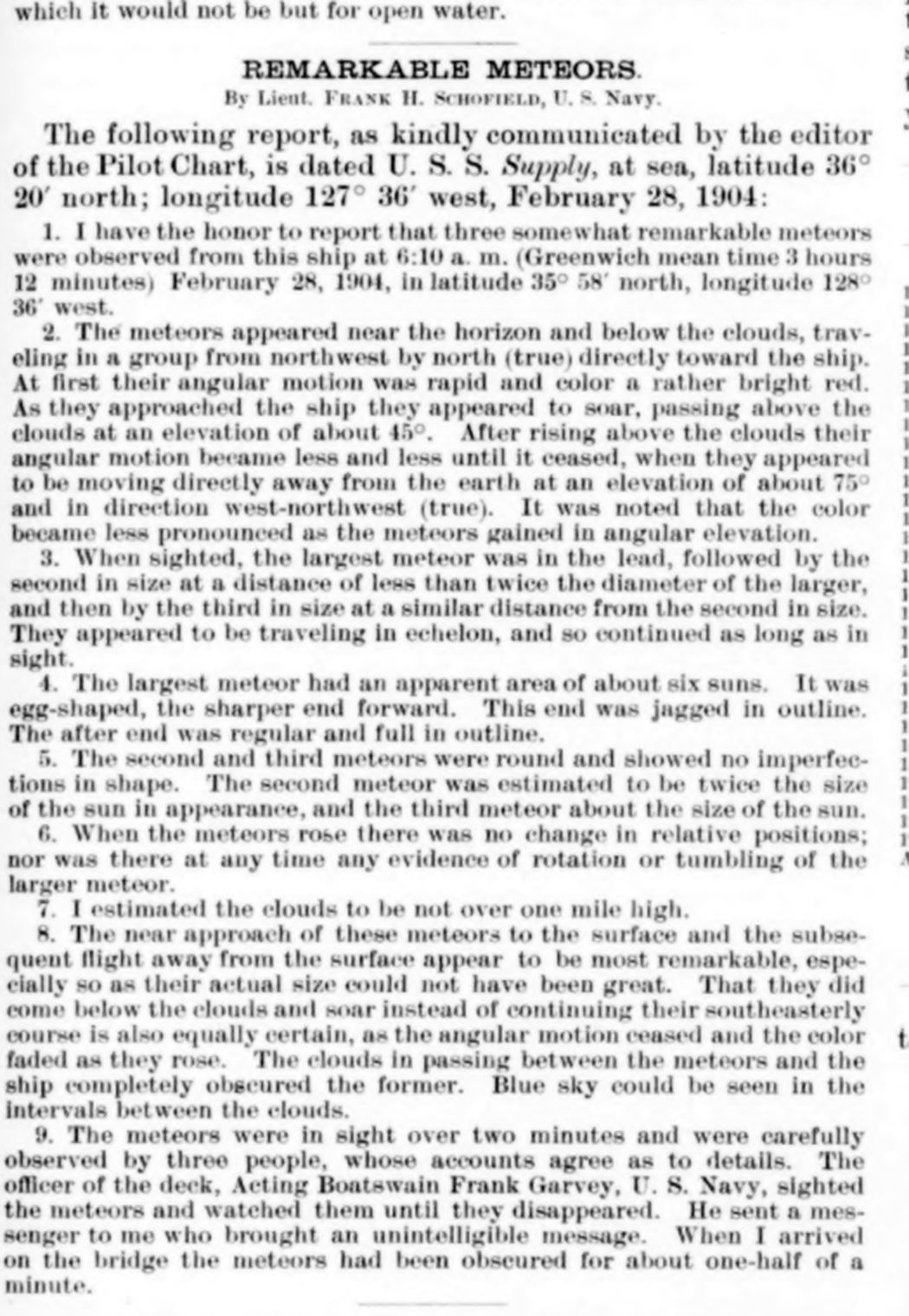
Monthly Weather Review, March 1904, p. 115: "Remarkable Meteors," by Lt. Frank H. Schofield
Column of page 115 with Schofield's shortened report in nine numbered paragraphs: position and time, path, order and size of the three objects, cloud height, observers and duration. The magazine presents it as communicated by the editor of the Pilot Chart.
Monthly Weather Review, vol. 32, no. 3, via archive.org · Public domain · published in 1904 · open original
Documented evidence
- Report by Lt. Frank H. Schofield to the Secretary of the Navy, dated aboard the Supply on February 28, 1904: three objects observed at 6:10 at 35°58′ N, 128°36′ W, "carefully observed by three people, whose accounts agree as to details." Printed in full in the Army and Navy Journal (March 12, 1904, p. 736) and shortened in the Monthly Weather Review (March 1904 issue, p. 115).
- Log of the Supply, 4 to 8 watch of Sunday, February 28, 1904, signed by Acting Boatswain F. Garvey: three large objects from N.W. ½ W. at 6:10, the largest "egg or pear shaped," about six times the size of the sun, "a dull red in color," "in sight about three minutes," "like an airship" when first seen.
- Report and log agree on three objects in echelon, the largest egg-shaped and about six suns in size, seen below the clouds and rising toward overhead. They differ in the direction of origin (northwest by north in the report, northwest by a half point toward the west in the log), the color (brighter in the report) and the duration (over two minutes against about three).
- Clouds: Schofield put them at not over one mile and saw blue sky between them; the hourly table records stratus at cloud cover 9 out of 10 at 5 and 6. He reached the bridge when the objects had been hidden by clouds for half a minute, and the officer of the deck had followed them until they vanished.
- Log, midnight to 4 watch: "Bright moonlight." By a calculation made for this case, the Moon set around 4:30 local time and, at 6:10, Venus, Saturn and Mercury were in the east-southeast (4° to 12° high), Jupiter and Mars below the horizon; none in the northwest.
- Later analyses reaching opposite conclusions: Bruce Maccabee (MUFON, 2003, updated 2005) concludes they were not meteors because of the height below the clouds, the change of direction and the duration; Brad Sparks (NICAP evaluation, December 19, 2006) concludes they were meteors because clouds hid the objects and nobody timed the event.
Sources
- Schofield, F. H. — "Remarkable Meteors," Monthly Weather Review, vol. 32, no. 3 (March 1904), p. 115 — Primary source: Schofield's shortened report, communicated by the editor of the Pilot Chart (archive.org scan, PDF page 11 of the issue).
- "Meteors Seen at Sea," Army and Navy Journal, March 12, 1904, p. 736 — Primary source: Schofield's report to the Secretary of the Navy, in full and signed as commanding officer, with the messenger episode; the same issue notes the Supply's arrival and Sewell's condition.
- Log of the station ship Supply, February 28, 1904 (U.S. National Archives), as reproduced by Maccabee — Reproduced primary source: image of the log with the entry signed by Garvey (figure 3) and the hourly table (figure 2) in Maccabee's text; Maccabee's transcription gives the third body as "twice the size of the sun" and the image reads "about the size of the sun."
- Maccabee, B. — "Even More Remarkable Meteors?" (MUFON, 2003; updated 2005) — Secondary source: analysis comparing the report and the log with what a meteor would show, concluding they were not meteors.
- Sparks, B. — NICAP evaluation "1904 Feb 28 USS Supply" (December 19, 2006) — Secondary source: evaluation holding that they were meteors, with the argument about the clouds and the untimed duration.
- NICAP — "Three Red Objects Sighted From USS Supply, Feb. 28, 1904" — Secondary source: the case entry in the NICAP archive, with links to the Maccabee and Sparks analyses.
- Wikipedia — William Elbridge Sewell — Secondary source: Sewell, governor of Guam, fell ill and was brought to San Francisco aboard the Supply, arriving March 1, 1904.
Related cases
Cases this case cites and cases with the same likely cause.
Cited in this case · Within 10 years
Britain · airships with searchlights in the night sky
1909 · Tier B
Meteor or fireball · Same country
New Mexico · green fireballs over the nuclear sites
1948 · Tier A
Meteor or fireball · Same country
Chiles-Whitted · two airline pilots and a windowed object
1948 · Tier A
Meteor or fireball · Same country
Avalon · a resident sees an orange-red light drop straight down
1955 · Tier A
Associated actors (1)