1980·Huffman, Texas (near Houston)
United States.Cash-Landrum
On the night of 29 December 1980, Betty Cash, Vickie Landrum and her grandson watched a glowing diamond-shaped object radiating heat near Huffman, Texas, followed by some 23 military helicopters. All three fell ill and Cash was hospitalized; the Army could not identify the helicopters, and the lawsuit against the federal government was dismissed in 1986. The medical files were never published and the exact site of the encounter was never located.
Tier B · IndicativeWhat do they mean? →
Limited evidence: a single witness, testimony gathered years later, or an account without contemporary primary documentation.
What it was
60%no known cause
The evidence is not enough to decide between the explanations
See the split across the six explanations
No known cause
Natural or human cause
Primary documents
U.S. Army Inspector General (1982): Whiting's FOIA request, the Inspector General's release letter, the reply to Congressman Wyden and Lt. Col. Sarran's memorandum, 7 pp.
Army Inspector General (DAIG) papers released under FOIA to Frederic L. Whiting. The letter of 19 August 1982, signed by Lt. Gen. Richard G. Trefry, releases the file except for opinions, personal data and material originating with the Air Force. The reply to Congressman Ron Wyden says the allegation that Army, National Guard or Army Reserve helicopters were involved "is not substantiated". Lt. Col. George C. Sarran's memorandum records the 23 helicopters the witnesses counted, the exchange with CW3 Culberson, the Dayton policeman who heard twin-rotor helicopters around 0030-0100 hours, and every unit's denial; it judges the witnesses credible and notes that the medical evidence "seems almost irrefutable".
Inspección General del Ejército de EE. UU., liberado por FOIA (copia de Curt Collins) · Public domain · US Government work · open original
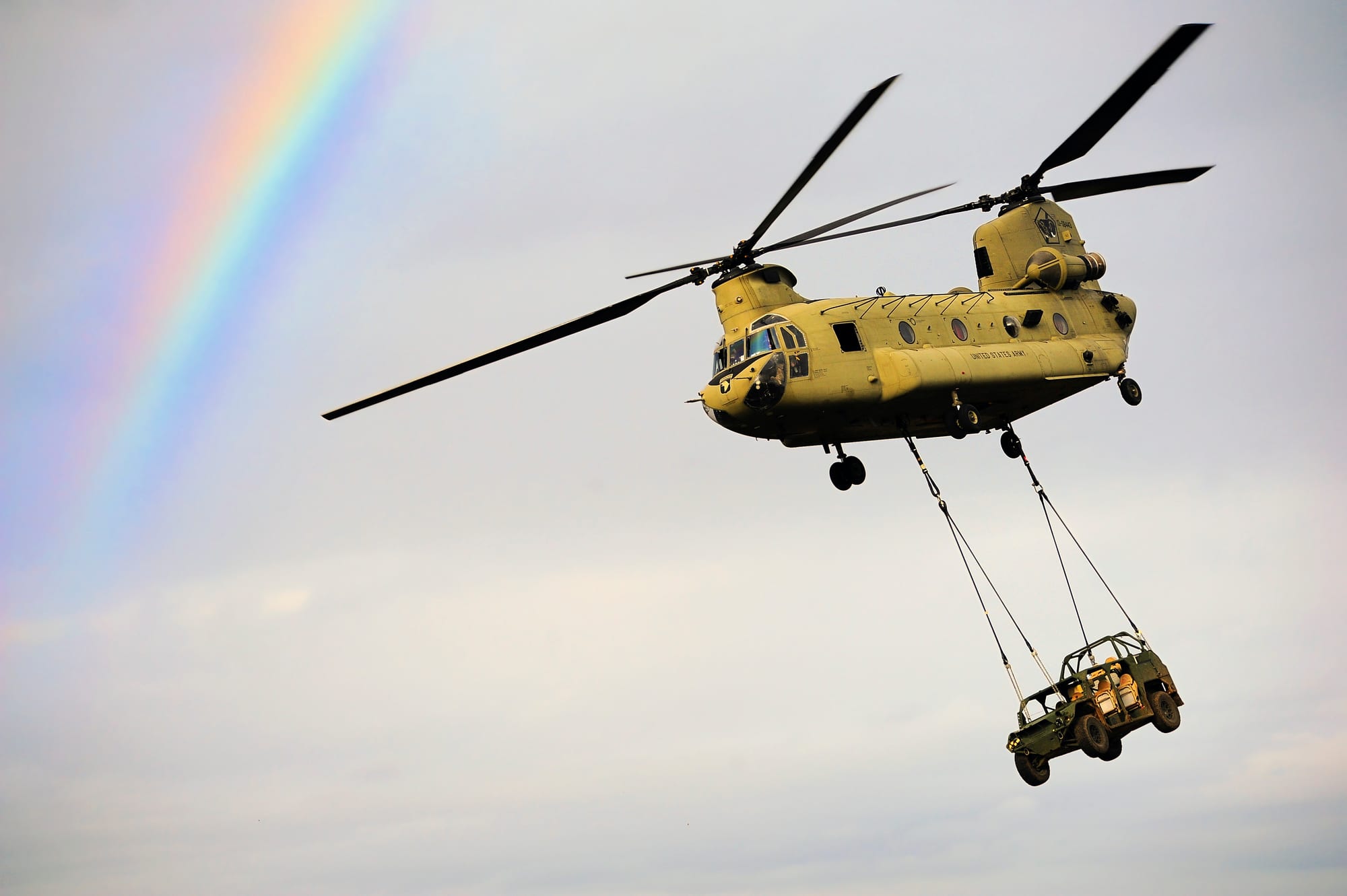
Context · CH-47 Chinook helicopters, of the type escorting the object per the witnesses
An Army CH-47 Chinook helicopter during a training exercise (210120-A-II094-096M).jpg · Wikimedia Commons · Public domain · open original
The night in question
On the night of December 29, 1980, around 9:00 p.m., Vickie Landrum (57), her grandson Colby Landrum (7) and Betty Cash (51) were driving home from dinner along FM 1485, in a wooded, lightly traveled area near Huffman, Texas, northeast of Houston. They stopped the vehicle upon seeing, low over the road, an incandescent diamond- or rhombus-shaped object that periodically emitted flames from its underside with a sound described as an intermittent roar or bellow. The radiated heat was so intense that, according to the witnesses, it warmed the car's body; Vickie reported that the door handle was too hot to touch and that the dashboard was left marked. Betty Cash, the driver, stood outside the vehicle for several minutes watching; Vickie stayed inside shielding her grandson, who was crying.
As the object began to rise, a large number of military helicopters appeared around it (the witnesses counted about 23, several identified as twin-rotor CH-47 Chinooks) that seemed to escort or follow it. It is a distinctive feature of the case, and the one with the most support beyond the three victims: according to the compilations by John Schuessler and Richard Hall, a Crosby resident saw the helicopters fly over his house and oilfield worker Jerry McDonald, in Dayton, saw a large diamond-shaped object pass overhead. The best-documented testimony is that of a Dayton policeman and his wife, whom the Army investigator interviewed: at around 00:30 to 01:00 on December 30, some three hours after the encounter and within five miles of the site, they heard loud noises and saw twin-rotor helicopters flying low, in groups of three in a 'V' formation, periodically turning on spotlights or landing lights. Another person who, according to Schuessler, had seen helicopters at the time of the encounter refused to be interviewed. Vickie Landrum said that in May 1981, at a static display in Dayton, the pilot of a National Guard CH-47, CW3 Culberson, told her he had flown that night; interviewed by the Army, Culberson 'emphatically stated that he was not flying that evening' and said he had only repeated what he had heard in the media. In the hours and days that followed, the three victims developed nausea, vomiting, diarrhea, burning eyes and sunburn-like skin; Betty Cash, the most exposed, went to the emergency room on January 3, 1981, blistered, with patches of hair lost and unable to walk, and spent twelve days in hospital and later another fifteen. Radiologist Peter Rank reviewed Cash's medical files for the investigators, and Schuessler's book reproduces his opinions in order. The dermatologist had diagnosed alopecia areata, a benign disorder of localized hair loss, a diagnosis 'partially confirmed by the pathology report', and the ophthalmologist found 'no evidence of damage to the interoccular structures secondary to radiation'. In April 1981 Rank wrote that the nail shedding in both women 'also occurs secondary to emotional stress, is a psychosomatic expression of disease, although I think this unlikely', and that nail and hair loss 'favor the presence of ionizing radiation'; he later doubted the alopecia areata diagnosis because of the initial inflammation and the biopsy. His final conclusion was more cautious: radiation damage confined to the skin, 'type unknown', probably 'limited in severity', 'without evidence of systemic involvement', and whether it was ionizing was 'at this point unclear'. Those files, however, have never been made public: Schuessler withheld them, citing the victims' privacy.
On August 17, 1981, the three were interviewed in the law library at Bergstrom Air Force Base, in Austin, by the acting staff judge advocate and two Air Force claims officers, as a first step toward a damages claim; Betty Cash later handed over the tape and its transcript is public. Early in 1982 the Air Force stated that none of its helicopters had been involved, and the Army Inspector General's office assigned an inquiry to Lieutenant Colonel George Sarran, who found the witnesses credible but could not trace the helicopters to any Army, National Guard or Reserve unit, in the middle of the year-end stand-down. His memorandum, released minus its withheld portions, makes clear that the inquiry was limited to that question and made no effort to substantiate the event or the medical problems, though it notes that the medical evidence of deteriorating health 'seems almost irrefutable'; it checked with Army commands, the National Guard helicopters at Ellington and the Reserve helicopters at Tomball, the Houston police, the FAA and the Conroe sheriff, and no one knew of helicopters flying that night. Earlier, an August 20, 1981 memorandum from the Bergstrom legal office had noted that the site was about 13 miles from Houston Intercontinental Airport, within its terminal control area, and that airport radar and pilots on the routes overhead would most likely have seen such a deployment; Schuessler's report, by contrast, cites the FAA as saying Houston radar does not cover below about 2,000 feet around Lake Houston. Represented pro bono by attorney Peter Gersten, the victims sued the federal government for $20 million in the US District Court for the Southern District of Texas (Cash et al. v. United States, H-84-348). The court dismissed it on August 21, 1986 in a brief order under Federal Rules of Civil Procedure 12(b)(1), 12(b)(6) and 56, after the government filed sworn statements from NASA, the Air Force, the Navy and the Army that no object like the one described was in their inventories; the order says nothing about the injuries, and the plaintiffs had objected that the Army's declaration did not deny ownership of the helicopters. Betty Cash died in 1998; her family has maintained the causal connection between her health problems and the incident.
Why it matters
The case brings together three elements: (a) three victims with acute physical symptoms and hospital stays, (b) a federal lawsuit against the US government, dismissed in 1986, and an Army Inspector General inquiry, (c) secondary witnesses who saw military helicopters in the area later that same night. It is structurally comparable to ↗ (FAB Operação Prato, medical victims) and ↗ (simultaneous military operation). The cultural label of 'abduction' does not fit what the victims reported: they described no capture and no missing time.
The strongest medical objection was raised in 1999 by researcher Brad Sparks, who had reviewed it for APRO with radiation oncologist Richard Niemtzow: the rapidity of symptom onset and the full clinical picture do not fit sub-lethal ionizing radiation, because a dose able to cause burns and hair loss that quickly would typically have been fatal, yet all three victims survived for years. Physician Gary Posner reached the same conclusion and further suggested that the round burns on Cash's arms, seen on television, could have been self-inflicted; Sheaffer linked this to Münchausen syndrome, without documentary proof and against the assessment of the Army investigator, who saw no attempt by anyone to exaggerate. The file also has two holes that came to light in 2013, when researcher Curt Collins published documents that had not been circulated: the Texas Department of Health found no residual radiation on the road, and its inspector noted that neither the witnesses nor Schuessler knew where the encounter had taken place, beyond a straight stretch of FM 1485 'between a beer joint and some kind of highway warning sign'; Allan Hendry's 1981 report for the Fund for UFO Research adds that no marks were found on the pavement. There is no photo or radar record of the object, and the medical history that supports the harm remains unpublished. The 1986 dismissal was not a ruling on what happened: without a trial and with discovery stayed, the court granted the government's motion, which rested on sworn statements that the object was not its own. On balance: the injuries and the helicopter deployment are supported by the record; attributing those injuries to radiation from an anomalous object is not established, and the ultimate nature of the object remains indeterminate.
What's left on paper
Documented evidence
- Interview of the three witnesses with the Air Force staff judge advocate and claims office at Bergstrom AFB, August 17, 1981 (public transcript)
- Army Inspector General inquiry (Lt. Col. George Sarran, 1982): credible witnesses, helicopters not traceable to any Army, National Guard or Reserve unit; the medical evidence of deteriorating health 'seems almost irrefutable' but was not part of the inquiry
- Lawsuit Cash et al. v. United States, H-84-348, Southern District of Texas, dismissed August 21, 1986 (Rules 12(b)(1), 12(b)(6) and 56) after sworn statements from NASA, the Air Force, the Navy and the Army that no object like the one described was in their inventories
- Secondary witnesses of twin-rotor helicopters (a Dayton policeman and his wife, around 00:30-01:00, some three hours later, interviewed by the Army investigator; a Crosby resident, according to Schuessler) and of a diamond-shaped object (Jerry McDonald, Dayton)
- Hospitalization of Betty Cash from January 3, 1981; medical files reviewed by radiologist Peter Rank but never published
Show 2 more items
- Texas Department of Health: no residual radiation on the road and no exact site of the encounter; Allan Hendry's report (1981): no marks on the pavement
- Bergstrom legal office memorandum (August 20, 1981): the site lies within the Houston Intercontinental terminal control area, about 13 miles from the airport; radar and pilots would most likely have seen the helicopters
Sources
- Transcripción de la entrevista en la base aérea de Bergstrom, 17 de agosto de 1981 (CUFON, copia en NICAP) — Tape supplied by Betty Cash; interviewers are the acting staff judge advocate and the Air Force claims office
- Richard Hall, «The UFO Evidence», vol. II, pp. 226-229 (extracto en NICAP) — Summarizes Lt. Col. George Sarran's Army Inspector General inquiry and radiologist Peter Rank's conclusion
- US Army Inspector General — memorandum by Lt. Col. George C. Sarran and inquiry notes (1982), released under FOIA to Frederic L. Whiting on August 19, 1982 (Curt Collins copy) — Primary source: scope of the inquiry, interviews with the Dayton policeman and helicopter commanders, and assessment of the witnesses.
- Bergstrom AFB / Army Inspector General FOIA file on Cash-Landrum, August 22, 1983 (Curt Collins copy) — Primary source: Bergstrom legal office memoranda of August 1981, including the August 20 one on the Houston terminal control area.
- Robert Sheaffer, «The ‘Classic’ Cash-Landrum Case Unravels», Skeptical Inquirer 38(2), marzo-abril de 2014 — Collects the Sparks-Niemtzow medical objection and the Texas Department of Health and Allan Hendry documents published by Curt Collins
- Cash et al. v. United States, H-84-348, Tribunal de Distrito de EE. UU., Distrito Sur de Texas (desestimada el 21 de agosto de 1986) — Federal court record (dismissal order, government motion and sworn statements), in the Quest Publications compilation hosted by the AFU archive
- John F. Schuessler, «The Cash-Landrum UFO Incident» (1998) — The main MUFON investigation of the case; the most complete source and one committed to the case's reality. Pages 107-111 reproduce radiologist Peter Rank's opinions and the dermatologist's and ophthalmologist's findings
Related cases
Associated actors (1)