2013·Collahuasi mine, Tarapacá
Chile.Collahuasi (CEFAA)
In April 2013, workers at the Doña Inés de Collahuasi mine (over 4,300 m up on the Tarapacá altiplano) photographed a disc-shaped object that stayed near the site for one to two hours before moving off. CEFAA, the official committee of Chile's DGAC under General (ret.) Ricardo Bermúdez, received two photos in February 2014, ruled out clouds, drones and balloons, and its image analyst rated it an object or phenomenon of great interest, unidentified. Bermúdez himself urged caution: it was a single analyst's conclusion and the witnesses did not cooperate.
Tier A · AcceptableWhat do they mean? →
Institutional evidence: several identified independent witnesses, or contemporary official documentation, without an instrumental record to corroborate them.
What it was
61%natural or human cause
Most likely an ordinary cause that no one has identified
See the split across the six explanations
Natural or human cause
No known cause
Read the full reasoning
The CEFAA's director said its cases 'most of the time turn out to be birds, hot-air balloons, probes or other objects without mystery'. The absence of a published analysis is not evidence against an ordinary cause: in 2024 AARO resolved all 174 finalized cases to 'prosaic objects', though 'many other cases remain unresolved'.Primary documents
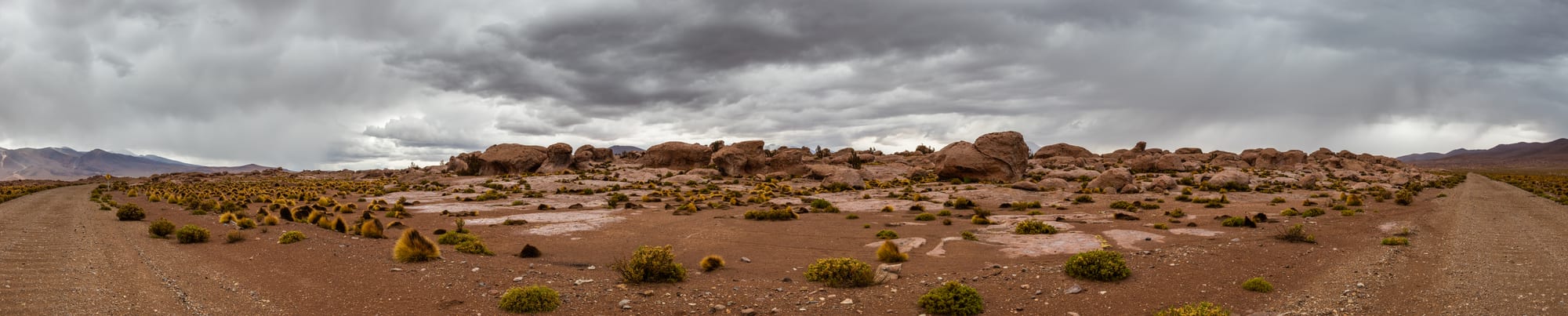
Context · the Collahuasi mine (Tarapacá, Chile), where staff filmed the object
Paisaje cerca de la mina de Collahuasi, Chile, 2016-02-10, DD 16-21 PAN.JPG · Wikimedia Commons · CC BY-SA 4.0 · open original
CEFAA report "The Collahuasi Case" (July 2014), in Scott Corrales's English translation
Text of the report with which the DGAC committee released the case; the Spanish original on cefaa.gob.cl is no longer online. It places the sighting in mid-2013, from the mine site at 4,300 m, for a couple of hours: a bright, flattened disc 5 to 10 m across that rose, descended and moved about 600 m above the ground. It says a meteorologist ruled out lenticular clouds and gives the analysis of the two photos (Samsung Kenox camera): filters, a half-sphere that saturates the sensor and the reading that the object emits light rather than reflecting the sun; it concludes it is "an object or phenomenon" that would be classified as a UFO. No open licence, so it is linked.
CEFAA (DGAC de Chile), vía The UFO Chronicles · view source
The night in question
In mid-April 2013, workers at the Doña Inés de Collahuasi copper mine, in the Tarapacá region (over 4,300 meters above sea level, under some of the clearest and driest skies on the planet), observed an object that slowly approached the area. The number of witnesses varies by source: CEFAA's director spoke of a group of 35 workers and professionals, while the journalist Leslie Kean, who discussed the case with the committee, describes four technicians in electricity, electronics and fluid control. The object remained nearby for more than an hour according to Kean, or about two hours according to CEFAA, making short rising, descending and horizontal movements some 600 meters over the surface, before moving off to the east. They described it as a flattened disc, of brilliant color, between 5 and 10 meters across, which at times took the shape of a shining balloon, although its most evident shape was that of a silvery, fixed, static disc. According to Kean, the photos were taken by one of the technicians with a Samsung Kenox S860 camera. The witnesses decided not to tell anyone; months later, the photographer showed the images to the group leader, who sent them to CEFAA on 22 February 2014 and also asked for anonymity.
The images show an object of discoidal appearance with a dome or upper section. The two photographs that reached CEFAA, the Committee for the Study of Anomalous Aerial Phenomena, part of the Directorate General of Civil Aeronautics (DGAC) and under the jurisdiction of the Chilean Air Force, were analysed by the committee. A meteorologist ruled out lenticular cloud formation; according to José Lay, the committee's director of international relations, no drones were operating near the mine, and according to Kean the DGAC also ruled out experimental aircraft, planes and weather balloons, although the details of those exclusions were not published. Bermúdez spoke of 'a year of analysis' with scientists 'who are generally very skeptical', even though the photos arrived on 22 February 2014 and the report was released in early July of that year. The image analysis was done by an analyst at the DGAC Meteorological Office, and it used no thermal sensor: it applied filters to photos from a consumer camera and read the area that appeared completely dark in the filtered images as a sign of very high temperature; the same report notes that in the luminous half-sphere the camera's sensor saturates. The analyst concluded that the object 'emitted its own energy, which does not coincide with the natural sunlight that is also reflected off it': at noon, the brightness underneath could not be due to the sun, which was reflecting off the top. His verdict was that it was 'an object or phenomenon of great interest, which can be qualified as a UFO', and a drone was explicitly ruled out.
CEFAA was, as in its other cases, transparent about the limits of the file. The witnesses did not want to cooperate with the investigation: 'We tried to contact them and got no reply', noted José Lay, the committee's director of international relations, which prevented a precise reconstruction of camera conditions, exact time and geometry. And CEFAA's director, General (ret.) Ricardo Bermúdez, stressed that the 'UFO' conclusion came from a single analyst among several: 'We recognize that this is the determination of only one CEFAA analyst among several, so we still must be cautious'. Lay explained that, without witnesses, the material was filed for future reference or comparison: 'That's all we can do in this case'. The material and the report were made public in July 2014, adding to the Chilean body's record of open disclosure and giving it international press exposure. In 2015 it was reported that CEFAA had ruled the object was not man-made; Lay denied it to HuffPost: the committee confirmed that the origin remained unexplained, but it had never said that.
Why it matters
Collahuasi is another CEFAA file (the official committee of Chile's DGAC) that reached formal technical image analysis and open publication. But General Bermúdez himself asked for caution: the 'UFO' conclusion came from a single analyst and the witnesses did not cooperate. The DGAC's exclusions of clouds, drones, planes and balloons were announced without publishing their data, and no source proposes a conventional candidate: CEFAA names none, and the photo analyst Bruce Maccabee mentions a hoax only to dismiss it (the object was 'either the real thing - UFO - or a hoax, and it doesn't appear to be a hoax'), although he warned that the inability to question the witnesses 'does reduce the credibility'.
The contrast with other CEFAA files is instructive. When the committee had a chain of custody, a time and a geometry, as in the 2014 naval-helicopter infrared video (the 'Chile Navy' case), it could sustain a far more demanding technical analysis. Collahuasi lacks precisely that: photographs from personal cameras with no reconstructable metadata and witnesses who withdrew from the investigation. The analyst's strongest argument (that the object emitted its own energy incompatible with solar reflection at noon) is interesting but depends entirely on inferences about photos whose orientation, exact time and exposure could not be fixed, made with filters on an image whose sensor, by the report's own account, was saturated in the decisive area.
What's left on paper
Documented evidence
- Two photographs from a Samsung Kenox S860 camera, taken by a Collahuasi mine technician (Tarapacá, April 2013) and sent to CEFAA by the group leader on 22 February 2014
- Witnesses: 35 workers according to CEFAA's director; four technicians according to Leslie Kean; duration from more than an hour to about two hours
- Exclusions announced by the DGAC and CEFAA: lenticular clouds (meteorologist), drones, experimental aircraft, planes and weather balloons; no data published
- Image analyst's verdict: self-emitted energy not attributable to solar reflection; 'object or phenomenon of great interest'; inferred with filters on the photo, with no thermal sensor, and with the sensor saturated in the luminous half-sphere
- Limitations acknowledged by CEFAA: uncooperative witnesses, a single-analyst conclusion and material filed for future reference
- No source proposes a conventional candidate; Maccabee mentions a hoax only to dismiss it ('it doesn't appear to be a hoax')
Sources
- La Tercera — «El extraño ovni de Collahuasi» (jul 2014) — Statements by Bermúdez and from the report: reported to CEFAA on 22 February 2014, lenticular cloud ruled out by a meteorologist, and a disc shape that at times looked like a shining balloon.
- El Mostrador (EFE) — «Difunden imagen de Ovni avistado en mina Collahuasi» (1 jul 2014) — Bermúdez: 35 workers, about two hours, 'a year of analysis' with scientists 'who are generally very skeptical'.
- HuffPost (Leslie Kean) — 'Chile Releases Official Study on UFO Photos' (jul 2014) — Four technicians, Samsung Kenox S860 camera, the DGAC's exclusions, quotes from Lay and Bermúdez and Bruce Maccabee's opinion. Published on the contributor platform.
- HuffPost — 'Did A UFO 'Not Made By Man' Hover Over Chile?' (2015) — CEFAA denies having said the object was not man-made.
- The UFO Chronicles — 'The Chilean Collahuasi UFO Case: Official Photographic Analysis/Report' — Aggregator; reproduces in English CEFAA's photographic analysis report, including the sensor saturation.
Related cases
same country · same period
Chilean Navy helicopter
2014 · Tier S
same country · same period
Karim Bianchi · the Chilean senator who says he was abducted
2012 · Tier B
same country · same period
La Serena · the two-tailed object seen by five aircrews at the end of 2014
2014 · Tier A
same country · same period
El Bosque, Chile (CEFAA)
2010 · Tier A
Associated actors (2)