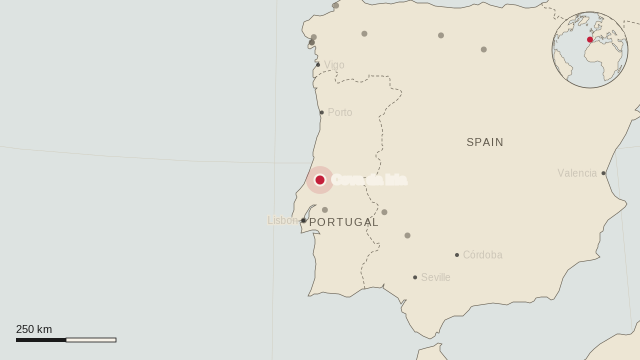
1917·Cova da Iria, Fátima (Ourém), Portugal
Portugal.Fátima · a crowd sees the Sun spin after the rain
On October 13, 1917, a crowd of between 30,000 and 70,000 people said they saw the Sun spin and drop toward the ground at Fátima, Portugal, after hours of rain. Three shepherd children who said they saw the Virgin Mary had announced a sign for that day. The press and several witnesses described it in the following days, among them a lawyer who went convinced it was a hoax and ended up convinced it was a miracle. Descriptions vary. According to an astronomer quoted by the 1930 commission and to the Bishop of Leiria, no observatory recorded it. A physicist attributes it to the effects of staring at the Sun.
Tier A · AcceptableWhat do they mean? →
Institutional evidence: several identified independent witnesses, or contemporary official documentation, without an instrumental record to corroborate them.
What it was
70%medical or neurological cause
The most likely explanation.
- 70% medical or neurological cause
- 30% no known cause
See the split across the six explanations
Earthly origin (human or natural)70%
No known cause30%
Ordinary cause the sources propose: medical or neurological cause
Record of the event
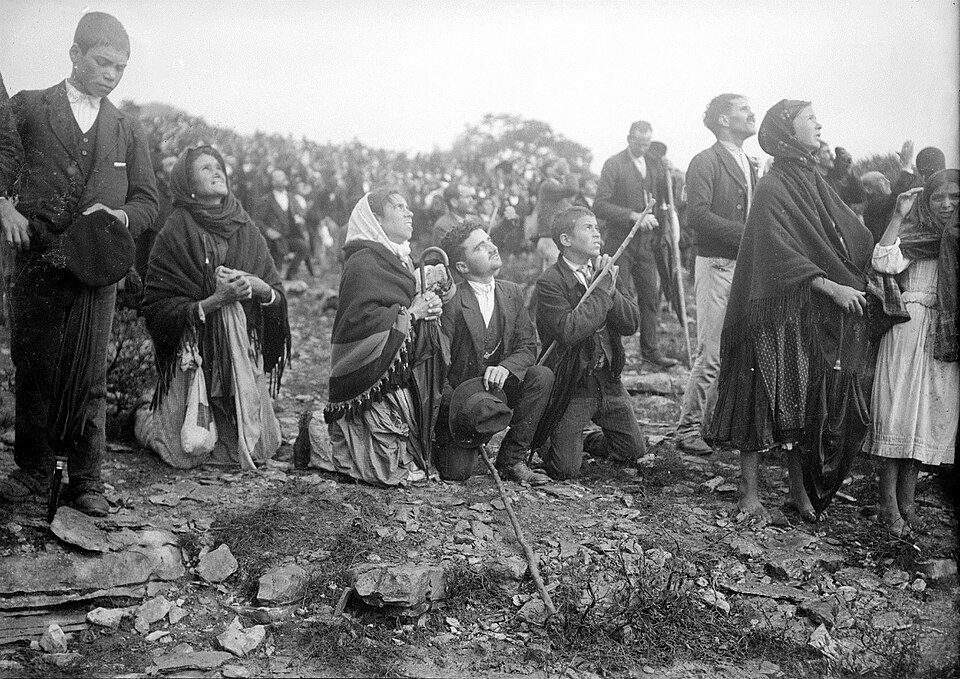
The crowd looks up at the sky at Fátima on October 13, 1917 (photo by Judah Bento Ruah)
Photograph taken at Cova da Iria on October 13, 1917, by Judah Bento Ruah and published on October 29 in Ilustração Portugueza with Avelino de Almeida's report. It shows the crowd looking up; the Sun does not appear in the picture.
People looking miracle sun.jpg · Wikimedia Commons (published in Ilustração Portugueza, October 29, 1917) · Public domain (Portuguese photo from before 1970; published in 1917) · open original
What happened
In 1917 Portugal had been fighting in the First World War since 1916 and was a young republic, with tension between the state and the Church. On May 13, three shepherd children from Aljustrel, a hamlet in the parish of Fátima, said a Lady dressed in white had appeared to them above a holm oak on scrubland called Cova da Iria. They were Lúcia de Jesus, ten, and her cousins Francisco and Jacinta Marto, nine and seven. They said the Lady would return on the 13th of every month. In July a correspondent for O Século ran the first press report. He found the case "extremely ridiculous" and suspected a "financial speculation."
In August the administrator of the municipality of Vila Nova de Ourém took the children away for questioning, and they missed the meeting on the 13th. In September there were between 15,000 and 20,000 people, according to one witness, Leonor de Avelar e Silva Constâncio. She said the Sun's heat dropped and yellow spots appeared on white clothing. She herself saw only "a slight eclipse of the Sun," while others saw a star or a small cloud cross the sky. The lawyer Luís António Vieira de Magalhães e Vasconcelos later talked to people who had been there: some had seen nothing, some a star, and some gave fantastic descriptions. He concluded it was a "blague," a hoax.
The announcement of a sign is recorded in 1917 documents. On July 14 Lúcia told the parish priest that when she asked the Lady for a miracle so that everyone would believe, the Lady answered: "In three months I will then make everyone believe." On September 27, in a questioning by Formigão, Lúcia declared that on the 13th the Lady would make all the people believe. The date spread across Portugal.
October 13 dawned rainy. From ten o'clock it rained hard in a strong wind, and the roads turned to mud. O Século's special correspondent, Avelino de Almeida, wrote that someone had counted more than a hundred automobiles and more than a hundred bicycles along the Leiria road, and he reported estimates of 30,000 to 40,000 people. Other witnesses at the time said 40,000, 50,000 or more than 50,000. In 1930 the Church commission spoke of 70,000.
The children arrived around midday and said the rosary. Almeida wrote that Lúcia asked the crowd to close their umbrellas and that they obeyed. Lúcia later told the Fátima parish priest that she saw a flash of lightning, that the Lady asked for a chapel, and that the war would end that day. According to Almeida, the sky "begins, suddenly, to brighten high up" and the rain stopped. The times the witnesses give run from one o'clock to almost two in the afternoon; some use solar time and some official time, which was an hour ahead of Greenwich under wartime summer time, and not all say which. By a calculation made for this case, solar noon fell at 1:21 p.m. official time.
Almeida wrote in O Século that the Sun, "a plate of dull silver," could be looked at without effort and neither burned nor blinded. After a roar of "Miracle, miracle!" he wrote that the Sun "trembled" and made "abrupt movements never seen before, outside all cosmic laws"; it "danced," he said, in the peasants' phrase. According to him, most said they had seen the Sun tremble or dance. Others said they saw the smiling face of the Virgin, or that the Sun spun like a firework wheel and dropped almost to the point of burning the earth. Some said it changed color.
That same night the parish priest of Monte Redondo, Manuel Pereira da Silva, wrote to a colleague that the Sun "spins on itself dizzyingly like a firework wheel" for more than eight minutes, with pauses, and that everything went almost dark and faces looked yellowish. On October 25 the vicar of Porto de Mós, on behalf of the Patriarchate of Lisbon, took statements from 16 residents of two nearby villages, nearly all under oath. Most saw the Sun spin like a firework wheel, with colors around it. Some said it came closer or gave off more heat, and two saw figures in it.
Maria Augusta Saraiva Vieira de Campos, who was in the crowd, wrote on October 19 that the rain stopped, that they felt a heat "as if we were entering a heated greenhouse," and that the Sun turned violet, red and emerald green. Afterward, in Vila Nova de Ourém, some ladies lent them clothes to replace the ones they wore, which were "still wet."
José Maria de Proença de Almeida Garrett was on the road, a little over a hundred meters from the apparition site, and wrote his account on December 18, two months later and without having taken notes. He saw that the Sun, which had just broken through the clouds, was a disc with a sharp edge, pearly in color, that did not hurt the eyes and spun on itself at great speed for about ten minutes, with two brief interruptions. Suddenly, he wrote, it "detaches from the firmament" and advances on the earth: "seconds of terrifying impression." He saw the landscape turn amethyst and then yellow, though he cannot say when and thinks it was toward the end. He wrote that there was no fog and that he had never seen such phenomena. Days later he stared at the Sun for a few moments and saw yellow patches that moved with his gaze.
Vasconcelos went to Fátima that day convinced it was all a "blague" and told his acquaintances so. A friend asked him to look at the Sun at one o'clock, "the hour announced by the little shepherds." In his written statement of December 30 he says that at first he saw only clouds racing by; then an intensely pink halo ringed the Sun, which looked like a disc of dull silver and seemed to him to shift from its place, and wispy clouds in violet and orange tones passed. It lasted "perhaps minutes." He wrote that he cried out "I believe, I believe, I believe" and that, had he not been a Catholic, he would have converted at that moment.
Lúcia told the parish priest on October 16 that she looked at the Sun, saw Saint Joseph with the Child and then Our Lord and Our Lady, and told the people to look. On the 19th the priest Manuel Nunes Formigão, who later joined the Church commission, questioned the three children separately. Francisco saw the Sun "go around like a wheel," in blue, yellow and other colors, and saw Saint Joseph with the Child but not Our Lord. Jacinta saw it red, green and other colors and saw Saint Joseph; the other Lady, she said, was seen by Lúcia and not by her. Lúcia said she looked at it "because all those people said to look at the Sun" and that it "looked like the moon."
Asked whether she had told people to look at the Sun, Lúcia said she did not remember; Francisco and Jacinta said she had. On the umbrellas she said she had told people to close them "the month before" and did not remember this time. On November 2 she repeated that she did not remember the umbrellas, the cry or the Lady pointing at the Sun. The same October 19, the priest José Ferreira de Lacerda noted that, asked whether they always saw the marks on the Sun, Lúcia answered "I never saw anything in the Sun because I only looked at the Lady," and that she then saw next to the Sun something like the face of a man and a child. In 1941 Lúcia wrote that she cried out to the people to look at the Sun because of "an interior impulse."
According to Almeida, the crowd dispersed quickly and without disorder. Lúcia announced that the war had ended and the soldiers would return. The war did not end. In December a priest noted that Lúcia admitted she might have been mistaken.
On October 15 O Século led with "Astonishing things! How the Sun danced at noon in Fátima." On the 29th its magazine Ilustração Portugueza ran another report by Almeida, with photographs, written as a letter to a friend who had stopped believing. It ended: "Miracle, as the people shouted; natural phenomenon, as the wise men say? I am not concerned now with knowing, only with telling you what I saw. The rest is for Science and the Church." On October 13, 1930, the Bishop of Leiria declared the children's visions worthy of belief and permitted the cult.
Where it happened
Why it matters
There are written statements from the following weeks by witnesses with opposite attitudes: press reports, letters, sworn statements and accounts by people who said they went without believing. The rain stopping, the Sun that could be looked at without pain, a disc that spins and colors that change all coincide; several accounts add the sense that it was approaching. The duration (eight or ten minutes, or "perhaps minutes"), the colors, whether it dropped toward the people and the figures seen beside the Sun all differ. One witness writes that anyone who did not see it did not want to.
According to the astronomer Frederico Oom, quoted by the Church commission of 1930, if it had been a cosmic event the observatories would have recorded it, and that is what is missing. The 1930 pastoral letter of the Bishop of Leiria says that no astronomical observatory recorded it. From this they conclude it was not natural. The opposite reading starts from the same lack of a record: if the Sun did not change, what changed was the perception of those who looked at it. The photographs in Ilustração Portugueza show the crowd kneeling or looking up, without the Sun, and their captions describe it "awaiting the sign from God." Almeida, Garrett ("near the zenith") and the commission ("at its zenith") speak of the Sun at the zenith. By a calculation made for this case, on October 13, 1917 it culminated at Fátima about 43° above the horizon, at 12:21 Greenwich time (1:21 p.m. official time).
Explanations began in 1917. Gonçalo de Almeida Garrett, a doctor of mathematics and retired professor of astronomy at the University of Coimbra, wrote on December 3 that what was seen was meteorological, an effect of the atmosphere on the image of the Sun, and not astronomical; at midday such effects are weaker, he said, which gives the event more value. He himself considered it miraculous. He added that since October 13 many people were seeing the Sun spin on many days and in many places: "Much of it will be imagination." The physicist Auguste Meessen, of the Catholic University of Louvain, has argued since 2003 that these are effects of staring at the Sun: the eye sees it as a gray disc, the retina produces colors and afterimages, and the brain generates apparent spinning and approach. He supposes that humid air after the rain dimmed the light enough to look at it.
Against this, Garrett's son wrote that there was no fog. The 1930 pastoral letter states that the phenomenon was seen by people of all classes, believers and nonbelievers, journalists, and even people miles away, which in the bishop's view destroys the explanation of a collective illusion. The letter does not name those distant witnesses. The story of clothes drying suddenly appears in a 1922 testimony; in 1917 Campos wrote that their clothes were still wet on reaching Vila Nova de Ourém afterward.
Documents and sources
Documents
Ilustração Portugueza no. 610 · "O Milagre de Fátima," by Avelino de Almeida (October 29, 1917)
Report by Avelino de Almeida, special correspondent of O Século, published two weeks after the event in the same newspaper's illustrated magazine, with photographs of the crowd looking at the sky.
Read more
The full 25-page issue is scanned at the Hemeroteca Digital de Lisboa; the account fills PDF pages 15 to 17. It is in 1917 Portuguese. Almeida presents himself as an impartial witness, describes the Sun as a disc of dull silver that danced in brilliant colors, and leaves the explanation to science and the Church.
Documentação Crítica de Fátima · selection of documents 1917-1930 (Sanctuary of Fátima, 2013)
A volume of more than 600 pages transcribing the documents on Fátima from 1917 to 1930: press reports, the children's interrogations, witness statements, letters, the 1930 report of the Church commission and the pastoral letter of the Bishop of Leiria. It is the Sanctuary's own edition; the linked PDF is a copy hosted at archive.org. The reports from O Século and Ilustração Portugueza appear as docs. 13 and 21.
Documented evidence
- O Século, October 15, 1917, report by Avelino de Almeida ("Astonishing things!"): the Sun "trembled" and made "abrupt movements never seen before." It gives estimates of 30,000 to 40,000 people. It says some saw the face of the Virgin and others a Sun that spun, dropped or changed color, and that the freethinkers present were impressed, according to reliable people. The full text is in the Documentação Crítica de Fátima, doc. 13.
- Ilustração Portugueza no. 610, October 29, 1917, pp. 353 to 356: Almeida's report with photographs of the crowd looking at the sky. It estimates about 50,000 people and recalls that at earlier gatherings some had claimed to see "astronomical and atmospheric singularities" (temperature drops, stars at midday, clouds around the Sun). It describes the Sun as a disc of dull silver that danced in brilliant colors and leaves the explanation to science and the Church.
- Letter from the parish priest Manuel Pereira da Silva, night of October 13, 1917: the Sun spins "dizzyingly like a firework wheel" for more than eight minutes, with pauses; everything went almost dark and faces looked yellowish (doc. 12). Inquiry by the vicar of Porto de Mós, October 25: 16 residents of Reguengo do Fetal and Alqueidão da Serra, nearly all under oath; most saw the Sun spin with colors, some that it dropped or gave off more heat, and two saw figures in it (doc. 19).
- Account by José Maria de Proença de Almeida Garrett, December 18, 1917, two months later and without notes: a pearly disc with a sharp edge that spins for about ten minutes and then "advances on the earth"; the landscape turned amethyst and then yellow, without being able to say when; there was no fog. Days later he tried staring at the Sun and saw yellow patches. Documentação Crítica de Fátima, doc. 29.
- Letter from Gonçalo de Almeida Garrett, December 3, 1917: eight to ten minutes, three rotating movements with sparks at the edges, then violet and orange. He attributes it to the atmosphere acting on the image of the Sun, though he considers the events of the 13th miraculous, and says that since then many people saw rotations ("Much of it will be imagination"). He cites reports of rotation and color change in Torres Novas on October 20. Doc. 28.
Show 3 more facts
- Written statement by Luís de Vasconcelos, December 30, 1917: he went convinced it was a "blague." At one o'clock he saw a pink halo around the Sun, a disc of dull silver that seemed to shift, for "perhaps minutes," and he wrote that he became convinced. He says his companions saw the same with somewhat different descriptions. Documentação Crítica de Fátima, doc. 32.
- Those who did not see it or were not there: Leonor de Avelar e Silva Constâncio arrived half an hour late. Maria José de Lemos Queirós asked her coachman, who had stayed by the carriage, whether he had seen the Sun, and wrote that he seemed to be feeding the horses. A witness in the October 25 inquiry says that anyone who did not see it did not want to. Docs. 17, 23 and 19.
- Questioning of the children: Manuel Nunes Formigão, October 19, 1917 (doc. 18); Lacerda, October 19 (doc. 15); the Fátima parish priest, October 16 (doc. 14). Francisco and Jacinta describe the Sun "going around like a wheel" with colors. Lúcia says it looked like the moon, that she looked because everyone said to look, and that she does not remember telling anyone to look, while on October 16 she had said she did. The figures each child describes beside the Sun do not match.
Sources
- Documentação Crítica de Fátima. Selection of documents (1917-1930), Sanctuary of Fátima, 2013 — The Sanctuary's own edition, with transcriptions of the documents: the reports in O Século (doc. 13) and Ilustração Portugueza (doc. 21), the children's interrogations (docs. 14 and 18), the Porto de Mós vicar's inquiry (doc. 19), witnesses' letters and accounts (docs. 12, 17, 23, 25, 26, 28, 29, 31, 32), the 1930 commission report (doc. 120) and the pastoral letter (doc. 133). The linked copy is hosted at archive.org.
- O Século (Lisbon), October 15, 1917, "Coisas espantosas! Como o sol bailou ao meio dia em Fátima," Avelino de Almeida — Report by the special correspondent, written in Ourém on October 13. The original newspaper page was not reached; the full text was read as transcribed in doc. 13 of the Documentação Crítica de Fátima.
- Ilustração Portugueza, 2nd series, no. 610 (October 29, 1917), pp. 353-356, "O Milagre de Fátima," Avelino de Almeida — Full 25-page issue scanned by the Hemeroteca Digital de Lisboa. The report fills PDF pages 15 to 17, with photographs of the crowd.
- Meessen, A., "Apparitions and Miracles of the Sun," Consciências 2, 2005, pp. 199-222 (International Forum in Porto, October 2003) — Paper by a physicist at the Catholic University of Louvain. It gathers the common features of "miracles of the sun" and explains them with the effects of staring at the Sun. It is a hypothesis, not an investigation of the 1917 event: it has no data of its own from Fátima.
- Lúcia, Fourth Memoir (December 8, 1941), in "Fatima in Lucia's Own Words," Secretariado dos Pastorinhos, 16th ed., 2007 — Lúcia's account written 24 years later, on her bishop's orders: a late source from an interested party. Here she explains that she cried out to the people to look at the Sun from an interior impulse; on October 19, 1917 she said she did not remember doing so.
- De Marchi, J., "The True Story of Fatima," 1947 (secondary source) — A devotional history by a missionary. It translates fragments of the daily O Dia, undated in De Marchi, that could not be checked against the original, and attributes to Almeida Garrett an estimate of more than 100,000 people. Use only as a lead.
Related cases
Cases with the same likely cause.
Medical or neurological cause
Eagle River · a plumber says a saucer's crew gave him pancakes
1961 · Tier B
Medical or neurological cause
Carlos de los Santos · three discs surround his light plane
1975 · Tier A
Medical or neurological cause
Robert Taylor · a forester sees a dome and comes home injured
1979 · Tier A
Medical or neurological cause
Dulce · Phil Schneider says he survived an underground firefight
1979 · Tier B