1913·Southern Ontario, Canada (seen from Saskatchewan to Bermuda)
Canada.Great Meteor Procession · rows of lights from Canada to Bermuda
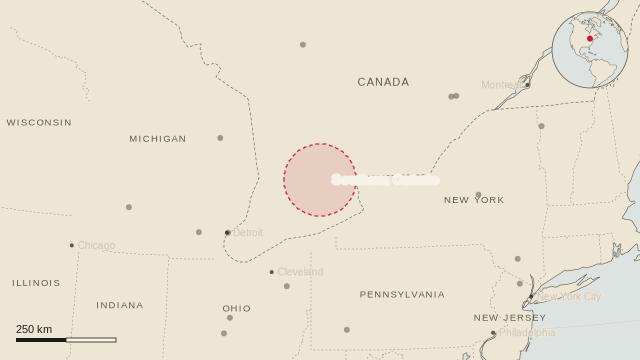
On Sunday, February 9, 1913, at 9:05 in the evening, numerous witnesses in Canada, the United States and Bermuda saw groups of red lights with tails cross the sky in a line, slowly and without falling. The astronomer C. A. Chant of the University of Toronto gathered more than a hundred reports and drawings, calculated the height from angles several witnesses had measured and followed the passage from Saskatchewan to Bermuda, about 3,900 km. In 1915 and 1916, accounts from at least two ships farther south were published. Astronomers called them meteors and disagreed on whether this was a group orbiting the Earth or fragments of slow fireballs.
Tier A · AcceptableWhat do they mean? →
Institutional evidence: several identified independent witnesses, or contemporary official documentation, without an instrumental record to corroborate them.
What it was
84%meteor or fireball
The most likely explanation.
- 84% meteor or fireball
- 16% no known cause
See the split across the six explanations
Earthly origin (human or natural)84%
No known cause16%
Ordinary cause the sources propose: meteor or fireball
Record of the event
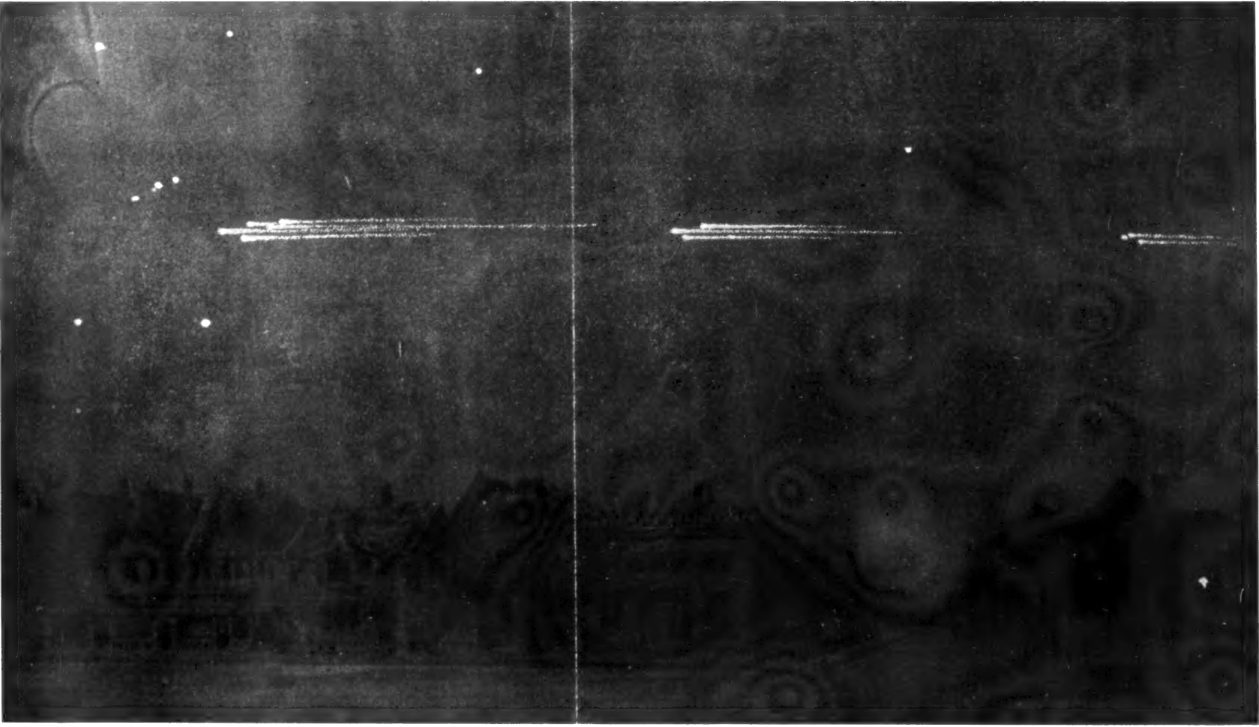
Gustave Hahn's drawing of the meteor groups seen from High Park, Toronto, Plate IX of Chant's study (1913)
Drawing by Gustave Hahn, an artist and amateur astronomer, who saw the meteors with his wife near High Park in Toronto, published as Plate IX of Chant's study.
Read more
It shows several groups of bodies with tails, in a line against a sky with stars. Chant notes that the spaces between one group and the next were actually somewhat greater than in the drawing. It is a witness's drawing, not an instrumental record. Microfilm scan joined from two frames, with the contrast enhanced.
C. A. Chant, Journal of the Royal Astronomical Society of Canada, vol. 7 (1913), plate IX; archive.org scan · Public domain · published in 1913 · open original
What happened
On the evening of Sunday, February 9, 1913, at 9:05 Eastern time, people in Toronto and in other towns of southern Ontario saw a fiery red body appear in the northwestern sky. It grew larger as it came closer and trailed a long tail. Some made out a single body; others saw two or three traveling together, each with its own tail. To many it looked like a giant skyrocket. But it did not fall: it moved forward on a level path, without sinking toward the ground, at a pace that the astronomer C. A. Chant of the University of Toronto later described as "peculiar, majestic, dignified deliberation." The body disappeared in the distance toward the southeast.
Before the astonishment had passed, other bodies came out of the same point, in twos, threes or fours, with shorter tails. They followed the same path at the same pace, growing smaller until they were red sparks; some went out before arriving. They compared the bodies to a fleet of airships with lights on each side, to battleships escorted by cruisers and to a lighted train traveling in sections. Chant noted that airmen would have to practice for many years before they could keep such perfect order.
Two newspapers spoke of aircraft: the "Marshall Chronicle" in Michigan quoted two young people who saw "an airship going east," and the "North Bay Times" said that at Sturgeon Falls, 186 miles from Toronto, several residents saw a slow-moving object that "resembled a large aeroplane or dirigible, with two tiers of lights strung along the sides." Both papers called it a meteor.
The usual estimate was 15 to 20 bodies; others said 60 or 100, and some said thousands. Cecil Carley, a student at a Trenton high school, looked through an opera glass and counted about ten groups of 20 to 40 meteors each. Estimates of the duration ran from one to seven minutes, with an average of 3.3.
As the last lights vanished, or a few minutes later, many places heard a dull rumbling, like distant thunder or a wagon crossing a bridge. Sometimes there were three rumbles in a row. At Niagara-on-the-Lake windows rattled and at Keldon a resident felt the floor tremble. Chant placed the sound as far as 78 miles (125 km) from the path, on the word of a doctor at Edgar who did not hear it himself. The next farthest places were 51 and 49 miles away. At Fort Frances a Native patient of Dr. Robert Moore remarked, "It must be the end of the world!"
The same procession was seen at the same time far away. At Mortlach, Saskatchewan, John R. Smith saw it between 7:06 and 7:15 in the evening, Mountain time, which equals 9:06 and 9:15 in Toronto: he imagined there "must have been hundreds of them." At Pense, G. and B. Spring Rice saw "a procession of stars" that crossed directly overhead from west to east for about two minutes.
To the southeast, at Watchung, New Jersey, Margaret Griffiths counted seven balls of fire over her head, and two of them burst like a skyrocket. In Bermuda, Col. W. R. Winter saw them from Paget at 10 p.m. Atlantic time, which corresponds to 9 in Toronto. There were two leading bodies resembling large arc lights, with a diameter equal to the Moon's, which were breaking into pieces, and about 100 smaller ones followed them. Between Mortlach and Bermuda, the extreme points, Chant calculated 2,437 miles (3,922 km).
Chant saw nothing himself. A telephone call a few minutes afterward told him something out of the ordinary had occurred, and the next day he interviewed witnesses and read the newspapers. He asked for reports through the Toronto press and received letters and sketches from many localities, of which he printed extended extracts in the journal of the Royal Astronomical Society of Canada in May and June 1913. To fix the height he relied on the few witnesses who had measured an angle against a fixed object. Gustave Hahn, an artist and amateur astronomer, saw the bodies pass about midway between Rigel and the Belt of Orion; the Rev. F. Herman of Caledon East saw them cross over or nearly over the same group of stars, and the Rev. Marsh of Springville saw them pass behind the top of a telephone pole. From the three he derived about 26 miles (42 km).
Other measurements gave impossible results. A Mill Bridge resident, who saw them at the eave of his barn, gave 106 miles. Another used a clinometer, an instrument that measures angles of elevation, and gave 17; he attributed the figure to not remembering exactly where he had been standing. Chant warned that intelligent people can describe the same phenomenon in very different ways.
Each body stayed in view usually 20 to 30 seconds and covered an angle of 120° to 135° in the sky. From that, Chant estimated a speed of 5 to 10 miles per second relative to the ground, or 8 to 16 km/s. From the apparent size he calculated that the largest would measure at least 100 feet (30 m). Using the positions at Pense and at a point in Ontario, he drew the great circle (the kind that passes through the center of the Earth) along which they would have traveled. It passed almost over Guelph and about 131 miles (211 km) from Bermuda. Extended, it crossed the South Atlantic, went around the Cape of Good Hope and reached Western Australia. No mariner had reported seeing anything.
Later, witnesses turned up at sea. William F. Denning, the Bristol astronomer who had followed the case, asked in the "Nautical Magazine" for anyone who had been in the Atlantic that night to write to him. In April 1915 A. Y. Porter, aboard the steamer Bellusia at 16°39′ N, 50°15′ W, replied. He saw the sky lit with meteoric fire, from the north to the southeast by way of the east, from 10:30 to 11:05 p.m. ship's time. Capt. J. Kiddie, Porter and an apprentice signed a description in June 1914 and sent it to the Hydrographic Office in New York.
Denning wrote that he did not understand a duration of 35 minutes when the flight over Canada lasted about 3. Porter placed the fire only 10 or 12 miles from the ship, and Denning revised that to 150 or 200. O'Keefe noted that the Bellusia's time is only very rough.
In 1916 Denning published the letter of W. W. Waddell, first mate of the steamer Newlands, written at sea on February 10, 1913. The ship was at 3°20′ S, 32°30′ W, off northeastern Brazil. At 12:13 a.m. local time, for six minutes, "over fifty large stars" passed from the west to the south, at 20° to 23° elevation, dropping other stars like a rocket when it explodes. From that point Denning calculated a visible flight of about 5,500 miles (8,900 km).
Where it happened
Why it matters
The astronomers of 1913 agreed that these were natural bodies and disagreed on how to explain what they did. Chant supposed that a group of bodies traveling around the Sun was captured by the Earth and began to circle it as a satellite. Denning of Bristol, whom Chant called the leading authority on meteors, had been watching the sky since 1865. He wrote that he had never seen anything similar and that the display seemed, like Saturn's rings, "without a parallel"; he spoke of a string of newly made terrestrial satellites.
What remained to be explained was how bodies so low held a level flight over thousands of kilometers without the air slowing them down. Chant first set the height at 26 miles and then at about 34; Denning put it at about 38. The Rev. M. Davidson of the British Astronomical Association calculated that below 34 miles not even the largest of the bodies could have covered 2,400 miles without being slowed by the air. Only a speed far above 5 miles per second would allow it. He believed they flew near 45 miles. Winter wrote from Bermuda that the display was unlike anything seen before and not accounted for in any astronomical work. In Bermuda most of the large bodies had already broken up, and they reminded him more of semi-gaseous bodies than of an ordinary aerolite.
Later explanations did not settle the matter either. According to Mebane's review, William H. Pickering, in 1922 and 1923, could not reconcile the times: the speed came out at half what a satellite needs. In 1928 W. J. Fisher explained that a slow body covering such a distance follows a course curved toward the west as the Earth rotates, although the observed curvature was too great for 5 miles per second. He pointed out that at 30 miles up it would collide with the equatorial bulge and endorsed the idea of a column of large bodies that the air wears away from below.
In 1923 Charles Fort wrote in "New Lands" that either these were groups of meteors or "a procession of unknown objects, carrying lights." He left both possibilities open, and Mebane read the second as a fleet of spaceships. According to Mebane and O'Keefe, in 1939 C. C. Wylie held that it was an ordinary meteor shower, local to Ontario, together with a fireball.
In 1956 Alexander D. Mebane canvassed newspapers in seven states: of some 615, 274 searched their files and 27 found something relevant. He concluded that the new data ruled out both Fort and Wylie. None of the witnesses at close range described the bodies as anything other than meteoric. The only two claims that vessels were seen, at Marshall, Michigan, and at North Bay, Ontario, came from observers about 200 miles away.
Mebane judged Chant's complete continuity untenable. The procession at Hibbing, Minnesota, was not the body seen at Houghton, in northern Michigan. The one at Watchung, New Jersey, with no sound, was distinct from the New York one, which from Buffalo to Elmira looked like a single group. He saw the route as that of slow fireballs that sank gradually and burned out over Pennsylvania; paths of 500 to 750 miles are commonplace for such fireballs. He could not explain the repetition, around 2:30 in the morning, of another procession along the same route.
In 1959 John A. O'Keefe concluded that no normal meteoric orbit satisfied the measurements, including those from the ships, and proposed a natural satellite in a nearly circular orbit with a 90-minute period. The starting data are witnesses' estimates, almost none made with an instrument. The three best measurements, made against a star or a pole, gave about 26 miles. The ones Chant discarded gave 106 and 17, and his 31 estimates by eye averaged between 31 and 44 miles depending on how they are corrected.
Independent witnesses in Canada, the United States, Bermuda and at sea described a formation of lights that others compared to an aerial fleet. The astronomers and the later authors who analyzed the data spoke of meteors; the only reading that admitted unknown objects carrying lights was Fort's, which Mebane rejected. The height, speed and route quoted come from witnesses' estimates.
Documents and sources
Primary documents
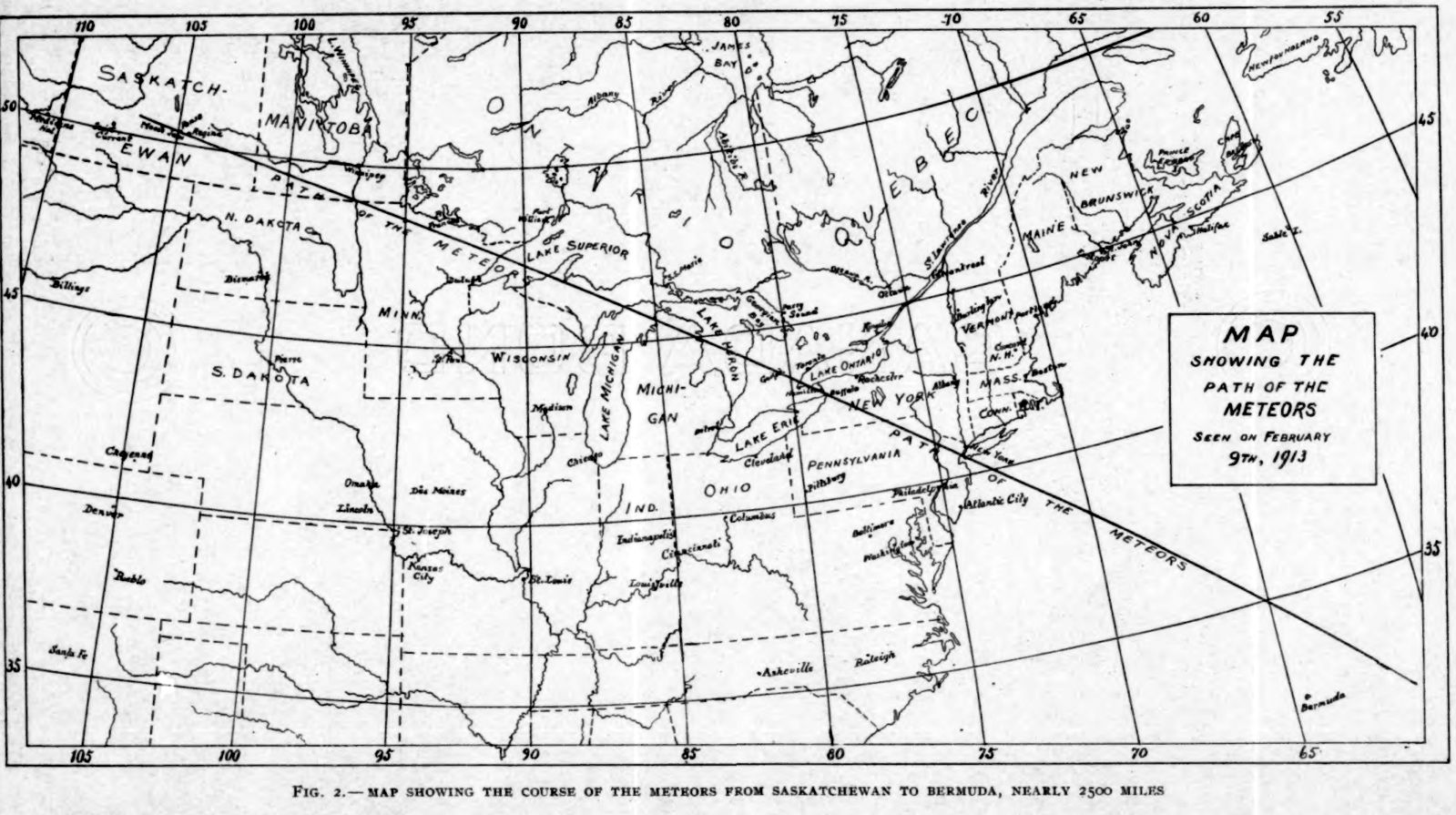
Chant's map of the path of the meteors from Saskatchewan to Bermuda, Figure 2 of his study (1913)
Map from Chant's study: a straight line, the great circle he calculated, crosses central Canada and the United States from Saskatchewan, passes almost over Guelph, cuts across New York and comes within reach of Bermuda, over nearly 2,500 miles. It is Chant's reconstruction from the witnesses' letters, not a measurement; Mebane and O'Keefe later discussed whether all the witnesses had seen the same bodies.
C. A. Chant, Journal of the Royal Astronomical Society of Canada, vol. 7 (1913), figure 2; archive.org scan · Public domain · published in 1913 · open original
Documented evidence
- Chant, Journal of the Royal Astronomical Society of Canada, May-June 1913: letters, sketches and accounts received after an appeal in the Toronto newspapers, from Mortlach, Saskatchewan, to Bermuda. The first bodies were seen at about 9:05 Eastern time; the average of the duration estimates was 3.3 minutes.
- Mortlach, Saskatchewan: John R. Smith, between 7:06 and 7:15 in the evening, Mountain time, saw a line of lights he imagined to be "hundreds." Pense, Saskatchewan: G. and B. Spring Rice, at about 7 in the evening, saw "a procession of stars" pass overhead from west to east for about two minutes.
- Ontario: Gustave Hahn (Toronto), the Rev. F. Herman (Caledon East) and the Rev. Marsh (Springville) measured angles against Orion or a telephone pole. From the three, Chant derived a height of about 26 miles (42 km); in November-December 1913, after reviewing 31 more estimates, he proposed about 34 miles, and Denning gave about 38. The 31 estimates by eye average between 31 and 44 miles.
- Bermuda: Col. W. R. Winter, at Paget, saw at 10 p.m. Atlantic time two leading bodies resembling arc lights and about 100 followers. Watchung, New Jersey: Margaret Griffiths counted seven balls of fire, two of which burst like a skyrocket.
- Sound: rumblings like distant thunder were heard as far as 78 miles (125 km) from the path, on the word of a doctor at Edgar who did not hear them himself; at Niagara-on-the-Lake windows rattled and at Keldon a resident felt the floor tremble.
Show 2 more facts
- Steamer Bellusia (16°39′ N, 50°15′ W): officer A. Y. Porter recorded meteoric fire from 10:30 to 11:05 p.m.; Porter, Capt. J. Kiddie and an apprentice signed the description in June 1914 and sent it to the Hydrographic Office in New York; Porter gave a duration of 35 minutes and Denning said he did not understand it (Denning, 1915). Steamer Newlands (3°20′ S, 32°30′ W): W. W. Waddell counted over fifty large stars in six minutes at 0:13 on February 10 (Denning, 1916).
- Mebane (1956) canvassed newspapers in seven states; of some 615, 274 searched their files and 27 found something relevant, with accounts from Minnesota, Michigan, New York, Pennsylvania and New Jersey that he arranged from west to east.
Sources
- Chant, C. A. — "An Extraordinary Meteoric Display," Journal of the Royal Astronomical Society of Canada, vol. 7 (May-June 1913), pp. 145-215 — Primary source: Chant's study with the general description, the calculation of path, height and speed, and the extracts of the witnesses' letters, from Saskatchewan to Bermuda (University of Toronto reprint, archive.org scan).
- Denning, W. F.; Chant, C. A. — "Notes on the Great Meteoric Stream of 1913, February 9th" and "Further Information Regarding the Meteoric Display," Journal of the Royal Astronomical Society of Canada, vol. 7 (November-December 1913), pp. 404-412 and 438-447 — Primary source: Denning's reply on the height, Winter's letter from Bermuda, the summary of Davidson's calculation and Chant's correction (archive.org scan).
- Denning, W. F. — "The Great Meteoric Stream of February 9, 1913," Journal of the Royal Astronomical Society of Canada, vol. 9 (July-August 1915), pp. 287-289 — Primary source: the letter of A. Y. Porter of the steamer Bellusia, with the signed statement he sent to the Hydrographic Office in New York (archive.org scan).
- Denning, W. F. — "The Great Meteoric Stream of February 9th, 1913," Journal of the Royal Astronomical Society of Canada, vol. 10 (July-August 1916), pp. 294-296 — Primary source: the letter of W. W. Waddell, first mate of the steamer Newlands, who saw the procession off northeastern Brazil (archive.org scan).
- Mebane, A. D. — "Observations of the Great Fireball Procession of 1913 February 9, Made in the United States," Meteoritics, vol. 1, no. 4 (1956), pp. 405-421 — Secondary source: a review of the earlier work, among it that of Pickering (1922-23), Fisher (1928) and Wylie (1939), cited here through him and O'Keefe, and a canvass of newspapers in seven states; it gathers the new accounts from Minnesota, Michigan, New York, Pennsylvania and New Jersey and discusses the hypotheses of Chant, Fort and Wylie.
- O'Keefe, J. A. — "A Probable Natural Satellite: The Meteor Procession of February 9, 1913," Journal of the Royal Astronomical Society of Canada, vol. 53 (1959), pp. 59-65 — Secondary source: summarizes the arguments of Pickering, Fisher and Wylie, reviews the positions at Regina, Toronto, Bermuda and the two ships and proposes a natural satellite in a nearly circular orbit.
- Fort, C. — "New Lands" (New York, Boni & Liveright, 1923), pp. 226-227 — Secondary source: Fort quotes Chant and leaves open that they were meteors or "a procession of unknown objects, carrying lights"; he also quotes the Toronto Daily Star of February 10, 1913 (archive.org scan).
Related cases
Cases with the same likely cause.
Meteor or fireball · Within 10 years
Tunguska · an airburst flattens 80 million trees
1908 · Tier S
Meteor or fireball · Within 10 years
USS Supply · three red objects seen from a Navy ship
1904 · Tier A
Meteor or fireball
Ghost rockets · Sweden gets about 1,000 reports in four months
1946 · Tier A
Meteor or fireball
Ghost rockets · lights and smoke trails over Finland
1946 · Tier B