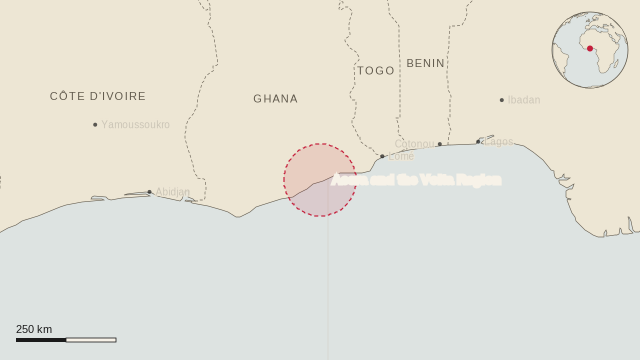
1987·Accra and the Volta Region (Kpandu and Hohoe), southeastern Ghana
Ghana.Ghana · a pilot sees a glowing object cross Accra out to sea
On the night of July 27, 1987, between 11 p.m. and midnight, witnesses around Accra and in the Volta Region of southeastern Ghana briefly saw a large object over the country's southeast and the Gulf of Guinea; some called it silent and others heard explosions. A Ghana Air Force pilot, unnamed in the record, told the U.S. Defense Attaché Office that it looked like a meteorite, then climbed, and that its single yellowish light was replaced by eight blue ones. DIA suggested space debris as the most plausible explanation, without naming an object.
Tier B · IndicativeWhat do they mean? →
Limited evidence: it falls short of what Tier A requires. Any one of these is enough: a single testimony (or several witnesses who saw it together), testimony gathered years later, or an account without contemporary primary documentation.
What it was
72%reentry
The most likely explanation.
- 72% reentry
- 4% other earthly causes
- 24% no known cause
See the split across the six explanations
Earthly origin (human or natural)76%
No known cause24%
Ordinary cause the sources propose: reentry
What happened
On the night of Monday, July 27, 1987, between 11 p.m. and midnight, people around Accra, the capital of Ghana, and in Kpandu and Hohoe, two towns in the Volta Region more than 150 km to the northeast, briefly saw a large object over the country's southeast and the Gulf of Guinea. Ghana keeps Greenwich time, so local time and the time in the report that records the sightings are the same. The Ghanaian Times newspaper carried the sightings in its Wednesday, July 29 edition. According to the summary of that article written by the U.S. Defense Attaché Office in Accra, some witnesses said the object was silent and others heard "explosions" as it passed. The summary is a short paragraph and names no witness.
On August 4 and 5, in private conversations with the attaché office, a Ghana Air Force pilot described what he had seen that night from the ground near Accra. The report does not give his name. In his account, the object came from the north and at first looked like a falling meteorite. Very soon it stopped falling and began to climb, and as it gained altitude over Accra and the sea its details could be seen clearly, thanks to its own light and the clear sky.
When he saw it best, the pilot judged it to be at about 15,000 ft, roughly 4,600 meters. It was shaped like a very large aircraft fuselage or a missile body, metallic in color, like aluminum, and it looked two or three times the size of a Boeing 747. He heard no sound from it. While it was descending it showed a single large yellowish light at the center of its rear end, "like a rocket." Around the time it stopped descending, that light went out and eight smaller blue lights appeared, arranged in a circle around the end. The pilot compared them to small jets that seemed to drive the object as it disappeared over the horizon above the Gulf of Guinea.
The pilot added that he had heard of other sightings, apparently of the same object, in which people heard "two explosions," and he guessed they could have been sonic booms. According to the report, he was apparently not aware of any sound from the object at any time while he watched it. In its comments, the attaché office described him as a qualified jet fighter pilot, known as "a serious professional," not given to flights of fancy or to seeking attention. It also noted that he seemed embarrassed as well as mystified, and that he gave the details reluctantly, mainly because the commander of the Ghana Air Force had asked the attaché office to help identify the object.
Col. D. M. Parker of the U.S. Army, the defense attaché in Accra, prepared and approved intelligence information report IIR 6 835 0129 87, "Unidentified Flying Object," classified confidential and marked as information not finally evaluated. It went to the Defense Intelligence Agency (DIA) on August 20, 1987, and the same day the Joint Chiefs of Staff relayed it to the CIA, the NSA, the State Department and the service headquarters.
Six minutes after the report was sent, another note went to DIA with the sender blacked out; by its subject line, it is a communication between the attaché and an analyst. Its author says he promised someone, whose identity is also blacked out, to forward the case to Washington to see whether the U.S. government could suggest an explanation, and that, "testing his sense of humor," he suggested it might have been an experimental missile launched by Qadhafi. That person, the note's author writes, "passed the test." The note asked for an answer that could be passed on to him.
DIA answered two months later. In a message dated October 23 it wrote that "precise identification" of what was described was not presently possible, but that the patterns, noise and colors reported strongly suggested "space debris." The next paragraph is blacked out. The third says UFOs "remain a concern here, although not heavily publicized," and jokes that some were supposed to show up for the "Harmonics Convergence" (sic), a New Age gathering that summer, "but only Incas could see them." In a second message, dated October 26, DIA explained that the first had arrived garbled, "perhaps extra terrestrial interference." It repeated that, in this case, debris from a weather, communications or experimental satellite appeared to be "the most plausible explanation," and it signed off with "Happy Halloween."
Where it happened
Why it matters
The case is known from an intelligence report written at the time, and what sets it apart is the witness. The attaché office presented the pilot as a serious professional and put on record that he told his story reluctantly, mainly because the commander of his air force had asked the attaché office for help. His account reached Washington more than three weeks after the event, with the time, the heading and the sequence of lights, and with the pilot's own caution that the "explosions" others heard may have been sonic booms.
What he described resembles an object entering the atmosphere from space: something that first looks like a meteorite, a main light that goes out, and a cluster of smaller lights that travel on together until they drop below the horizon. In the 1996 Yukon sighting ↗ Yukon, which orbital analyst Ted Molczan matched in 2012 to a reentry and whose time he worked out, witnesses also described a huge object with lights. The altitude and size the pilot gave are naked-eye estimates, made at night with no point of reference. The detail that fits a fall least well is that the object seemed to climb. An object moving almost horizontally at great height toward an observer rises in the sky as it approaches. That is one possible reading, though the record does not state it.
Satellite catalogs offer a specific candidate that DIA did not name. According to astronomer Jonathan McDowell's GCAT catalog and to CelesTrak, the third stage of the Soviet Proton-K rocket that put the Kosmos-1870 satellite into orbit on July 25, 1987, a cylinder of 4,185 kg and 6.5 meters long, reentered the atmosphere on July 27, the day of the sightings. Its orbit, inclined 71.9 degrees to the equator, passed over Ghana's latitude, and by a calculation made for this case, on a north-to-south pass it would have crossed the region on a heading close to the one the pilot gave.
The catalogs do not give the time of reentry. By two independent calculations made for this case, the stage's only north-to-south pass of the day over Accra fell around 11:10 p.m. GMT, within the hour of the sightings, and the area was in full night: the stage could only have been seen if it was already burning up on reentry. Without knowing where along its orbit it was, or whether it was still in orbit, it remains only a candidate.
The exchange also shows how DIA handled a report like this in 1987. It replied two months later, amid jokes about Qadhafi, the Incas and Halloween, and what was left unredacted contains no trajectory calculation and names no specific object. The second message adds that DIA had nothing further, but that UFOs are always "a terrific subject for cocktail chatter" and might lead into other subjects like air defense and surveillance. The papers are published by The Black Vault, John Greenewald's archive, which obtained them from DIA; the same compilation includes the 1980 report on the La Joya case ↗ La Joya in Peru.
Documents and sources
Primary documents
U.S. Defense Attaché Office Accra, report IIR 6 835 0129 87, "Unidentified Flying Object," and DIA replies (August and October 1987, 7 pp.)
Intelligence report the U.S. Defense Attaché Office in Accra sent to DIA on August 20, 1987 about the object seen over southeastern Ghana on the night of July 27, with the Ghanaian Times summary and a Ghana Air Force pilot's account.
Read more
Pages 1 to 4 are the two sections of the report, prepared and approved by Col. D. M. Parker; page 5 is the note that traveled with it, sender blacked out; pages 6 and 7 are DIA's replies of October 23 and 26, which propose space debris. Extract from the 12-page compilation, with the pages unaltered and put in date order.
Defense Intelligence Agency · FOIA response (The Black Vault copy, “ghana-ufos-dia-1987.pdf”) · Public domain · US Government work · open original
Documented evidence
- Intelligence information report IIR 6 835 0129 87, "Unidentified Flying Object," from the U.S. Defense Attaché Office in Accra to DIA (August 20, 1987, confidential), prepared and approved by Col. D. M. Parker: dates of information July 29 to August 5, and a sighting "late in the evening" of July 27.
- The same report summarizes the July 29 edition of the Ghanaian Times: witnesses near Accra and in Kpandu and Hohoe saw a large UFO between 2300 and 2400 GMT on July 27; some called it silent and others spoke of "explosions."
- Account of a Ghana Air Force jet fighter pilot, unnamed in the report, gathered on August 4 and 5: north-to-south heading, an apparent fall and then a climb, about 15,000 ft, two or three times the size of a Boeing 747, no sound, a yellowish rear light and then eight blue lights in a circle.
- Note that traveled with the report on August 20, with the sender blacked out: it asked Washington for an explanation that could be passed on to the other man, and recounted the Qadhafi missile joke.
- DIA replies of October 23 and 26, 1987: precise identification "is not presently possible," the patterns, noise and colors suggest "space debris," and satellite debris is "the most plausible explanation." Part of the text is blacked out.
- Jonathan McDowell's GCAT catalog and the CelesTrak catalog: the third stage of the Proton-K that launched Kosmos-1870 (1987-064B, 4,185 kg, inclination 71.94 degrees) reentered on July 27, 1987; neither gives the time.
Sources
- Defense Intelligence Agency, IIR 6 835 0129 87, "Unidentified Flying Object" (USDAO Accra, August 20, 1987), cover note and DIA replies of October 23 and 26, 1987 (FOIA release published by The Black Vault) — Seven pages of declassified cables, with redactions. Primary source for the whole account.
- "DIA UFO Files 1980-1987," compilation on UFOScans (pp. 2-8, Ghana; pp. 9-11, Finland and Peru) — Same Black Vault copy, bound with the Finland (1982) and La Joya (1980) reports. The page dates the document July 27, 1987, which is the date of the event; the report is from August 20.
- Jonathan McDowell, General Catalog of Artificial Space Objects (GCAT), satcat.tsv, object 1987-064B — Third stage of the Proton-K that launched Kosmos-1870 on July 25, 1987; reentry on July 27, no time given.
- CelesTrak, SATCAT record for object 18226 (SL-13 R/B, 1987-064B) — Decay date July 27, 1987; last recorded orbit 133 × 160 km.
Related cases
Cases this case cites and cases with the same likely cause.
Cited in this case · Within 10 years
Yukon · 22 witnesses see a huge row of lights
1996 · Tier B
Cited in this case · Within 10 years
La Joya · a Peruvian fighter fires on an object
1980 · Tier B
Reentry · Within 10 years
France · thousands see a triangle of light cross the sky
1990 · Tier S
Reentry · Within 10 years
Odense · a light with a trail and smaller lights crosses Denmark
1991 · Tier A