Case No. 154·Canada
Developing2025·Office of Canada's Chief Science Advisor (OCSA), Ottawa
Canada.Sky Canada Project · federal scientific review of UAP reporting
The Sky Canada Project is the review the Office of the Chief Science Advisor of Canada (OCSA), under Mona Nemer, devoted to the state of public reporting of unidentified aerial phenomena. Launched in 2022, its report — 'Management of Public Reporting of Unidentified Aerial Phenomena in Canada' — had a preview in January 2025 and full publication in mid-2025. It finds that Canada receives between 600 and 1,000 UAP reports a year but that since 1995 no federal body has held the mandate to collect them: they are scattered across the RCMP, Transport Canada and the Canadian Space Agency. It recommends creating a single national lead to standardize, collect and publish the data. It is the first Canadian federal-scientific acknowledgment that the reporting system is broken; it does not investigate sightings nor pronounce on their nature.
Year
2025
Tier
A
Probability
62%
Category
Document
Institutional evidence: multiple verifiable witnesses or official documentation. Three independent axes: the «tier» measures the strength of the evidence; the «probability» estimates how genuinely unexplained the case is —a natural phenomenon can remain unexplained, so it does not equal «non-prosaic»—; and the partition of explanations (below) says what it most plausibly was. So a well-documented case can have a possible hoax as its most plausible cause, and a Tier B is not, for that reason, a hoax.
Primary documents · viewer
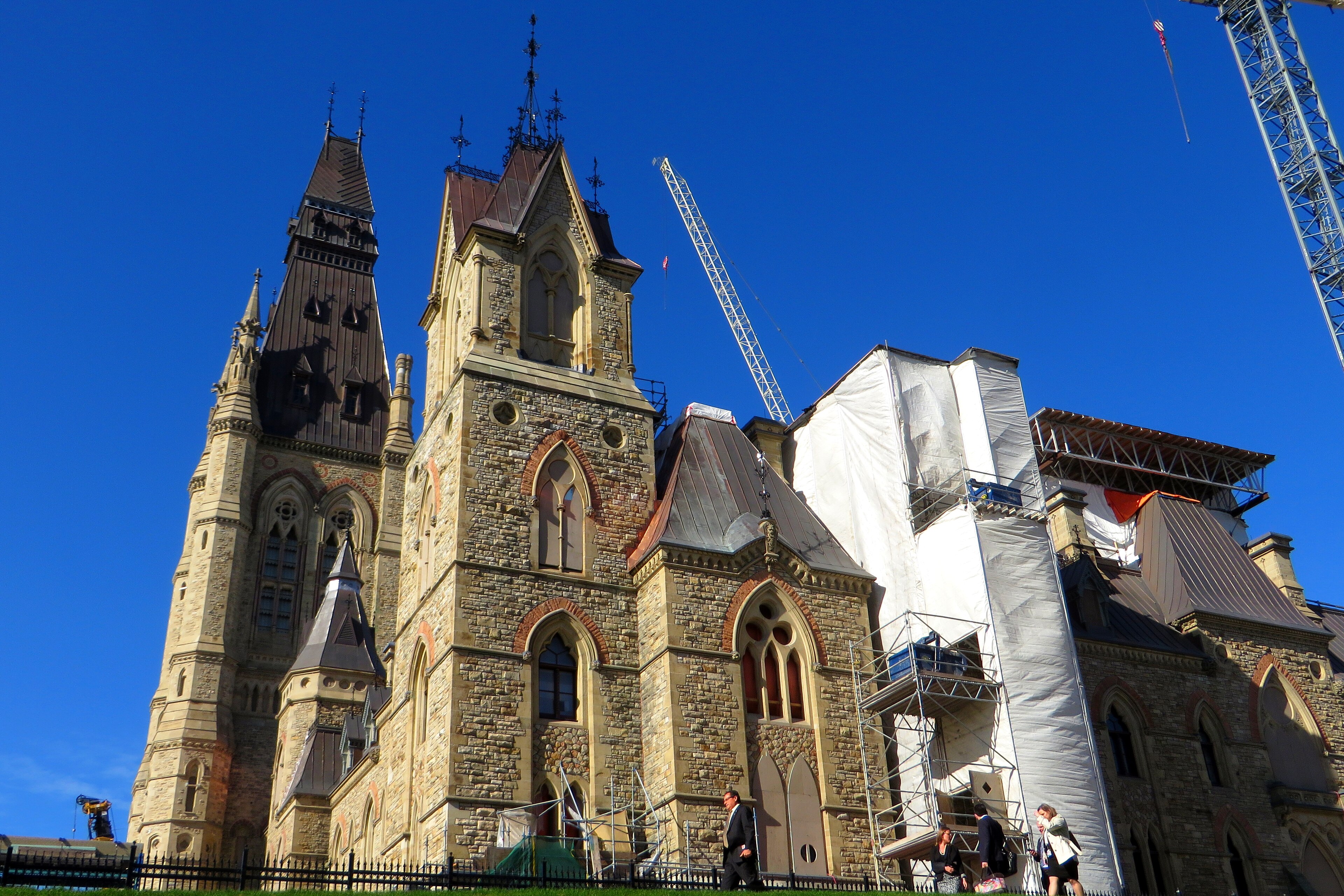
Context · the West Block of Parliament in Ottawa (Canada)
West Block, Parliament Hill, Ottawa, Ontario (29442366923).jpg · Wikimedia Commons · CC BY-SA 2.0 · open original
Part 01
The file in question
In 2022, the Office of the Chief Science Advisor of Canada (OCSA), led by Mona Nemer —a biochemist and cardiovascular scientist appointed the federal government's chief science advisor in 2017—, launched the Sky Canada Project: a systematic review of how the Canadian government manages the public reporting of unidentified aerial phenomena (UAP). It was not conceived as an investigation of sightings nor as an effort to prove or disprove extraterrestrial life — its object was the reporting mechanism itself, not first-hand data. The project did not collect or analyze photos, videos or individual testimonies; instead it examined how, where and by whom reports are currently received in Canada, what is done with them, and what good practices exist in other jurisdictions.
The resulting report, 'Management of Public Reporting of Unidentified Aerial Phenomena in Canada', had a preview version in January 2025 and full publication in mid-2025. Its diagnosis is blunt: Canadians report between 600 and 1,000 UAP sightings per year, and a national survey commissioned for the project found that roughly one in four respondents (around 27%) say they have observed something they could not identify in the sky at some point in their lives — yet since 1995, when the last centralized channel was closed, no federal body has held the mandate to collect or investigate those reports systematically. The result is a fragmented system: reports scatter across the Royal Canadian Mounted Police (RCMP), Transport Canada (via the CADORS civil-aviation incident database), the Canadian Space Agency and private operators such as observatories and citizen-science platforms, with none of them compiling or analyzing them under a common methodology. The consequence, the report argues, is twofold: potentially useful air-safety information is lost, and the absence of a credible channel leaves the field open to misinformation.
The recommendations aim to close that institutional gap. The principal one is to designate a single national lead —a trusted scientific organization, and the report explicitly suggests the Canadian Space Agency— to standardize and centralize the collection of testimonies, investigate cases and publish its analyses. To this it adds enabling a dedicated reporting service (with a hotline and app), opening the data and providing citizen-science tools, and publishing findings and conclusions transparently. The report also specifically recommends that Transport Canada encourage pilots, cabin crews and air traffic controllers to report sightings without fear of professional stigma. The overarching framing stresses scientific rigor and countering misinformation as justification: without a credible, documented channel, the vacuum is filled by stigma, speculation and unverified narratives. The report is clear about what it does not do —it does not investigate specific sightings nor pass judgment on their nature—; its product is a governance diagnosis and a set of recommendations the government may or may not adopt.
Part 02
Why this case moved the needle
It is the Canadian analog of the institutional cycle the corpus already tracks in the U.S. (AARO, PURSUE, UAP Disclosure Act): a Western state acknowledges at the federal-scientific level that UAP reporting deserves formal infrastructure. Its weight is procedural, not probative — the report explicitly does not investigate cases nor pronounce on their nature — but it restructures the problem in Canada: it documents that for three decades there was no institutional owner of the data, and names the cost of that vacuum (stigma, misinformation, 600-1,000 annual reports lost without analysis). Unlike PURSUE (Tier S: executive directive with an operational portal and mandate), Sky Canada is advisory: it recommends, it does not order, and its implementation was left to government decision. Hence Tier A. It pairs with Project Magnet/Second Storey (1950) as the two poles of Canadian state involvement: an operational program in the mid-20th century and a scientific audit of reporting 75 years later. The internal Canadian contrast completes the picture: Paul Hellyer, Minister of National Defence (1963-1967), was from 2005 the highest-ranking official in the world to publicly assert an extraterrestrial presence, without ever producing a document; Sky Canada is the same state approaching the topic the opposite way — data governance and a credible reporting channel, no cosmology.
Part 03
What's left on paper
Documented evidence
- Official report 'Management of Public Reporting of Unidentified Aerial Phenomena in Canada' from the Office of the Chief Science Advisor of Canada (OCSA)
- Sky Canada Project launched in 2022; preview version published in January 2025 and full report in mid-2025
- Documented diagnosis: 600-1,000 UAP reports per year in Canada; a 2024 national survey with 27% reporting observation of something unidentifiable
- Finding that since 1995 no federal body has held the mandate to collect or investigate public UAP reports
- Recommendation of a single national lead (the Canadian Space Agency is suggested) plus a public portal, open data and citizen science
- Reports currently scattered across the RCMP, Transport Canada (CADORS database) and the Canadian Space Agency, with no systematic compilation
Sources
- Office of the Chief Science Advisor of Canada — Sky Canada Project (portal oficial) — Primary project page.
- Management of Public Reporting of Unidentified Aerial Phenomena in Canada — informe (gov.ca) — Full report and recommendations.
- CBC News — 'Canada needs agency to manage public UFO sightings, says new federal report' — Press coverage of the launch and the recommendations.
- The Debrief — 'Canada's UAP Challenges: Will the Government Act on the Sky Canada Project Report?' — Analysis of the pending implementation status.
- EarthSky — 'UFOs in Canada? Official new report' — Popular synthesis of the report.
Patterns it exhibits (1)
Location
Office of Canada's Chief Science Advisor (OCSA), Ottawa · 45.42°, -75.70°
Related cases