Caso Nº 48Case No. 48·Estados Unidos / GlobalUnited States / Global
2016·Podesta emails leakedPodesta emails leaked
Estados Unidos / GlobalUnited States / Global.WikiLeaks Podesta CacheWikiLeaks Podesta Cache
En octubre de 2016, los correos filtrados de John Podesta revelaron intercambios sustantivos sobre UAP con Tom DeLonge, el astronauta Edgar Mitchell y otras figuras del campo de la divulgación. Más allá del contenido, la filtración —criptográficamente auténtica— documenta una red operacional de pre-divulgación que precedió por años a los eventos públicos de 2017-2026.In October 2016, John Podesta's leaked emails revealed substantive UAP exchanges with Tom DeLonge, astronaut Edgar Mitchell and other disclosure-world figures. Beyond the content, the cryptographically authentic leak documents an operational pre-disclosure network that preceded the public events of 2017–2026 by years.
AñoYear
2016
TierTier
S
ProbabilidadProbability
72%
CategoríaCategory
DocumentoDocument
Evidencia fuerte: registro de sensor instrumental + múltiples testigos (típicamente militar). Tres ejes independientes: el «tier» mide la fuerza de la evidencia; la «probabilidad» estima cuán genuinamente inexplicado está el caso —un fenómeno natural puede seguir sin explicación, así que no equivale a «no-prosaico»—; y la partición de explicaciones (abajo) dice qué fue más plausiblemente. Por eso un caso bien documentado puede tener como causa más plausible un posible fraude, y un Tier B no es, por eso, un fraude.Strong evidence: instrumental sensor record + multiple witnesses (typically military). Three independent axes: the «tier» measures the strength of the evidence; the «probability» estimates how genuinely unexplained the case is —a natural phenomenon can remain unexplained, so it does not equal «non-prosaic»—; and the partition of explanations (below) says what it most plausibly was. So a well-documented case can have a possible hoax as its most plausible cause, and a Tier B is not, for that reason, a hoax.
Documentos primarios · visorPrimary documents · viewer

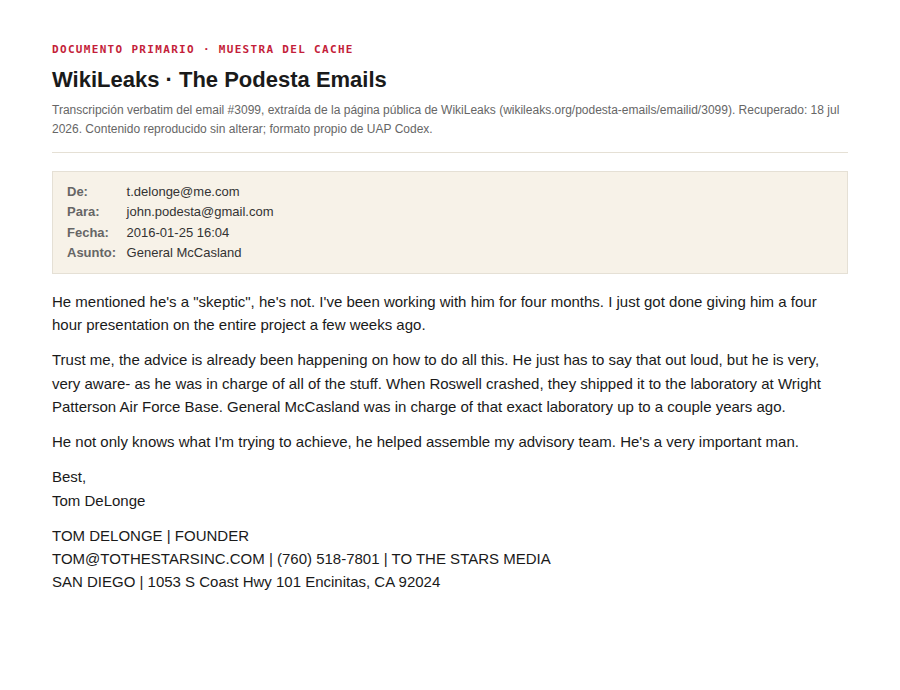
WikiLeaks · Podesta Emails #3099 — Tom DeLonge a John Podesta (25 ene 2016)WikiLeaks · Podesta Emails #3099 — Tom DeLonge to John Podesta (25 Jan 2016)
WikiLeaks · «The Podesta Emails» (2016), email 3099 · Transcripción verbatim con fines documentales; derechos del contenido de sus autores · abrir originalopen original
Parte 01Part 01
El expediente en cuestiónThe file in question
En octubre de 2016, durante la recta final de la campaña presidencial estadounidense, WikiLeaks publicó por entregas el archivo masivo de correos electrónicos de John Podesta, jefe de campaña de Hillary Clinton y antiguo consejero de la Casa Blanca con Obama y Clinton. Entre los miles de documentos divulgados aparecieron varios intercambios sobre el tema UAP con figuras del espacio de la divulgación, principalmente el músico y empresario Tom DeLonge (exguitarrista de Blink-182, futuro fundador de To The Stars Academy) y el astronauta del Apollo 14 Edgar Mitchell, sexto ser humano en pisar la Luna.
“ del primer mandato de Obama había sido no lograr una mayor desclasificación de los archivos UFO. Los correos de Edgar Mitchell a Podesta (2015) solicitaban reuniones urgentes sobre ”
Los correos de DeLonge a Podesta, fechados entre octubre de 2015 y enero de 2016, buscaban concertar reuniones sobre lo que él describía como un 'tema sensible' y vinculaba a su proyecto multimedia Sekret Machines; en ellos DeLonge afirmaba estar en contacto con personas de 'liderazgo principal' relevantes en la materia y adjuntaba imágenes de aeronaves y de un objeto sobre la atmósfera terrestre. Conviene precisar el alcance: los correos documentan que DeLonge gestionaba accesos y narrativas de divulgación, no constituyen un organigrama verificado de un programa clasificado. Podesta, por su parte, había sido públicamente locuaz sobre el asunto: en 2015 declaró que su 'mayor fracaso' del primer mandato de Obama había sido no lograr una mayor desclasificación de los archivos UFO.
Los correos de Edgar Mitchell a Podesta (2015) solicitaban reuniones urgentes sobre 'divulgación y energía de punto cero' (zero-point energy) y mencionaban a una colaboradora, Terri Mansfield, que supuestamente informaría sobre la 'conciencia del Vaticano' respecto a inteligencia extraterrestre; uno de los mensajes contenía afirmaciones marcadamente especulativas sobre una 'ETI no violenta' que ayudaría a llevar esa energía a la Tierra. Estas son las propias palabras de Mitchell y deben leerse como las creencias de un divulgador veterano, no como un hallazgo institucional. La autenticidad del archivo fue respaldada por verificación criptográfica de las firmas DKIM con que los servidores de Google habían firmado originalmente los mensajes, lo que distingue a este caso de las filtraciones no verificables: independientemente de lo especulativo de algunos contenidos, las comunicaciones son auténticas y muestran que un operador político del más alto nivel mantenía un canal activo con actores del campo de la divulgación.
In October 2016, during the final stretch of the U.S. presidential campaign, WikiLeaks published in installments the massive email archive of John Podesta, Hillary Clinton's campaign chairman and a former White House counselor under Obama and Clinton. Among the thousands of disclosed documents were several exchanges on the UAP topic with figures from the disclosure space, principally the musician and entrepreneur Tom DeLonge (former Blink-182 guitarist, future founder of To The Stars Academy) and Apollo 14 astronaut Edgar Mitchell, the sixth human to walk on the Moon.
DeLonge's emails to Podesta, dated between October 2015 and January 2016, sought to arrange meetings about what he described as a 'sensitive topic' and tied to his Sekret Machines multimedia project; in them DeLonge claimed to be in contact with people of 'principal leadership' relevant to the matter and attached images of aircraft and of an object above Earth's atmosphere. The scope should be stated precisely: the emails document that DeLonge was managing disclosure access and narratives — they do not constitute a verified org chart of a classified program. Podesta, for his part, had been publicly outspoken on the issue: in 2015 he stated that his 'biggest failure' of Obama's first term had been not achieving greater declassification of the UFO files.
Edgar Mitchell's emails to Podesta (2015) requested urgent meetings about 'disclosure and zero-point energy' and mentioned a collaborator, Terri Mansfield, who would supposedly brief on the 'Vatican's awareness' of extraterrestrial intelligence; one message contained markedly speculative claims about a 'non-violent ETI' that would help bring such energy to Earth. These are Mitchell's own words and should be read as the beliefs of a veteran disclosure advocate, not an institutional finding. The archive's authenticity was supported by cryptographic verification of the DKIM signatures with which Google's servers had originally signed the messages, which distinguishes this case from unverifiable leaks: regardless of how speculative some content is, the communications are authentic and show that a top-level political operator maintained an active channel with actors in the disclosure field.
Parte 02Part 02
Por qué este caso movió la agujaWhy this case moved the needle
El valor de este caso para el corpus es de naturaleza distinta a la de los casos de avistamiento: no aporta evidencia sobre el fenómeno en sí, sino sobre la sociología de la divulgación. Es uno de los pocos episodios con un registro criptográficamente auténtico de comunicaciones privadas entre una figura política del más alto nivel (Podesta) y operadores activos del campo UAP (DeLonge, Mitchell). Su importancia es que, con independencia del contenido especulativo de algunos mensajes, documenta que existía un canal de pre-divulgación funcionando años antes de los hitos públicos de 2017 en adelante (el reportaje del New York Times sobre las 'Glowing Auras', la revelación del AATIP, la creación de la AARO y el testimonio de David Grusch ante el Congreso). El interés de DeLonge se materializó poco después en To The Stars Academy, que sirvió de vehículo a la difusión de los videos de la Navy.
La cautela editorial es aquí especialmente necesaria, porque el caso es fácil de sobreinterpretar en ambas direcciones. Por un lado, la mera existencia de un correo no prueba el contenido de sus afirmaciones: que Mitchell creyera en una 'ETI no violenta' o en la 'conciencia del Vaticano' no convierte esas creencias en hechos, y que DeLonge afirmara tener contactos de alto nivel no acredita la estructura que describía. Por otro lado, los escépticos que descartan el cache como mera excentricidad de figuras marginales subestiman lo verificable: que el jefe de campaña de una candidata presidencial dedicara tiempo y atención a estas conversaciones, y que su trayectoria pública (su 'mayor fracaso' declarado sobre la desclasificación) sea coherente con ellas. Lo que el caso establece sólidamente es el patrón comunicacional —una red de pre-divulgación operando en el nivel político alto— y no la veracidad de las tesis sustantivas que circulaban dentro de esa red.
This case's value to the corpus is of a different nature than the sighting cases: it provides evidence not about the phenomenon itself but about the sociology of disclosure. It is one of the few episodes with a cryptographically authentic record of private communications between a top-level political figure (Podesta) and active operators of the UAP field (DeLonge, Mitchell). Its importance is that, regardless of the speculative content of some messages, it documents that a pre-disclosure channel was operating years before the public milestones from 2017 onward (the New York Times report on the 'Glowing Auras,' the AATIP revelation, the creation of AARO, and David Grusch's congressional testimony). DeLonge's interest materialized shortly afterward in To The Stars Academy, which served as the vehicle for releasing the Navy videos.
Editorial caution is especially necessary here, because the case is easy to over-read in both directions. On one hand, the mere existence of an email does not prove the content of its claims: that Mitchell believed in a 'non-violent ETI' or in the 'Vatican's awareness' does not make those beliefs facts, and that DeLonge claimed high-level contacts does not certify the structure he described. On the other hand, skeptics who dismiss the cache as the eccentricity of marginal figures underestimate what is verifiable: that a presidential candidate's campaign chairman devoted time and attention to these conversations, and that his public record (his stated 'biggest failure' on declassification) is consistent with them. What the case solidly establishes is the communicational pattern — a pre-disclosure network operating at the high political level — not the veracity of the substantive theses circulating within that network.
Parte 03Part 03
Lo que queda en papelWhat's left on paper
Evidencia documentadaDocumented evidence
- Emails DeLonge-Podesta autenticados por DKIM signature de GmailDeLonge-Podesta emails authenticated by Gmail's DKIM signature
- Emails Mitchell-Podesta sobre 'extraterrestria la divulgación'Mitchell-Podesta emails about 'extraterrestrial disclosure'
- Verificación criptográfica de autenticidad por investigadores independientesCryptographic verification of authenticity by independent researchers
- Coherencia narrativa con eventos institucionales posteriores (TTSA → AATIP → AARO)Narrative coherence with subsequent institutional events (TTSA → AATIP → AARO)
FuentesSources
- WikiLeaks Podesta Emails (2016)
- Podesta on UAP — Bill Maher interview (2015)
- Sheaffer, R. & Greer, S. — Independent verification of cache — Verificación cryptographicCryptographic verification
Patrones que exhibe (2)Patterns it exhibits (2)
UbicaciónLocation
Podesta emails leakedPodesta emails leaked · 38.89°, -77.04°
Casos relacionadosRelated cases
mismo país · 2 patronessame country · 2 patterns
PURSUE · sistema presidencial de release UAPPURSUE · Presidential Unsealing and Reporting System for UAP Encounters
2026 · Tier A · 95%
mismo país · 2 patronessame country · 2 patterns
Investigación Burlison · contratistas FFRDC (MITRE, MIT Lincoln Lab)Burlison investigation · FFRDC contractors (MITRE, MIT Lincoln Lab)
2026 · Tier A · 85%
mismo país · 2 patronessame country · 2 patterns
UAP Disclosure Act 2025 (S.Amdt.3111)UAP Disclosure Act 2025 (S.Amdt.3111)
2023 · Tier A · 80%
mismo país · 2 patronessame country · 2 patterns
«Glowing Auras and Black Money» · el NYT revela el AATIP'Glowing Auras and Black Money' · The NYT reveals AATIP
2017 · Tier S · 80%
Actores asociados (3)Associated actors (3)