Case No. 321·United States
2017·The Pentagon, Arlington, Virginia (AATIP's home)
United States.'Glowing Auras and Black Money' · The NYT reveals AATIP
On 16 December 2017, The New York Times ran on its front page 'Glowing Auras and "Black Money": The Pentagon's Mysterious U.F.O. Program' (bylined Helene Cooper, Ralph Blumenthal and Leslie Kean), revealing the Advanced Aerospace Threat Identification Program (AATIP): a Department of Defense program funded with ~US$22 million between 2007 and 2012, pushed by Senator Harry Reid, with contracts to Bigelow Aerospace. The same day, To The Stars Academy released two Navy videos (FLIR1/Nimitz and Gimbal) and Luis Elizondo surfaced as the former official who claimed to have run it. It was the event that made UAP mainstream and chained into the UAPTF (2020) and the ODNI report (2021).
Year
2017
Tier
S
Probability
80%
Category
Document
Strong evidence: instrumental sensor record + multiple witnesses (typically military). Three independent axes: the «tier» measures the strength of the evidence; the «probability» estimates how genuinely unexplained the case is —a natural phenomenon can remain unexplained, so it does not equal «non-prosaic»—; and the partition of explanations (below) says what it most plausibly was. So a well-documented case can have a possible hoax as its most plausible cause, and a Tier B is not, for that reason, a hoax.
Primary documents · viewer
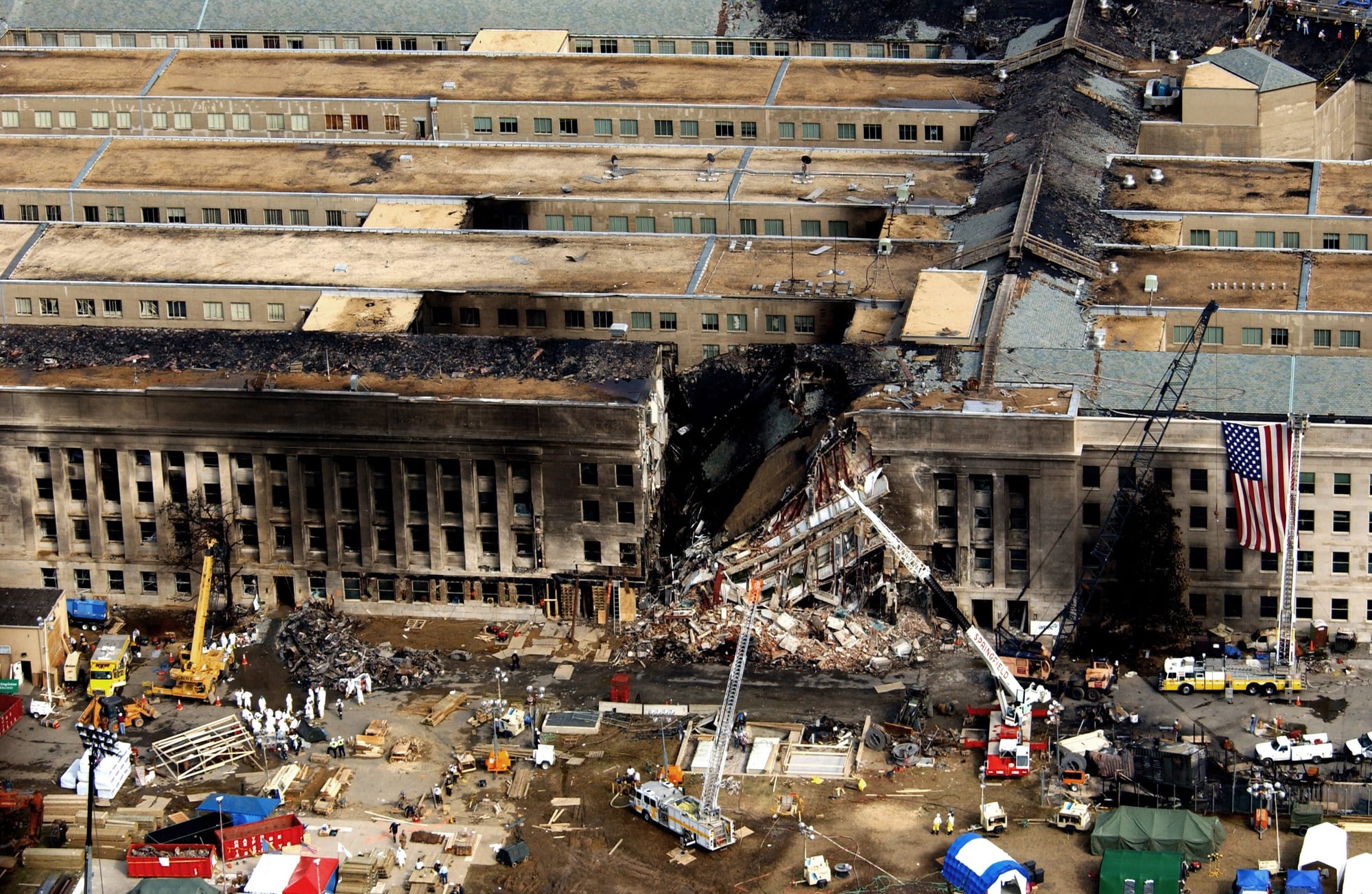
Context · the Pentagon (Arlington, Virginia), home of the AATIP programme
Aerial view of the Pentagon during rescue operations post-September 11 attack.JPEG · Wikimedia Commons · Dominio público · open original
Part 01
The file in question
On 16 December 2017, The New York Times published on its front page an article bylined by Pentagon correspondent Helene Cooper, former staff writer Ralph Blumenthal and author Leslie Kean, titled 'Glowing Auras and "Black Money": The Pentagon's Mysterious U.F.O. Program.' The piece revealed a previously unacknowledged program: the Advanced Aerospace Threat Identification Program (AATIP), dedicated within the Department of Defense to investigating unidentified aerial phenomena.
According to the report and later documentation, the program began in 2007 within the Defense Intelligence Agency, driven by then Senate Majority Leader Harry Reid (D-Nevada), with support from senators Ted Stevens and Daniel Inouye. It was funded with about 22 million dollars over five years, until appropriations ended in 2012. Much of that money went to Bigelow Aerospace Advanced Space Studies (BAASS), a company of billionaire Robert Bigelow —a friend of Reid— which produced a 494-page report on decades of sightings and dozens of technical studies. The program's contractual origin is known as AAWSAP; 'AATIP' is the name under which its UAP-focused strand became popular.
The article introduced Luis Elizondo as the military intelligence official who said he had run AATIP from the fifth floor of the Pentagon's C Ring, and who had resigned in October 2017 in protest at excessive secrecy and lack of internal support. In coordinated fashion, the newly created To The Stars Academy (TTSA) —co-founded by Elizondo and musician Tom DeLonge— released the same day two videos captured by the U.S. Navy: the 'FLIR1' clip associated with the 2004 USS Nimitz encounter, and the one called 'Gimbal.' The Pentagon, when asked, confirmed that AATIP had existed, though it maintained the program had ended in 2012; over the following months and years it kept qualifying what exactly it had been and who had led it. The report thus anchored, on a single front page, three pieces that until then circulated separately: an obscure program, a named institutional witness, and some military footage.
Part 02
Why this case moved the needle
Few events in UAP history matter as much for their form as for their content, and this is one. The NYT article proved nothing about the origin of the objects; its weight is institutional and cultural. By bringing the subject to the front page of the newspaper of record, treated as a flight-safety matter rather than folklore, it dissolved at a stroke the stigma that for half a century had kept it out of serious conversation. Almost everything that came afterward —the formalization of Navy reporting procedures, the UAP Task Force acknowledged in 2020, the ODNI preliminary report in 2021, the congressional hearings and the creation of AARO— takes this moment as its starting point. The corpus needed it anchored because it already had the incident that fed it (Nimitz, 2004) and the official assessment that flowed from it (ODNI, 2021), but was missing the 2017 hinge that connects them.
At the same time, the case lives in Tier S for its influence, not for being proof of anything, and reading it honestly requires marking the cracks. The program that was revealed was, above all, a broad research contract awarded to a private company (BAASS/Bigelow), spanning from exotic physics to Skinwalker Ranch, whose concrete output is disputed. Luis Elizondo's role at the head of AATIP was questioned: in 2019 The Intercept and, over time, contradictory statements from the Pentagon itself cast doubt on whether he had actually led it, and even on what formal relationship he had with the 'AATIP' name. The simultaneous release of the videos by a commercial entertainment company (TTSA) also introduced an interest that is not that of a neutral body. None of this cancels the central fact —the program existed and the Pentagon confirmed it— but it forces one to separate the hard datum (there was public money investigating UAP) from the narrative built on top of it. It is the very model of a document-case: it changes the institutional regime of the phenomenon without saying a word about its nature.
Part 03
What's left on paper
Documented evidence
- NYT front-page article 'Glowing Auras and "Black Money": The Pentagon's Mysterious U.F.O. Program' (16 Dec 2017), bylined Helene Cooper, Ralph Blumenthal and Leslie Kean
- Pentagon confirmation that AATIP existed (a DIA program, ~US$22M, 2007–2012)
- Program pushed by Senator Harry Reid; contract to Bigelow Aerospace (BAASS); a 494-page report and dozens of studies
- Luis Elizondo, described as AATIP's director, resigned in October 2017; the same day TTSA released the Navy videos 'FLIR1'/Nimitz and 'Gimbal'
- The Intercept (2019) and later contradictory Pentagon statements questioned Elizondo's role at the head of the program
- The event chained into the UAP Task Force (2020) and the ODNI preliminary report (2021)
Sources
- The New York Times — «Glowing Auras and 'Black Money': The Pentagon's Mysterious U.F.O. Program» (16 dic 2017)
- Wikipedia — 'Advanced Aerospace Threat Identification Program'
- The Intercept — 'The Media Loves This UFO Expert Who Says He Worked for an Obscure Pentagon Program. Did He?' (2019) — Skeptical counterweight on Elizondo's role and the real scope of AATIP.
Patterns it exhibits (3)
Location
The Pentagon, Arlington, Virginia (AATIP's home) · 38.87°, -77.06°
Related cases
same country · 3 patterns
Burlison investigation · FFRDC contractors (MITRE, MIT Lincoln Lab)
2026 · Tier A · 85%
same country · 3 patterns
UAP Disclosure Act 2025 (S.Amdt.3111)
2023 · Tier A · 80%
same country · 2 patterns
WikiLeaks Podesta Cache
2016 · Tier S · 72%
same country · 2 patterns
Capitol Press Conference · Grusch + lawmakers (Jun 9, 2026)
2026 · Tier A · 80%