2025·Virginia coast, western Atlantic
United States.Virginia coast · the Navy reports about a hundred objects
The fiscal year 2025 annual report of the Pentagon office for these phenomena (AARO), released in July 2026, devotes three sentences to its only maritime case: U.S. Navy units operating off the coast of Virginia reported about 100 unidentified objects in the air and two surface systems, likely uncrewed. The office says it is actively investigating the event together with the reporting unit. The report gives no date, duration or exact location, and does not say whether the objects were seen at once or over several days.
Tier B · IndicativeWhat do they mean? →
Limited evidence: a single witness, testimony gathered years later, or an account without contemporary primary documentation.
What it was
75%natural or human cause
Most likely explanation: adversary technology
See the split across the six explanations
Natural or human cause
No known cause
Read the full reasoning
Base rate from the same report: AARO assesses that "all resolved cases are attributable to prosaic objects such as balloons, satellites, birds, aircraft, and unmanned aerial systems (UAS)", and it sent 191 of the 319 cases to its active archive for insufficient data.What happened
Everything officially known about the case fits in three sentences of the Fiscal Year 2025 Consolidated Annual Report on Unidentified Anomalous Phenomena, which the All-domain Anomaly Resolution Office (AARO) released in July 2026. In its trend section the office says that of the 319 reports received between June 2, 2024 and May 30, 2025, 274 were in the air domain, 44 in the space domain and one in the maritime domain. Of that single maritime case it writes: "The single maritime domain UAP case AARO received involved a report from U.S. Navy assets operating off the coast of Virginia. The report described approximately 100 airborne UAP and two, likely uncrewed, surface systems. AARO is actively investigating this event in coordination with the reporting unit."
That is all. The report gives no date for the event, and does not even allow one to say that it happened within the reporting period: of the 319 reports, 284 concerned events in that period and 35 earlier events, between 2010 and 2024, and the text does not say which group the Virginia report belongs to. Nor does it say how long it lasted, whether the hundred objects were seen at once or over several days, how far offshore the assets were, which sensors detected them, what the objects were doing or what the two craft were doing. It names no specific base, although the Virginia coast concentrates installations such as Naval Station Norfolk, Naval Air Station Oceana and Langley Air Force Base.
The rest of the report gives the context in which the case should be read. AARO resolved 114 of the 319 reports in that period, all attributable to prosaic objects such as balloons, birds, satellites, aircraft and drones, plus one rocket launch and one manned jet pack; 238 cases, including those from earlier periods, were resolved as satellite flares thanks to a new modelling capability. It sent 191 of the 319 cases to its active archive, the category of reports with insufficient data to assess them, and flagged nine for further analysis with its scientific and intelligence partners. The report stresses that a lack of timely and actionable sensor data continues to constrain its ability to resolve cases.
In a separate section, on reports in restricted airspace or near critical infrastructure, the office says it received several reports of UAP in or near national security sites, that some narratives suggested performance beyond the known state of the art within a given domain, and that none came with technical data. The report does not say whether the Virginia case is among those reports.
Specialist press such as DefenseScoop ran the story with the report's quotation and framed it within the series of UAP incidents near bases, ranges and nuclear plants; a Pentagon spokesperson did not respond to its request for more information. As of this file no resolution and no further detail on the case has been published.
Why it matters
The case matters, above all, for the scale it declares. A single Navy report describing a hundred airborne objects and two likely uncrewed craft does not resemble AARO's usual caseload, made up mostly of isolated lights, balloons and satellite flares. And it is the only maritime-domain case of the whole year. If the number describes a single event, it raises a direct operational question: who can put a hundred devices in the air and two uncrewed platforms on the water off the coast with the most U.S. naval installations, and to what end.
But the record is so terse that one should not read into it more than it says. The report does not state that the objects maneuvered in a coordinated way, that they were seen at the same time, that they were near a specific base, or that there was any confrontation or unsafe approach; nor does it say the opposite. It does not date the event, so we do not even know whether it belongs to 2024-2025 or to earlier years. The only description of the objects is the word UAP, which in AARO's terminology means only that they were not identified at the time. The multi-domain reading, air and surface together, is tempting because the mention of two uncrewed surface systems suggests naval drones, but the text only lists them together in a single report.
The possible explanations are all terrestrial and very different from one another. A hundred drones and two uncrewed craft could belong to an adversary probing defenses, to an own or allied program the reporting unit was not aware of, or to civilian operators; it could also be a cumulative count of detections of varied nature, balloons, birds or false returns among them, over a period of time. The report itself recalls that every case the office managed to resolve that year turned out to be prosaic, and that most of those it did not resolve were left unresolved for lack of data, not because of extraordinary features.
Finally, the case illustrates the gap between detection and public explanation that runs through AARO's reports. The annual reports give aggregate figures and one-line descriptions, and rarely publish the resolution of complex cases. AARO says it is investigating this one together with the reporting unit; until it publishes more, the only firm facts are that the Navy reported an event of unusual scale off Virginia and that the office has not explained it.
Documents and sources
Primary documents
AARO Fiscal Year 2025 Consolidated Annual Report on UAP: cover and pp. 4-5 (the single maritime case, off Virginia)
Extract from the Department of War report (All-domain Anomaly Resolution Office, information cut-off May 30, 2025). Page 4 gives the period's figures: 319 reports between June 2, 2024 and May 30, 2025, 284 about events in that period and 35 about events from 2010 to 2024; 274 in the air domain, 44 in space and one maritime.
Read more
Page 5 says that case came from U.S. Navy assets off the coast of Virginia, describing "approximately 100 airborne UAP and two, likely uncrewed, surface systems", and that AARO is investigating it with the reporting unit. It gives no date, sensors or duration.
Departamento de Guerra de EE. UU., All-domain Anomaly Resolution Office (AARO), vía The Black Vault · Public domain (US Government work) · open original
Documented evidence
- AARO Fiscal Year 2025 Consolidated Annual Report on UAP (July 2026): the only maritime-domain case among the 319 reports received between June 2, 2024 and May 30, 2025.
- Verbatim text of the report: U.S. Navy assets operating off the coast of Virginia reported "approximately 100 airborne UAP and two, likely uncrewed, surface systems".
- Status of the case: AARO "is actively investigating this event in coordination with the reporting unit"; no published resolution.
- The report gives no date, duration, exact location or sensors, and does not say whether the event falls in the reporting period or is one of the 35 reports of earlier events (2010-2024).
- Context from the same report: 114 of the 319 reports resolved, all as prosaic objects; 191 sent to the active archive for lack of data; nine flagged for further analysis.
- Separate section of the report: several reports of UAP in or near national security sites, some with narratives of performance beyond the state of the art and none with technical data; it does not say whether the Virginia report is among them.
Sources
- AARO — Fiscal Year 2025 Consolidated Annual Report on Unidentified Anomalous Phenomena — Primary institutional source documenting the Virginia swarm case as one of 319 UAP reports received during the FY2025 reporting period (June 2024 - May 2025).
- Pentagon investigating mysterious UAP event reported by the Navy near Virginia's coast | DefenseScoop — Defense-focused press coverage of the Pentagon's investigation of the Virginia event, published July 21, 2026.
- AARO Releases FY2025 UAP Report | The Black Vault — Detailed analysis of AARO's FY2025 report by archive specializing in UAP government documentation, highlighting the 319 new cases and the Virginia event.
- AARO — Fiscal Year 2025 Consolidated Annual Report on UAP (copy at The Black Vault) — Primary source: p. 5, the single maritime case off Virginia (approximately 100 airborne UAP and two likely uncrewed surface systems), actively investigated with the reporting unit.
Context (not images of the event)
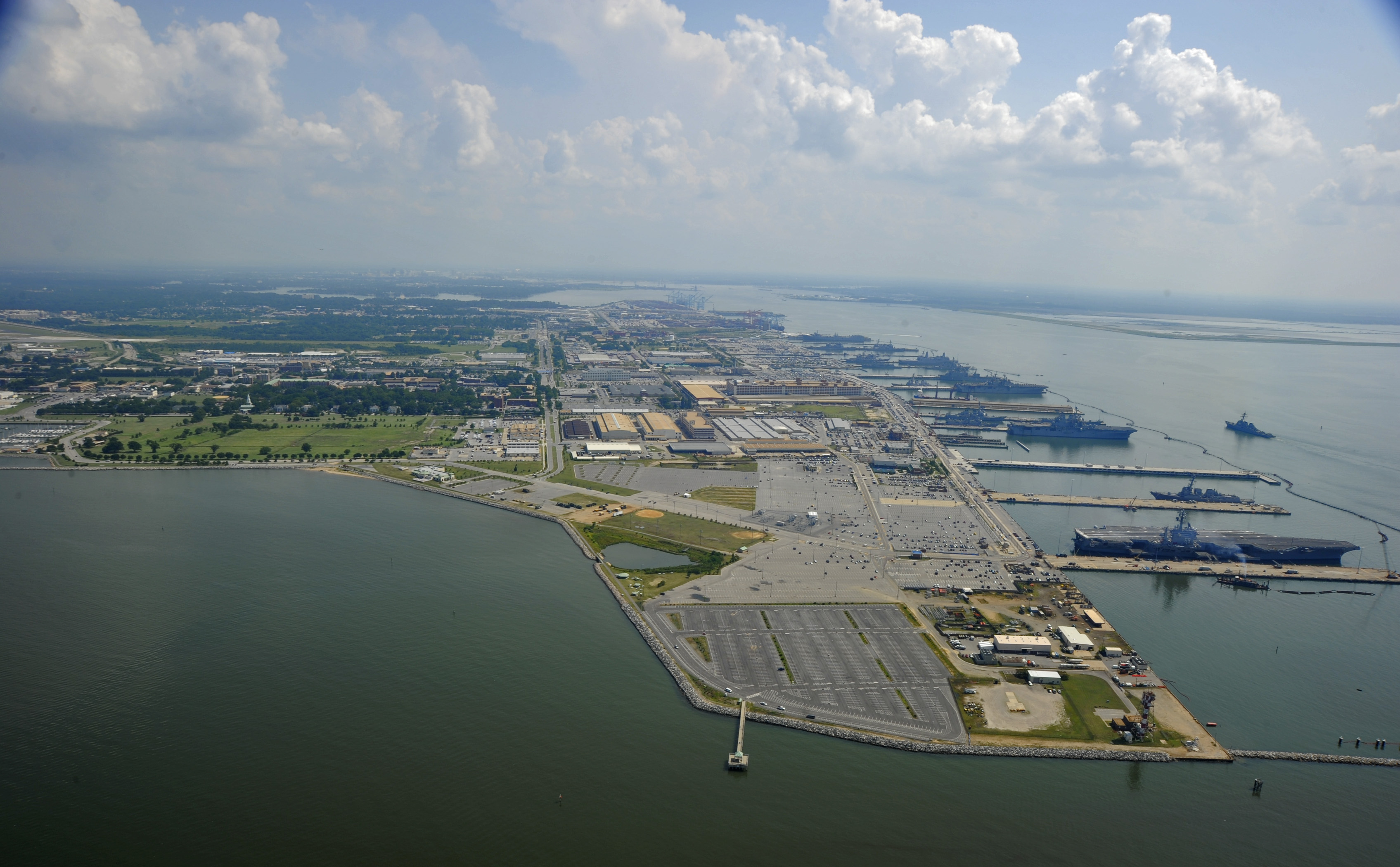
Context · Naval Station Norfolk in 2011, the world's largest naval base and the dominant military installation on the Virginia coast where the swarm was reported
US Navy 110707-N-XZ912-104, foto de Mass Communication Specialist 1st Class Christopher B. Stoltz · Wikimedia Commons · Public domain · open original
Related cases
same country · same period
Western U.S. · FBI sensor images of a small, rounded object
2025 · Tier B
same country · same period
Middle East · two drone crews spot spherical objects
2025 · Tier S
same country · same period
New Jersey · a wave of drone sightings on the East Coast
2024 · Tier B
same country · same period
Western U.S. · two federal employees watch red lights at night
2026 · Tier B