1986·Sobre Alaska
Alaska, EE.UU..JAL 1628
El 17 de noviembre de 1986, la tripulación del vuelo de carga Japan Airlines 1628 siguió sobre Alaska durante unos 45 minutos dos grupos de luces y, según el capitán, la silueta de un objeto «dos veces» mayor que un portaaviones. Controladores de Anchorage y el radar militar registraron retornos primarios intermitentes cerca del avión, pero la FAA, tras revisar sus datos, los atribuyó a un eco partido del propio 747 y declaró que no podía confirmar el suceso.
Tier S · Sólido¿Qué significan? →
Evidencia fuerte: un registro instrumental de la época (radar, sensor, película o foto con procedencia conocida) que corrobora a varios testigos independientes.
Qué fue
59%causa natural o humana
Explicación más probable: objeto astronómico
Ver el reparto entre las seis explicaciones
Causa natural o humana
Sin causa conocida
Documentos primarios
FAA, Región de Alaska · comunicado, transcripción de radio y análisis de radar del vuelo JAL 1628 (extracto)
Diez páginas del expediente que la Oficina de Asuntos Públicos del FAA en Anchorage publicó el 5 de marzo de 1987: el índice, el comunicado 87-09, en el que la agencia dice que «no pudo confirmar» el suceso y que el segundo blanco era un eco partido del propio 747, visto por el vuelo de United que no vio nada más; las siete páginas de la transcripción seleccionada de las comunicaciones entre JAL 1628, el centro de Anchorage, el ROCC militar, United 69 y el C-130, con horas UTC; y el análisis de los datos de radar del 25 de febrero de 1987, que no halló anomalías.
FAA, Región de Alaska — «Selected Material Relative to the FAA Investigation of Japan Air Lines flight 1628» (5 mar 1987), copia en NICAP · pp. 41-49 y 53 del PDF · Dominio público · obra del Gobierno de EE. UU. · abrir original
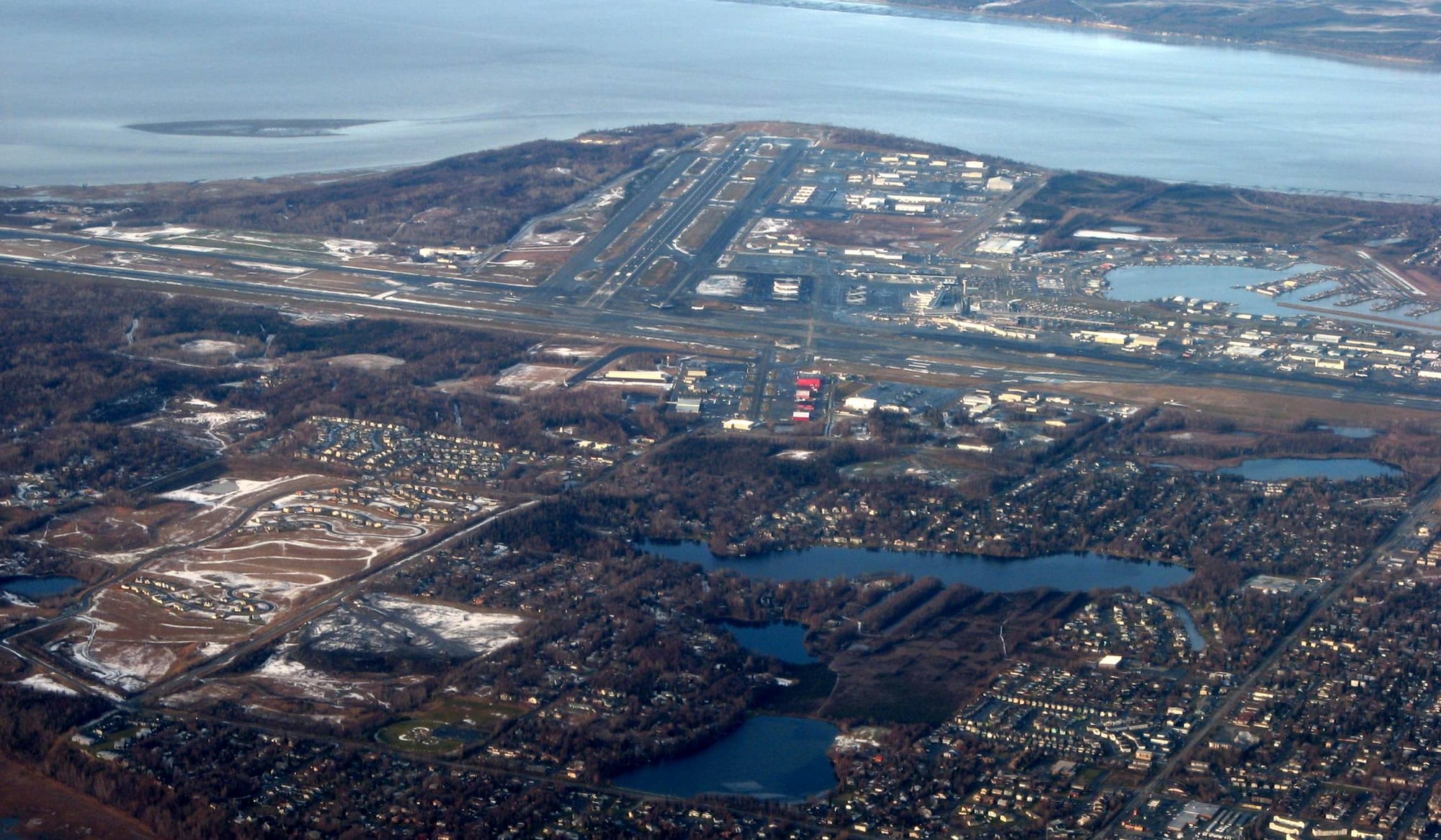
Contexto · el aeropuerto de Anchorage (Alaska), destino del vuelo JAL 1628
Anchorage International Airport and Cook Inlet.jpg · Wikimedia Commons · CC BY 2.0 · abrir original
La noche en cuestión
El 17 de noviembre de 1986, el vuelo de carga Japan Airlines 1628 (Boeing 747-200F) cruzaba el este de Alaska en ruta de Reikiavik a Anchorage con un cargamento de vino francés. El capitán Kenju Terauchi, el copiloto Takanori Tamefuji y el ingeniero de vuelo Yoshio Tsukuba reportaron, poco después de las 17:00 hora local y ya de noche, luces delante del avión que los acompañaron durante unos 45 minutos. En la entrevista que el FAA les hizo esa misma noche al aterrizar, los tres dijeron que vieron dos conjuntos de luces amarillas, ámbar y verdes, que en ningún momento pudieron ver una nave y que el radar meteorológico de a bordo mostró un eco a unas siete millas. Según las notas del agente Ronald Mickle sobre esa misma entrevista, Terauchi dijo que los dos conjuntos parecían unidos a un solo objeto y que, por lo que vio y por el radar, era del tamaño de un 747 o mayor; ya en vuelo lo había descrito al control como «un avión muy grande» («very quite big ah, plane», a las 02:30:56 UTC).
Las luces se mantuvieron delante del avión unos doce minutos y luego pasaron a su izquierda. En la entrevista más larga del 2 de enero de 1987, Terauchi describió además un tercer objeto enorme, visto como silueta a siete u ocho millas, que estimó en «dos veces» el tamaño de un portaaviones; esa escala no figura en sus declaraciones de la noche, que ya hablaban de un objeto grande, y la silueta descansa sobre su relato, y el ingeniero de vuelo declaró al FAA que las luces de esa segunda fase le costaba verlas y que no estaba seguro de si eran de un pueblo lejano o de un objeto extraño, aunque insistió en que las primeras no eran luces de ciudad. El centro de control de Anchorage (ARTCC) vio retornos primarios intermitentes donde el piloto señalaba el tráfico y consultó al centro militar de operaciones (ROCC) de Elmendorf, que respondió que tenía «un blanco primario» en la misma posición, lo calificó de «desconocido» y más tarde de «una formación de dos» junto al 747. El control desvió hacia el avión japonés a un vuelo de United Airlines y a un C-130 militar; el piloto de United vio el 747 recortado contra el cielo claro con su estela, «pero ningún otro avión», y el C-130 tampoco tuvo contacto. JAL 1628 hizo un giro de 360 grados cerca de Fairbanks y perdió de vista las luces hacia las 17:53, antes de aterrizar en Anchorage.
Un punto crítico para la interpretación es qué valen esos retornos. Los técnicos del FAA revisaron las grabaciones de radar en su centro técnico de Atlantic City y concluyeron que el segundo blanco cercano al vuelo no era otro avión sino un eco partido del propio 747, un «blanco primario y de baliza no correlacionado». El comunicado del 5 de marzo de 1987, firmado por el portavoz Paul Steucke, dice que la agencia «no pudo confirmar» el suceso y que no preveía seguir investigando; el expediente se tituló «Unidentified Traffic Sighting» (avistamiento de tráfico no identificado), pero en ningún momento el FAA dictaminó que hubiera un objeto no identificado. Las declaraciones de su propio personal van en ambos sentidos: el controlador Carl Henley precisó en enero que había visto blancos tentativos y de solo radar, y que la persistencia del tráfico en los giros era lo que le decía el piloto; el supervisor de área no vio en ningún momento datos que indicaran tráfico de forma concluyente; y dos especialistas que revisaron la grabación de datos no encontraron blancos en las zonas señaladas. En sentido contrario, esa misma noche el oficial de guardia de NORAD dijo a un agente del FAA que ellos también veían dos blancos, uno de ellos el JAL, y el ROCC los mantuvo como desconocidos mientras duró el seguimiento.
La explicación escéptica más citada la formuló Philip J. Klass (Aviation Week, CSICOP) en enero de 1987: las luces serían Júpiter y Marte. El cálculo de posiciones lo sostiene solo en parte: hacia las 17:15 Júpiter, muy brillante (magnitud −2,4), estaba a unos 10 grados de altura y azimut 140, y Marte, mucho más débil, a unos 7 grados; con el avión rumbo al suroeste, Júpiter quedaba unos 70 grados y Marte unos 55 grados a la izquierda del morro, según una carta del astrónomo Walter Webb que recoge el expediente, lo que encaja con la fase en que las luces iban al costado izquierdo pero no con los doce minutos en que estuvieron delante. Klass revisó después su hipótesis y atribuyó las luces delanteras a un reflejo de la luna llena en nubes; sin embargo, el piloto informó al control de cielo despejado y la tripulación solo mencionó nubes dispersas por debajo del avión, junto a las montañas. El 11 de enero de 1987 Terauchi informó de otro avistamiento en la misma zona general, que recoge el comunicado del FAA del 5 de marzo; según el análisis de Bruce Maccabee incluido en el expediente, tras aterrizar el propio capitán lo atribuyó a luces de un pueblo vistas a través de cristales de hielo, y el FAA coincidió con él. Según relatos posteriores, que no figuran en el expediente del FAA, JAL apartó temporalmente a Terauchi de la cabina tras sus entrevistas públicas, un dato que los escépticos leen como señal de la fragilidad del testimonio y los defensores como presión institucional.
John Callahan, entonces jefe de la División de Accidentes, Evaluaciones e Investigaciones del FAA en Washington, conservó copias de las cintas de radar y de voz. En su testimonio para el Disclosure Project (2001) y, más tarde, en la Citizen Hearing on Disclosure (2013), un acto privado sin valor legal, afirmó que presentó los datos en una reunión con representantes del FBI, la CIA y un equipo científico de la Administración Reagan, y que un participante de la CIA les dijo que la reunión «nunca ocurrió» y que el suceso «nunca se registró». Ese relato no figura en el expediente que el FAA hizo público en 1987 y descansa en su palabra; el expediente sí recoge que la dirección regional del FAA informó al administrador de la agencia y habló del caso con oficiales de la Fuerza Aérea.
Por qué importa
JAL 1628 reúne elementos documentados en fuentes primarias: testimonio de una tripulación profesional recogido esa misma noche, grabaciones de las comunicaciones con el control, retornos de radar civil y militar en tiempo real y un expediente de casi 300 páginas que el FAA hizo público en 1987. La propia agencia lo tramitó como «avistamiento de tráfico no identificado» mientras buscaba un avión no declarado que pudiera poner en riesgo el tráfico.
Hay que sostener dos cosas a la vez. Primero, que el registro instrumental no sostiene la versión popular: el FAA atribuyó sus retornos a un eco partido del 747, dos revisiones de sus datos grabados no hallaron blancos, dos aviones enviados a mirar no vieron nada, la silueta del tamaño de dos portaaviones descansa en el relato posterior del capitán, que semanas después atribuyó a luces de un pueblo un segundo avistamiento en la misma zona, y la hipótesis astronómica explica bien la fase en que las luces iban a la izquierda.
Segundo, que el eco partido del FAA no explica por sí solo los blancos primarios que el radar militar comunicó en tiempo real y mantuvo como desconocidos, el eco del radar de a bordo, ni los doce minutos de luces delante del avión que Júpiter no cubre, en una noche que el piloto describió despejada. En lo procedimental, el caso muestra cómo una agencia civil documentó un evento UAP y lo cerró sin resolverlo, y la tesis de un encubrimiento posterior depende del testimonio de Callahan, no del expediente. No hay una firma sensora concluyente.
Lo que queda en papel
Evidencia documentada
- Transcripción del FAA de las comunicaciones entre JAL 1628, el ARTCC de Anchorage y el ROCC militar, con horas UTC
- Notas de los agentes del FAA de la noche del 17 de noviembre: luces sin nave visible, un eco a unas siete millas en el radar de a bordo y, según Mickle, un objeto que el capitán estimó del tamaño de un 747 o mayor
- Declaraciones de siete especialistas del ARTCC: retornos primarios intermitentes para unos; ningún dato concluyente o ningún blanco para otros
- Comunicado del FAA del 5 de marzo de 1987: eco partido del 747, «no pudo confirmar» el suceso
- Entrevistas del FAA a Terauchi (2 ene 1987), Tamefuji y Tsukuba, con dibujos del capitán
- Testimonio de John Callahan (Disclosure Project 2001, Citizen Hearing 2013) sobre una reunión con la CIA, no documentada en el expediente
Fuentes
- FAA, Región de Alaska — expediente público del caso JAL 1628 (1987), recopilado por NICAP — PDF de 377 páginas: comunicado del 5 mar 1987, transcripción ATC, declaraciones de controladores, notas de los agentes y entrevistas a la tripulación, más recortes y análisis añadidos por investigadores.
- NICAP — ficha del caso JAL 1628 (fuente secundaria) — Directorio con enlaces al expediente del FAA, la lista de documentos liberados y el informe de Bruce Maccabee.
- Disclosure Project — testimonio de John Callahan (2001), reproducido en UFO Evidence — Testimonio posterior del exjefe de división del FAA; sus afirmaciones sobre la reunión con la CIA no están en el expediente de 1987.
Casos relacionados
Actores asociados (2)
