Caso Nº 16Case No. 16·Estados UnidosUnited States
1969·USAF PentagonUSAF Pentagon
Estados UnidosUnited States.Bolender MemoBolender Memo
Memo interno del General Bolender (USAF, 1969) que establece que los reportes UFO con implicancias de seguridad nacional se canalizan por JANAP 146 y AFM 55-11, fuera del sistema Blue Book: confirmación documental de un canal paralelo que sobrevivió al cierre del programa público.Internal memo by General Bolender (USAF, 1969) stating that UFO reports affecting national security are filed under JANAP 146 and AFM 55-11, outside the Blue Book system — documentary confirmation of a parallel channel that outlived the public program's closure.
AñoYear
1969
TierTier
S
ProbabilidadProbability
80%
CategoríaCategory
DocumentoDocument
Evidencia fuerte: registro de sensor instrumental + múltiples testigos (típicamente militar). Tres ejes independientes: el «tier» mide la fuerza de la evidencia; la «probabilidad» estima cuán genuinamente inexplicado está el caso —un fenómeno natural puede seguir sin explicación, así que no equivale a «no-prosaico»—; y la partición de explicaciones (abajo) dice qué fue más plausiblemente. Por eso un caso bien documentado puede tener como causa más plausible un posible fraude, y un Tier B no es, por eso, un fraude.Strong evidence: instrumental sensor record + multiple witnesses (typically military). Three independent axes: the «tier» measures the strength of the evidence; the «probability» estimates how genuinely unexplained the case is —a natural phenomenon can remain unexplained, so it does not equal «non-prosaic»—; and the partition of explanations (below) says what it most plausibly was. So a well-documented case can have a possible hoax as its most plausible cause, and a Tier B is not, for that reason, a hoax.
Documentos primarios · visorPrimary documents · viewer

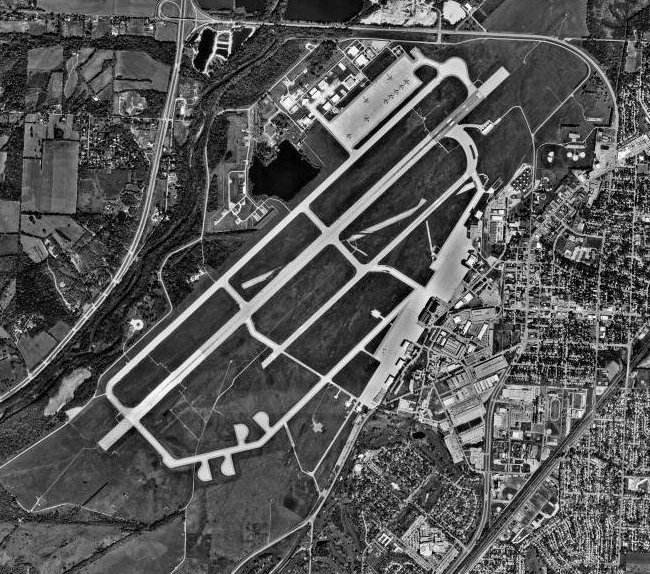
Contexto · la base Wright-Patterson, donde el USAF gestionó el Proyecto Blue BookContext · Wright-Patterson AFB, where the USAF ran Project Blue Book
Wright-Patterson Air Force Base - 10 Oct 2000.jpg · Wikimedia Commons · Dominio público · abrir originalopen original
Parte 01Part 01
El expediente en cuestiónThe file in question
Hacia finales de 1969, la USAF preparaba el cierre de Project Blue Book, el programa público de investigación de objetos voladores no identificados que había operado desde 1952. El detonante administrativo fue el Condon Report (Scientific Study of Unidentified Flying Objects, dirigido por el físico Edward U. Condon en la Universidad de Colorado y publicado en enero de 1969), que concluyó que el estudio continuado de los OVNIs no podía justificarse en términos de avance científico ni de seguridad nacional. La National Academy of Sciences avaló esa conclusión, y la USAF la utilizó como base para terminar el programa.
“Reports of UFOs which could affect national security are made in accordance with JANAP 146 or Air Force Manual 55-11, and are not part of the Blue Book system.”
En ese contexto, el 20 de octubre de 1969, el Brigadier General Carroll H. Bolender, alto oficial de la USAF, firmó un memorándum interno evaluando las implicaciones de cerrar Blue Book. El párrafo que ha hecho célebre al documento establece textualmente: 'Reports of UFOs which could affect national security are made in accordance with JANAP 146 or Air Force Manual 55-11, and are not part of the Blue Book system.' De ahí Bolender deriva una conclusión administrativa contundente: dado que los casos con implicancias de seguridad nacional nunca pasaron por Blue Book, su eliminación no afectaría la capacidad de la Fuerza Aérea para atender amenazas a la seguridad nacional.
El peso del memo está en su lógica interna, no en una revelación dramática. JANAP 146 (Joint Army-Navy-Air Force Publication) regulaba el procedimiento CIRVIS — Communications Instructions for Reporting Vital Intelligence Sightings —, el canal por el que pilotos militares y civiles debían reportar de inmediato avistamientos de objetos hostiles o no identificados que pudieran constituir una amenaza al continente; AFM 55-11 era el manual de la Fuerza Aérea sobre el mismo procedimiento de reporte. Ambos eran canales operativos de inteligencia con clasificación, distintos del archivo público de Blue Book. Es decir: por diseño, los reportes de mayor relevancia de seguridad seguían una ruta separada y no quedaban en el registro accesible al público y a los investigadores.
El documento fue posteriormente desclasificado y difundido por investigadores; circula hoy en repositorios de documentos desclasificados como The Black Vault. Su autenticidad como documento de la USAF no está en disputa; lo que se discute es su interpretación.
By late 1969, the USAF was preparing to close Project Blue Book, the public program investigating unidentified flying objects that had operated since 1952. The administrative trigger was the Condon Report (Scientific Study of Unidentified Flying Objects, led by physicist Edward U. Condon at the University of Colorado and published in January 1969), which concluded that continued study of UFOs could not be justified in terms of scientific advance or national security. The National Academy of Sciences endorsed that conclusion, and the USAF used it as the basis to terminate the program.
In that context, on October 20, 1969, Brigadier General Carroll H. Bolender, a senior USAF officer, signed an internal memorandum assessing the implications of closing Blue Book. The paragraph that made the document famous reads verbatim: 'Reports of UFOs which could affect national security are made in accordance with JANAP 146 or Air Force Manual 55-11, and are not part of the Blue Book system.' From this Bolender draws a blunt administrative conclusion: since cases with national security implications never went through Blue Book, eliminating it would not impair the Air Force's ability to address threats to national security.
The memo's weight lies in its internal logic, not in a dramatic revelation. JANAP 146 (Joint Army-Navy-Air Force Publication) governed the CIRVIS procedure — Communications Instructions for Reporting Vital Intelligence Sightings — the channel through which military and civilian pilots were to report immediately any sightings of hostile or unidentified objects that might constitute a threat to the continent; AFM 55-11 was the Air Force manual on the same reporting procedure. Both were classified operational intelligence channels, distinct from Blue Book's public file. In other words: by design, the most security-relevant reports followed a separate route and did not end up in the record accessible to the public and to researchers.
The document was later declassified and disseminated by researchers; it circulates today in declassified-document repositories such as The Black Vault. Its authenticity as a USAF document is not in dispute; what is debated is its interpretation.
Parte 02Part 02
Por qué este caso movió la agujaWhy this case moved the needle
El memo Bolender es un documento bisagra para la metodología del corpus porque, en palabras de la propia USAF, deja constancia de que el sistema público de investigación (Blue Book) y el cauce de seguridad nacional (JANAP 146 / CIRVIS) eran circuitos separados. Su consecuencia directa es que el cierre de Blue Book en diciembre de 1969 no equivale al fin del registro gubernamental del fenómeno: solo cierra la ventanilla pública. Los reportes con potencial de amenaza seguían fluyendo por un canal clasificado que no archivaba en el registro accesible a investigadores y prensa.
La honestidad interpretativa es esencial aquí, porque el caso suele sobreleerse. Existe una lectura mundana y probablemente correcta en lo administrativo: JANAP 146/CIRVIS no era un programa secreto de investigación de OVNIs, sino un procedimiento estándar de reporte de inteligencia para cualquier objeto no identificado que pudiera ser una amenaza militar (un bombardero soviético, un misil, una aeronave desconocida). Que esos reportes no fueran a Blue Book es trivial: Blue Book era un programa de relaciones públicas y catalogación científica, no un nodo de defensa aérea. En esta lectura, el memo no confiesa un encubrimiento ufológico, sino que describe la división normal del trabajo entre ciencia pública y defensa operativa.
Dicho eso, el memo conserva valor analítico real incluso en su versión mínima: prueba documentalmente, desde dentro de la institución, que la pregunta '¿quién recogía los casos serios después de 1969?' tiene una respuesta no pública. Ese hecho es el piso sobre el que se apoyan investigaciones posteriores acerca de programas compartimentados (AAWSAP, AATIP, UAPTF) y testimonios como el de David Grusch. El corpus lo lee como un peso firme a favor de la narrativa de programa clasificado (humano) precisamente porque es identificación textual de un canal paralelo y no clasificado en Blue Book — sin pretender, por ello, que ese canal demuestre la existencia de un programa dedicado al fenómeno anómalo. Distingue así entre lo que el documento prueba (dualidad de canales) y lo que solo sugiere o no prueba (que el canal clasificado ocultara tecnología no humana).
The Bolender memo is a pivot document for the corpus methodology because, in the USAF's own words, it records that the public investigation system (Blue Book) and the national-security channel (JANAP 146 / CIRVIS) were separate circuits. Its direct consequence is that the closure of Blue Book in December 1969 does not equate to the end of government recording of the phenomenon: it only closes the public window. Reports with threat potential continued to flow through a classified channel that did not file into the record accessible to researchers and the press.
Interpretive honesty is essential here, because the case is often over-read. There is a mundane and administratively likely reading: JANAP 146/CIRVIS was not a secret UFO investigation program but a standard intelligence-reporting procedure for any unidentified object that might be a military threat (a Soviet bomber, a missile, an unknown aircraft). That such reports did not go to Blue Book is trivial: Blue Book was a public-relations and scientific-cataloging program, not an air-defense node. On this reading, the memo confesses no ufological cover-up but describes the normal division of labor between public science and operational defense.
That said, the memo retains real analytical value even in its minimal version: it documents, from inside the institution, that the question 'who collected the serious cases after 1969?' has a non-public answer. That fact is the floor on which later investigations of compartmented programs (AAWSAP, AATIP, UAPTF) and testimony such as David Grusch's rest. The corpus reads it as firm weight in favor of the classified-program (human) narrative precisely because it is textual identification of a channel parallel to and unclassified in Blue Book — without thereby claiming that this channel demonstrates a program dedicated to the anomalous phenomenon. It thus distinguishes between what the document proves (duality of channels) and what it only suggests or does not prove (that the classified channel concealed non-human technology).
Parte 03Part 03
Lo que queda en papelWhat's left on paper
Evidencia documentadaDocumented evidence
- Memorándum Bolender original (20 octubre 1969) preservado y desclasificadoOriginal Bolender memorandum (October 20, 1969) preserved and declassified
- Cita textual confirmando canal paralelo JANAP 146 / AFM 55-11Verbatim quote confirming the parallel JANAP 146 / AFM 55-11 channel
- Cierre Blue Book en diciembre 1969 — confirmación cronológica del propósito del memoClosure of Blue Book in December 1969 — chronological confirmation of the memo's purpose
- Continuidad documentada de programas posteriores (AAWSAP 2008+, AATIP 2007+)Documented continuity of later programs (AAWSAP 2008+, AATIP 2007+)
FuentesSources
- Bolender Memo USAF (declassified)
- JANAP 146 — Joint Army-Navy-Air Force Publication
- Air Force Manual 55-11 (CIRVIS) — Communications Instructions Reporting Vital Intelligence SightingsCommunications Instructions Reporting Vital Intelligence Sightings
Patrones que exhibe (1)Patterns it exhibits (1)
UbicaciónLocation
USAF PentagonUSAF Pentagon · 38.89°, -77.04°
Citado por 1 casoReferenced by 1 case
Casos relacionadosRelated cases
mismo país · 1 patrónsame country · 1 pattern
Twining MemoTwining Memo
1947 · Tier S · 95%
mismo país · 1 patrónsame country · 1 pattern
RoswellRoswell
1947 · Tier S · 55%
mismo país · 1 patrónsame country · 1 pattern
Estimate of the SituationEstimate of the Situation
1948 · Tier A · 75%
mismo país · 1 patrónsame country · 1 pattern
Robertson PanelRobertson Panel
1953 · Tier S · 95%
Actores asociados (1)Associated actors (1)