Case No. 105·France
1977·CNES, Toulouse (France)
France.GEPAN / GEIPAN · CNES agency
In 1977 the French space agency (CNES) created GEPAN (Groupe d'Étude des Phénomènes Aérospatiaux Non-identifiés), initially directed by Claude Poher. Renamed SEPRA (1988) and then GEIPAN (2005), it is the only body in the world within a national space agency dedicated publicly and continuously —for nearly half a century— to receiving, investigating and publishing reports of unidentified aerospace phenomena. It classifies each case (A–D) by how much is explained; a small percentage remains 'PAN D', unidentified despite good information. It is the institutional gold standard, and the body that studied the Trans-en-Provence physical trace.
Year
1977
Tier
A
Probability
45%
Category
Document
Institutional evidence: multiple verifiable witnesses or official documentation. Three independent axes: the «tier» measures the strength of the evidence; the «probability» estimates how genuinely unexplained the case is —a natural phenomenon can remain unexplained, so it does not equal «non-prosaic»—; and the partition of explanations (below) says what it most plausibly was. So a well-documented case can have a possible hoax as its most plausible cause, and a Tier B is not, for that reason, a hoax.
Primary documents · viewer
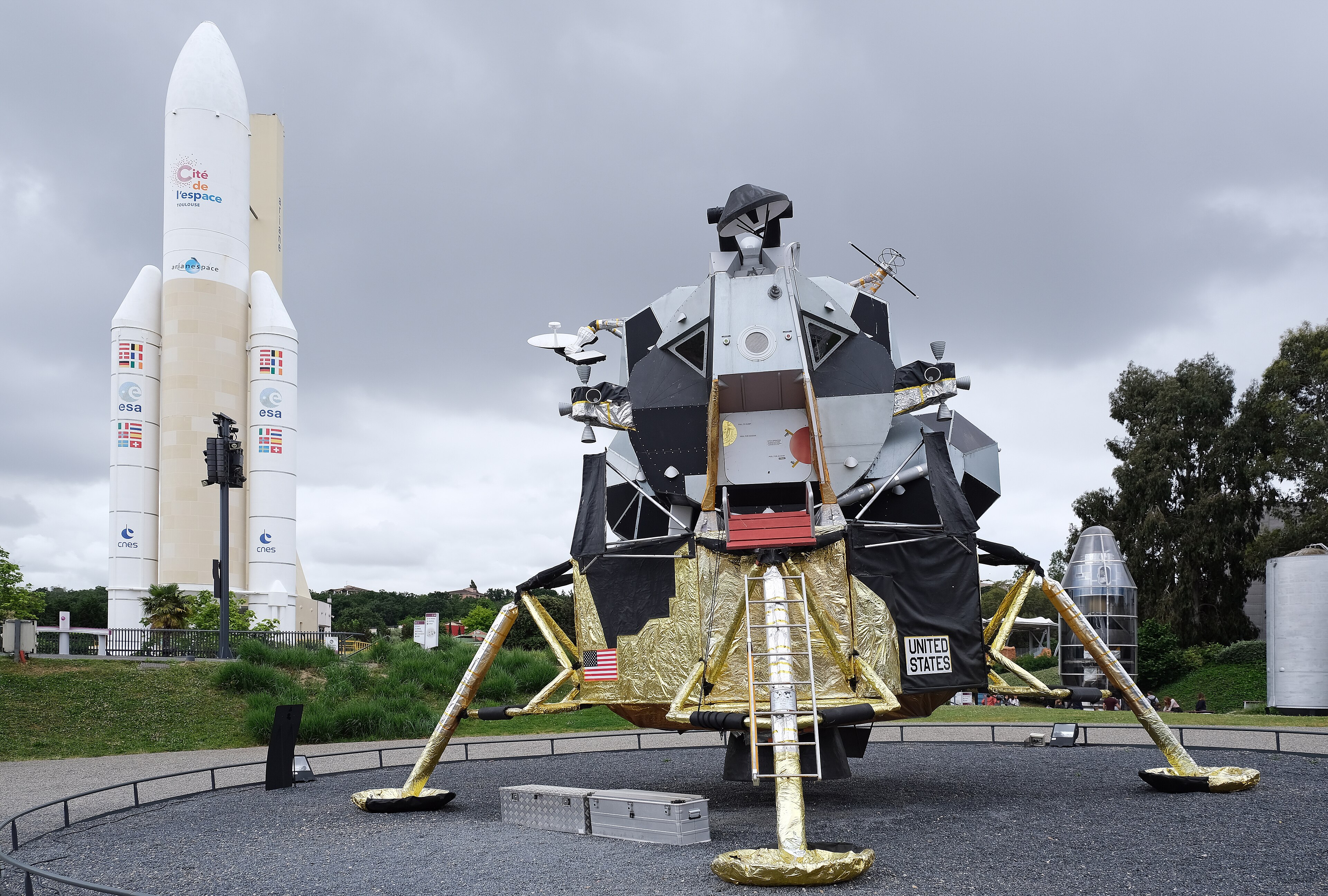
Context · Toulouse (France), home of the CNES and GEIPAN
Cité de l'espace Toulouse 1.jpg · Wikimedia Commons · CC BY-SA 4.0 · open original
Part 01
The file in question
In 1977, the director-general of CNES (Centre National d'Études Spatiales, the French space agency), Yves Sillard, authorized the creation of GEPAN —Groupe d'Étude des Phénomènes Aérospatiaux Non-identifiés—, based in Toulouse and directed by engineer Claude Poher. The idea was to treat the phenomenon as an object of scientific study within the state: receive reports —systematically channeled through the national gendarmerie and civil aviation, which guarantees a formal, traceable testimonial chain—, investigate them methodically, and archive and publish the results. It is something no other country has sustained over time: an official, public, permanent window within the national space agency, operating for nearly half a century across changes of government and cultural fashion.
The body changed name and scope over the years —it was reorganized as SEPRA (Service d'Expertise des Phénomènes de Rentrées Atmosphériques) in 1988, during much of the period led by Jean-Jacques Velasco, and adopted its current name, GEIPAN, in 2005— but kept its methodological core. Each case is classified into four categories according to how much can be explained and the quality of the available information: PAN A (perfectly identified), PAN B (probably identified), PAN C (not analyzable due to insufficient or poor-quality information) and PAN D (unidentified despite good-quality data), the last subdivided into D1 and D2 by degree of consistency. The statistics published by the body itself show that the vast majority of reports fall into A, B or C —on the order of a third each—, and only a small percentage, on the order of 2 to 3%, remains PAN D. Since 2007, GEIPAN has published its files online, a level of transparency unprecedented for a state body dedicated to the phenomenon.
Its reference work is the investigation of Trans-en-Provence (8 January 1981), considered one of the best-documented 'physical trace' cases in history. A resident, Renato Nicolaï, reported hearing a whistling sound and seeing a disc-shaped object briefly land on his property. Alerted immediately, the gendarmerie preserved the site, and GEPAN commissioned laboratory analyses of the soil and vegetation: the results indicated the ground had been compressed by a mechanical pressure on the order of several tons and heated to an estimated temperature between 300 and 600 °C, along with biochemical alterations in the nearby plants that were not trivially explained. The case is still debated —not even GEIPAN itself presents it as proof of exotic origin—, but it exemplifies the method: rapid collection, chain of custody, third-party analysis and publication. Beyond individual cases, the value of GEPAN/GEIPAN for the corpus is to be the proof of concept that a state can study the phenomenon seriously, without sensationalism or denial: most is explained, a minority resists, and everything is documented and available.
Part 02
Why this case moved the needle
GEPAN/GEIPAN is, institutionally, the most important piece in the corpus: the world's oldest, most transparent and methodical official body dedicated to the phenomenon. Where other states swing between secrecy and denial —or between late declassification and silence—, France chose almost fifty years ago to study it openly from its space agency, classify every case by an explicit criterion and publish the files for public scrutiny. That combination of temporal continuity, the backing of a serious scientific agency and documentary transparency has no equivalent in any other country.
Its importance for this project is also methodological and almost genealogical. The PAN A–D system is a direct ancestor of the kind of calibration the corpus attempts: instead of the sterile 'extraterrestrial or nothing' dichotomy, it distributes cases along a spectrum of explainability, separates data quality from degree of strangeness, and leaves an unidentified residue explicit rather than sweeping it under the rug or exaggerating it. That this residue is small and stable —on the order of 2-3% over decades— is itself a first-order calibrating datum: it quantifies, from inside the state and with sustained method, how much of the phenomenon resists rigorous analysis. GEPAN/GEIPAN completes —and in a sense heads— the corpus's set of official offices (CRIDOVNI, OIFAA, CEFAA, CIAE), contributes the Trans-en-Provence physical-trace case as one of the most solid technical files available, and anchors in Europe the figure of Claude Poher, its founding director and a pioneer of the quantitative study of the phenomenon.
Part 03
What's left on paper
Documented evidence
- Creation of GEPAN by CNES in 1977 (directed by Claude Poher); renamed SEPRA (1988) and GEIPAN (2005)
- PAN A–D classification system; ~3% remains PAN D (unidentified with good-quality data)
- Only body within a national space agency dedicated to the phenomenon publicly and continuously (~50 years)
- Online publication of files since 2007; reference investigation: Trans-en-Provence (1981)
- Investigates alongside the Gendarmerie Nationale, Météo-France and civil aviation (PAN A–D classification)
Patterns it exhibits (2)
Location
CNES, Toulouse (France) · 43.56°, 1.48°
Related cases
same country · 1 pattern
Air France 3532 · disc + military radar (GEIPAN)
1994 · Tier A · 55%
same country · 1 pattern
COMETA Report · French ex-officials (1999)
1999 · Tier A · 55%
same country · 1 pattern
Quarouble · Gendarmerie investigation (France)
1954 · Tier B · 40%
1 pattern
Lakenheath-Bentwaters
1956 · Tier S · 80%
Associated actors (2)